

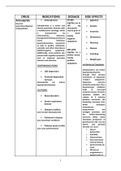
DRUG INDICATIONS DOSAGE SIDE EFFECTS
Amisulpride • Schizophrenia 50-300 • Agitation
(Second- mg/day (up to
generation/Atypical Schizophrenia is a severe and 300 mg • Anxiety
antipsychotic) chronic psychiatric disorder with amisulpride
a multifactorial aetiology, which may be given in
• Insomnia
is characterized by 1 dose)-
hallucinations, delusions, mainly
disorganized thinking and bizarre • Drowsiness
negative
motor behaviour symptoms
(psychotic/positive symptoms) • Dizziness
as well as apathy, anhedonia,
asociality and affect disturbance • Nausea
(deficit/negative symptoms). 400-1200
Additionally, many patients also mg/day (in 2
• Vomiting
present with cognitive symptoms divided doses)-
such as impaired executive mainly
function and attention. positive • Weight gain
symptoms
HYPERPROLACTINAEMIA!
CONTRAINDICATIONS:
Antipsychotics can induce
• CNS depression hyperprolactinaemia
through their primary
• Prolactin-dependent mechanism of dopamine
tumours receptor antagonism.
(Amisulpride can induce Dopamine restrains
hyperprolactinaemia) prolactin production; thus,
dopaminergic inhibition
CAUTIONS: leads to increased
prolactin release. Prolactin
elevation inhibits the
• Blood disorders
release of 2 anterior
pituitary hormones; the
• Severe respiratory luteinizing hormone (LH),
disease which stimulates
testosterone,
• Diabetes mellitus progesterone and
(can increase blood glucose) estrogen secretion, and
the follicle-stimulating
• Parkinson’s disease hormone (FSH), which
(can exacerbate condition) stimulates production of
gametes/sex cells- ova and
sperm. Low gonadal
• Patients prone to falls steroids can cause:
(can cause parkinsonism)
• Sexual
dysfunction
• Infertility
• Galactorrhoea
• Decreased bone
mineral density
• Gynecomastia (in
men)
• Menstrual
irregularities in
women such as:
1
, Secondary
amenorrhea
Oligomenorrhoea
Antipsychotics vary in
their propensity to cause
increased prolactin
production.
Hyperprolactinaemia is
primarily induced by
typical neuroleptics (FGAs)
and among atypical
antipsychotics risperidone
and amisulpride.
Quetiapine, aripiprazole,
olanzapine, clozapine and
ziprasidone appear to
cause insignificant change
in prolactin levels in most
patients treated.
• Blood disorders:
LEUKOPENIA:
General term referring to a
severe reduction in the
number of WBC in the
circulating blood.
AGRANULOCYTOSIS:
Rare but potentially life-
threatening hematologic
disorder characterized by
a severe reduction in the
number of granulocytes
(neutrophils- (40-70% of
all WBCs, basophils- (0.5-
1% of all WBCs,
eosinophils- (1- 3% of all
WBCs) circulating in the
blood. Can lead to severe
infections, sepsis and
death if left untreated
NEUTROPENIA:
Severe reduction in the
number of Neutrophils in
the blood. Neutrophils are
the most abundant type of
leukocytes (40-70% of all
WBCs in humans) and
represent the primary
defence against infections.
RARE:
• Parkinsonism
2
, • Tardive
dyskinesia
(both less likely than with
first-generation
antipsychotics)
• NEUROLEPTIC
MALIGNANT
SYNDROME
(NMS)
Rare but potentially life-
threatening reaction to
the use of neuroleptics.
Symptoms:
Pyrexia
Altered mental state
(delirium, paranoid
behaviour)
Diaphoresis
Hypersalivation
Muscle rigidity
Fluctuating BP
Rhabdomyolysis
Amlodipine • Hypertension 5-10mg/day • Gastrointestinal
(Calcium channel (reduces BP by widening blood disturbances:
blocker) vessels) Constipation
(Antihypertensive) Diarrhoea
• Angina
• Muscle cramps
Aspirin • Cardiovascular 75-300 • Dyspepsia
(Antiplatelet drug) disease mg/day
(Antipyretic, Non- (secondary prevention) • Haemorrhage
opioid analgesic,
NSAID) • Deep-vein thrombosis • Bruising
(secondary prevention)
• Rash
• Pulmonary embolism
(secondary prevention)
• Dyspnoea
300-900
• Pyrexia
mg/dose
every 4-6
• Mild-moderate pain hours
MAX 4g/day
• Acute Migraine
Atenolol • Hypertension 25-50 mg FOR ALL BETA-
(Beta-adrenoceptor (BP lowered due to the rate and daily BLOCKERS:
blocker) force at which the heart pumps • Abdominal
blood around the body)
discomfort
• Angina
• Fatigue
3
, CAUTION: • Confusion
• RAYNAUD’S DISEASE= • Bradycardia
Primary Raynaud’s=
Idiopathic Raynaud’s • Dry eyes
phenomenon (as the RARE:
condition occurs in
disease absence unlike • RAYNAUD’S
in Secondary
PHENOMENON
Raynaud’s= Raynaud’s
(RP):
phenomenon)
a condition where blood
Transient & reversible
flow to fingers, toes,
episodes of peripheral sometimes also ears and
ischemia. Triphasic colour nose is
pattern! (Same as RP). restricted/interrupted due
Risk factors: to vasospasms (sudden
Female gender contractions of the
Smoking muscular walls of arteries-
Family history arteries narrowing-
Triggers: reduced blood flow).
Cold (most common) ‘White-to-Blue-to-Red 3
Emotional stress phase colour sequence’;
the triphasic colour
pattern is characteristic of
RP. Affected areas first
turn white/pallor due to
diminished blood flow and
ischemia-then blue due to
prolonged lack of
oxygen=excessive
concentration of
deoxyhemoglobin in the
blood caused by
deoxygenation -finally
they turn red- blood
vessels open up again -
local flushing
phenomenon/ reactive
hyperemia (transient
increase in organ blood
flow that occurs following
a brief period of ischemia).
Livedo reticularis may also
be present during a
Raynaud’s attack.
Secondary Raynaud’s (RP)
can be caused by:
Drugs (beta blockers,
antimigraine medications
etc.)
Autoimmune disorders
Obstructive vascular
disease
4
Amisulpride • Schizophrenia 50-300 • Agitation
(Second- mg/day (up to
generation/Atypical Schizophrenia is a severe and 300 mg • Anxiety
antipsychotic) chronic psychiatric disorder with amisulpride
a multifactorial aetiology, which may be given in
• Insomnia
is characterized by 1 dose)-
hallucinations, delusions, mainly
disorganized thinking and bizarre • Drowsiness
negative
motor behaviour symptoms
(psychotic/positive symptoms) • Dizziness
as well as apathy, anhedonia,
asociality and affect disturbance • Nausea
(deficit/negative symptoms). 400-1200
Additionally, many patients also mg/day (in 2
• Vomiting
present with cognitive symptoms divided doses)-
such as impaired executive mainly
function and attention. positive • Weight gain
symptoms
HYPERPROLACTINAEMIA!
CONTRAINDICATIONS:
Antipsychotics can induce
• CNS depression hyperprolactinaemia
through their primary
• Prolactin-dependent mechanism of dopamine
tumours receptor antagonism.
(Amisulpride can induce Dopamine restrains
hyperprolactinaemia) prolactin production; thus,
dopaminergic inhibition
CAUTIONS: leads to increased
prolactin release. Prolactin
elevation inhibits the
• Blood disorders
release of 2 anterior
pituitary hormones; the
• Severe respiratory luteinizing hormone (LH),
disease which stimulates
testosterone,
• Diabetes mellitus progesterone and
(can increase blood glucose) estrogen secretion, and
the follicle-stimulating
• Parkinson’s disease hormone (FSH), which
(can exacerbate condition) stimulates production of
gametes/sex cells- ova and
sperm. Low gonadal
• Patients prone to falls steroids can cause:
(can cause parkinsonism)
• Sexual
dysfunction
• Infertility
• Galactorrhoea
• Decreased bone
mineral density
• Gynecomastia (in
men)
• Menstrual
irregularities in
women such as:
1
, Secondary
amenorrhea
Oligomenorrhoea
Antipsychotics vary in
their propensity to cause
increased prolactin
production.
Hyperprolactinaemia is
primarily induced by
typical neuroleptics (FGAs)
and among atypical
antipsychotics risperidone
and amisulpride.
Quetiapine, aripiprazole,
olanzapine, clozapine and
ziprasidone appear to
cause insignificant change
in prolactin levels in most
patients treated.
• Blood disorders:
LEUKOPENIA:
General term referring to a
severe reduction in the
number of WBC in the
circulating blood.
AGRANULOCYTOSIS:
Rare but potentially life-
threatening hematologic
disorder characterized by
a severe reduction in the
number of granulocytes
(neutrophils- (40-70% of
all WBCs, basophils- (0.5-
1% of all WBCs,
eosinophils- (1- 3% of all
WBCs) circulating in the
blood. Can lead to severe
infections, sepsis and
death if left untreated
NEUTROPENIA:
Severe reduction in the
number of Neutrophils in
the blood. Neutrophils are
the most abundant type of
leukocytes (40-70% of all
WBCs in humans) and
represent the primary
defence against infections.
RARE:
• Parkinsonism
2
, • Tardive
dyskinesia
(both less likely than with
first-generation
antipsychotics)
• NEUROLEPTIC
MALIGNANT
SYNDROME
(NMS)
Rare but potentially life-
threatening reaction to
the use of neuroleptics.
Symptoms:
Pyrexia
Altered mental state
(delirium, paranoid
behaviour)
Diaphoresis
Hypersalivation
Muscle rigidity
Fluctuating BP
Rhabdomyolysis
Amlodipine • Hypertension 5-10mg/day • Gastrointestinal
(Calcium channel (reduces BP by widening blood disturbances:
blocker) vessels) Constipation
(Antihypertensive) Diarrhoea
• Angina
• Muscle cramps
Aspirin • Cardiovascular 75-300 • Dyspepsia
(Antiplatelet drug) disease mg/day
(Antipyretic, Non- (secondary prevention) • Haemorrhage
opioid analgesic,
NSAID) • Deep-vein thrombosis • Bruising
(secondary prevention)
• Rash
• Pulmonary embolism
(secondary prevention)
• Dyspnoea
300-900
• Pyrexia
mg/dose
every 4-6
• Mild-moderate pain hours
MAX 4g/day
• Acute Migraine
Atenolol • Hypertension 25-50 mg FOR ALL BETA-
(Beta-adrenoceptor (BP lowered due to the rate and daily BLOCKERS:
blocker) force at which the heart pumps • Abdominal
blood around the body)
discomfort
• Angina
• Fatigue
3
, CAUTION: • Confusion
• RAYNAUD’S DISEASE= • Bradycardia
Primary Raynaud’s=
Idiopathic Raynaud’s • Dry eyes
phenomenon (as the RARE:
condition occurs in
disease absence unlike • RAYNAUD’S
in Secondary
PHENOMENON
Raynaud’s= Raynaud’s
(RP):
phenomenon)
a condition where blood
Transient & reversible
flow to fingers, toes,
episodes of peripheral sometimes also ears and
ischemia. Triphasic colour nose is
pattern! (Same as RP). restricted/interrupted due
Risk factors: to vasospasms (sudden
Female gender contractions of the
Smoking muscular walls of arteries-
Family history arteries narrowing-
Triggers: reduced blood flow).
Cold (most common) ‘White-to-Blue-to-Red 3
Emotional stress phase colour sequence’;
the triphasic colour
pattern is characteristic of
RP. Affected areas first
turn white/pallor due to
diminished blood flow and
ischemia-then blue due to
prolonged lack of
oxygen=excessive
concentration of
deoxyhemoglobin in the
blood caused by
deoxygenation -finally
they turn red- blood
vessels open up again -
local flushing
phenomenon/ reactive
hyperemia (transient
increase in organ blood
flow that occurs following
a brief period of ischemia).
Livedo reticularis may also
be present during a
Raynaud’s attack.
Secondary Raynaud’s (RP)
can be caused by:
Drugs (beta blockers,
antimigraine medications
etc.)
Autoimmune disorders
Obstructive vascular
disease
4


