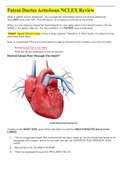
Patent Ductus Arteriosus NCLEX Review What is patent ductus arteriosus ? It’s a congenital heart defect where the ductus arteriosus does NOT close after birth. This will lead to an increase in pulmonary blood flow. When you are studying congenital heart defects for your peds class or the NCLEX exam, LET the NAME of the defect help you. For this condition, it is PATENT ductus arteriosus. “Patent ” means failing to close , hence it stays opened. Therefore, in other words, the patent ductus arteriosus stays open. Now, to understand PDA and to eliminate the need to memorize this condition, you have to know: • Normal blood flow of the heart • What the ductus arteriosus is and its function Normal blood flow through the heart? It starts on the RIGHT SIDE (goal of the right side is to get the UNOXYGENATED blood to the LUNGS) 1. The un-oxygenated blood (this is blood that has been “used -up” by your body that needs to be resupplied with oxygen) enters to the heart through the SUPERIOR AND INFERIOR VENA CAVA. 2. Blood enters into the RIGHT ATRIUM 3. Then it is squeezed through the TRICUSPID VALVE 4. Blood then enters into the RIGHT VENTRICLE 5. Then it is squeezed into the PULMONIC VALVE 6. Blood is then shot -up through the PULMONARY ARTERY and then enters into the lungs for some oxygen Left Side of the Heart (goal of this side is to get the richly, oxygenated blood to the body to feed the brain, tissue, muscles, organs etc.) 7. Blood enters from the lungs through the PULMONARY VEIN that has just been refreshed with oxygen to go 7. into the LEFT ATRIUM 7. Down through the BICUSPID VALVE (also called mitral valve) 7. Then blood is squeezed into the LEFT VENTRICLE 7. Up through the AORTIC VALVE 7. Lastly up through the AORTA, where it pumped throughout the body What the ductus arteriosus is and its function? • It’s a blood vessel that connects the aorta to the pulmonary artery in a fetus . It should be present in all newborns. However, it should close shortly after birth (usually within 3 days). • Its purpose is to help carry blood that is entering the right side of the heart to the rest of the body, hence it allows the blood to bypass the non-functional lungs in the fetus. o Remember babies in the womb don’t use their lungs yet (they are receiving oxygen from the placenta), so there isn’t a reason for blood to pass through the lungs until AFTER birth….which is why the ductus arteriosus will close because it’s no longer needed. After birth, the lungs will work and this vessel will close so blood from the right side of the heart can go through the lungs to become oxygenated. • Patent ductus arteriosus is more common in premature babies. • A large PDA causes problems and will need repair. Many small PDAs may close on their own and usually don’t lead to outright symptoms because they are not allowing too much blood to flow to the lungs abnormally. Why is patent ductus arteriosus a problem …what’s the big deal about the vessel not closing after birth? Unfortunately , more blood will enter the lungs and a left-to-right shunting of blood will occur. A large patent ductus arteriosus will cause blood that has already been oxygenated to pour back into the pulmonary artery to go back to the lungs. This overload of blood to the lungs will stress out the lungs and lead to high pressure in the arteries that feed the lungs. This is known as pulmonary hypertension . Furthermore, because of this high pressure in the arteries the arteries will narrow and the heart will have to pump even harder to get the blood to the lungs, which can lead to heart failure .
Exam (elaborations)
Patent Ductus Arteriosus NCLEX Review, (PDA) NCLEX Questions (solution) all correct
Rating
Sold
-
Pages
6
Grade
A
Uploaded on
03-11-2021
Written in
2021/2022
Patent Ductus Arteriosus NCLEX Review, (PDA) NCLEX Questions (solution) all correct-What is patent ductus arteriosus? It’s a congenital heart defect where the ductus arteriosus does NOT close after birth. This will lead to an increase in pulmonary blood flow. When you are studying congenital heart defects for your peds class or the NCLEX exam, LET the NAME of the defect help you. For this condition, it is PATENT ductus arteriosus. “Patent” means failing to close, hence it stays opened. Therefore, in other words, the patent ductus arteriosus stays open. Now, to understand PDA and to eliminate the need to memorize this condition, you have to know: • Normal blood flow of the heart • What the ductus arteriosus is and its function
Show more
Read less
Institution
Southwest Texas Junior College
Module
NURS 3622
Whoops! We can’t load your doc right now. Try again or contact support.
Written for
- Institution
-
Southwest Texas Junior College
- Module
-
NURS 3622
Document information
- Uploaded on
- November 3, 2021
- Number of pages
- 6
- Written in
- 2021/2022
- Type
- Exam (elaborations)
- Contains
- Questions & answers
Subjects
-
patent ductus arteriosus nclex reviewdocx
-
patent ductus arteriosus nclex review
-
pda nclex questions solution all correct
Content preview
$14.04
Get access to the full document:
100% satisfaction guarantee
Immediately available after payment
Both online and in PDF
No strings attached

Also available in package deal
Package deal
BUNDLE: COMPREHENSIVE NCLEX EXAMS ( REAL EXAMS) COVERED OVER THE YEARS ( LATEST REVISED EXAM QUESTIONS & ANSWERS) ALL GRADED 100%
77
2023
$ 1,218.82
More info