
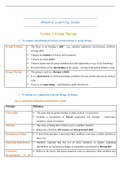
Week 4: Learning Goals
Lecture 7: Group Therapy
1. To compare and distinguish between group training vs. group therapy
Group Training The focus is on training a skill – e.g., emotion regulation, assertiveness, problem
solving skills
Trainers are teachers in theory and in practice
Trainers are more active
Trainers ensure that all group members have the opportunity to say or do something
No intervention on the interactions in the group – as long as the group climate is safe
Group Therapy The group is used as a therapy vehicle
It is a mini-society in which personality problems become visible and can be worked
with
Focus is on reparenting – and therapists guide the process
2. To identify key components of group therapy including:
The 12 therapeutic principles as identified by Yalom
Principle Definition
Universality The sense that no group member is alone in their ‘wretchedness’
Includes a recognition of shared experience and feelings – ameliorates
member’s sense of isolation
Altruism The sense of being able to help or give to another member
Believed to facilitate self-esteem and interpersonal skills
Installation of Hope Comes from members witnessing other members overcome a similar problem to
their own
Imparting Information Members reported that the act of other members or leaders imparting
information (or factual knowledge) is sometimes experienced as therapeutic
Corrective Refers to the theory that group members come to experience other members and
Recapitulation of the
,Primary Family leaders as their own parents or siblings
Members replay traumatic experiences from their family of origin within the
therapy group
This recapitulation of early family experiences is believed to be corrective –
when group members experience a different ending to an old pattern
E.g., getting their needs met by group members in ways they did NOT in early
family experiences
Development of Refers to group members trying out new interpersonal behaviors
Socializing Techniques Refining their social skills within the safety of the group therapy
Imitative Behavior Refers to group members learning new skills via modeling from other members
E.g., new group members model the productive in-group behaviors of other,
more experienced members – such as self-disclosure and support
Cohesion A member’s sense that they belong in the group and are accepted and validated
by the group
Considered to be the primary therapeutic factor in group psychotherapy
Cohesion has a strong positive relationship with patient improvement and
outcome
Existential Factors Refer to group members taking responsibility for their own lives and decisions
Catharsis The experience of emotional release of distress to a supportive group
Interpersonal Learning At the heart of Yalom’s model of group therapy
Refers to group members’ achievement of greater self-awareness
Receiving feedback from other members and leaders on how they are perceived
by others, how they make others feel, and how the group member receiving
feedback feels about themselves
Self-Understanding Akin to insight
Refers to group members gaining a better appreciation of how their behaviors
affect their interpersonal relationships
Stages of group development
Successful groups are expected to (1) negotiate each developmental stage and (2) move on to
the next in a predictable fashion
- Successful resolution of one stage must be obtained before moving on to the next
, Forming Orientation and dependence
Storming Intragroup conflict and differentiation
Norming Interpersonal intimacy and cohesion
Performing Work and functional role relatedness
Adjourning Loss and autonomy
Process variables that predict outcome
Process Variable Description
Group Cohesion Strong predictor of outcome
Relates to other group process variables which may in turn predict outcome – e.g.,
the relatedness of members, autonomy of group, and dependency on the leader
Increase in cohesion from initial sessions to termination sessions – appears to
predict better outcomes for group members
Groups with between 5-9 members had the strongest cohesion-outcome
relationship compared to smaller or larger groups
Interactive groups – i.e., those that are less structured – demonstrated a strong
correlation between cohesion and outcome
Constructive The idea group milieu allows patients to express anger, feel secure while self-
Therapeutic disclosing personal details, and to provide feedback to other members – while
Environment functioning in the here-and-now
Leader and member ratings of the group environment were shown to predict
outcome
It predicts other process variables which in turn may predict group outcome – e.g.,
the growth and progress of a group via traditional stages, and the building of trust
and cohesion among members and leaders
Group Flow (through Describes the process via which groups traditionally move from the first therapy
stages) session to the last
E.g., as a group moves through Tuckman’s stages – it becomes more autonomous
and less dependent upon the leader
Level of Involvement Members who are personally involved and show commitment to the group – tend
(of group members) to be members who contribute to shaping the group via (1) self-disclosure and (2)
Lecture 7: Group Therapy
1. To compare and distinguish between group training vs. group therapy
Group Training The focus is on training a skill – e.g., emotion regulation, assertiveness, problem
solving skills
Trainers are teachers in theory and in practice
Trainers are more active
Trainers ensure that all group members have the opportunity to say or do something
No intervention on the interactions in the group – as long as the group climate is safe
Group Therapy The group is used as a therapy vehicle
It is a mini-society in which personality problems become visible and can be worked
with
Focus is on reparenting – and therapists guide the process
2. To identify key components of group therapy including:
The 12 therapeutic principles as identified by Yalom
Principle Definition
Universality The sense that no group member is alone in their ‘wretchedness’
Includes a recognition of shared experience and feelings – ameliorates
member’s sense of isolation
Altruism The sense of being able to help or give to another member
Believed to facilitate self-esteem and interpersonal skills
Installation of Hope Comes from members witnessing other members overcome a similar problem to
their own
Imparting Information Members reported that the act of other members or leaders imparting
information (or factual knowledge) is sometimes experienced as therapeutic
Corrective Refers to the theory that group members come to experience other members and
Recapitulation of the
,Primary Family leaders as their own parents or siblings
Members replay traumatic experiences from their family of origin within the
therapy group
This recapitulation of early family experiences is believed to be corrective –
when group members experience a different ending to an old pattern
E.g., getting their needs met by group members in ways they did NOT in early
family experiences
Development of Refers to group members trying out new interpersonal behaviors
Socializing Techniques Refining their social skills within the safety of the group therapy
Imitative Behavior Refers to group members learning new skills via modeling from other members
E.g., new group members model the productive in-group behaviors of other,
more experienced members – such as self-disclosure and support
Cohesion A member’s sense that they belong in the group and are accepted and validated
by the group
Considered to be the primary therapeutic factor in group psychotherapy
Cohesion has a strong positive relationship with patient improvement and
outcome
Existential Factors Refer to group members taking responsibility for their own lives and decisions
Catharsis The experience of emotional release of distress to a supportive group
Interpersonal Learning At the heart of Yalom’s model of group therapy
Refers to group members’ achievement of greater self-awareness
Receiving feedback from other members and leaders on how they are perceived
by others, how they make others feel, and how the group member receiving
feedback feels about themselves
Self-Understanding Akin to insight
Refers to group members gaining a better appreciation of how their behaviors
affect their interpersonal relationships
Stages of group development
Successful groups are expected to (1) negotiate each developmental stage and (2) move on to
the next in a predictable fashion
- Successful resolution of one stage must be obtained before moving on to the next
, Forming Orientation and dependence
Storming Intragroup conflict and differentiation
Norming Interpersonal intimacy and cohesion
Performing Work and functional role relatedness
Adjourning Loss and autonomy
Process variables that predict outcome
Process Variable Description
Group Cohesion Strong predictor of outcome
Relates to other group process variables which may in turn predict outcome – e.g.,
the relatedness of members, autonomy of group, and dependency on the leader
Increase in cohesion from initial sessions to termination sessions – appears to
predict better outcomes for group members
Groups with between 5-9 members had the strongest cohesion-outcome
relationship compared to smaller or larger groups
Interactive groups – i.e., those that are less structured – demonstrated a strong
correlation between cohesion and outcome
Constructive The idea group milieu allows patients to express anger, feel secure while self-
Therapeutic disclosing personal details, and to provide feedback to other members – while
Environment functioning in the here-and-now
Leader and member ratings of the group environment were shown to predict
outcome
It predicts other process variables which in turn may predict group outcome – e.g.,
the growth and progress of a group via traditional stages, and the building of trust
and cohesion among members and leaders
Group Flow (through Describes the process via which groups traditionally move from the first therapy
stages) session to the last
E.g., as a group moves through Tuckman’s stages – it becomes more autonomous
and less dependent upon the leader
Level of Involvement Members who are personally involved and show commitment to the group – tend
(of group members) to be members who contribute to shaping the group via (1) self-disclosure and (2)


