
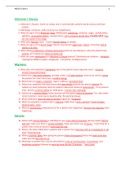
MDCIV Exam 1 1 Alzheimer’s Disease 1. Alzheimer’s Disease: Comes on slowly, and is nonreversible, p atient may be anxious and have anxiety 2. Mild Stage: Confusion, mild memory loss, forgetfulness 3. What are signs of the Moderate Stage : Withdrawal, wandering , confusion, anger , confabulation, agitation, visuospatial deficits ,misplace items, can’t recognize people faces Possible SATA they are not violent in this stage 4. What does Agnosia mean - Cannot identify objects or people 5. What are signs of the Severe Stage : Patient may become aggressive , violent , nonverbal, lack of ability to do ADLs 6. When doing an Alzheimer’s Disease Assessment what are we looking for : does the patient have anxiety, and making sure ADLs are being met 7. What are some medications for Alzheimer’s Disease patient ? Cholinesterase Inhibitors - donepezil , rivastigmine NMDA receptor antagonists - memantine, Antidepressants Migraines 8. What does the medication Ergotamine due to the patient treats migraines and it - Constrict vessels! (vasoconst riction) 9. Patient has a new onset migraine , provider orders a CT with contrast , what do we need to assess the patient for? Ask if they have a shellfish allergy 10. What food can trigger a migraine - yogurt, caffeine, marinated food 11. Patient has migraines they been prescribed beta blocker what do we need to educate the patient on/ what statement does the patient makes that shows he understands - If my seizures stop I need to continue taking my medication, I cannot stop it abruptly . 12. Patient h as a postictal phase motor function will the patient return to baseline ? Yes, (the clients motor function is returning to baseline after the postictal phase) 13. What medication does not treat or prevent migraines? Verapamil 14. What are symptoms a patient with a migraine might have if aura is present ? visual changes, flashing lights, colors 15. What do maintenance medications do for a patient with migraines? Prevents the migraines from happening. Seizures 16. Patient with seizure /epilepsy is admitted to your room what precautions do they need? Pad the bed rails , make sure there is suction available , make sure there is an IV access – main thing for a patient with a seizure would to select pad the rails . 17. What is the state called when a pati ent with a seizure has a decrease LOC or is sleeping for 5 -30 mins ? Postictal state 18. How to promote safety after giving the patient Ativan (lorazepam)? Raise the head of the bed , make sure the bed rails are up 19. What type of patient has a seizure described a s a loss of consciousness , incontinence , and breathing cessation followed by postictal state the last 10 minutes - Tonic clonic MDCIV Exam 1 2 20. What medication do we give to the patient with seizures ? Ativan (lorazepam) 21. What is the priority when your patient is having a seizure ? Safety and getting them to their side 22. A patient is taking Dilantin for epilepsy can they stop taking that medication? No they can not stop taking it 23. A patient that is experiencing a tonic clonic seizure , will most likely always have a loss of consciousness 24. Generalized seizures involve both cerebral hemispheres ? – Yes 25. Phenytoin will be given when the seizure stops Parkinson’s 26. Patient with Parkinson’s and displaying slow movement ( dyskinesia ) patient states he know he needs extra time to complete activities - he understands his condition 27. What are symptoms of Parkinson’s ? Mask like face , muscle rigidity , hypokinesis (movement disorder) 28. When screening for Parkinson’s, what would you notice? Patient is shuffling , and proposal forward move ment 29. Patient is taking levodopa , what is that medication helping with? Muscle rigidity. 30. Cardinal signs of Parkinson’s? Tremors, Muscle Rigidity, Bradykinesia, Postural Instability 31. How to prevent respiratory complication in a Parkinson’s patient? Raise the head of the bed , purse lipped breathing Meningitis 32. What need to happen with a patient that has bacterial meningitis – the first simple measure to decrease ICP? Elevate bed 30 degrees 33. What type of precaution is the patient have with bacterial meningitis ? Droplet precaution 34. Viral meningitis does NOT have a high rate of fatality . 35. Living in close quarters are a cause for meningitis 36. Lumbar puncture - In this procedure, they’re sticking a needle into the spine to test for meningitis . 37. Clinical manifestations of meningitis - nuchal rigidity (stiff neck), positive Kernig’s, Brudzinski’s sign Dysreflexia (Spinal Cord Injury ) 38. Patient with paraplegic T6 -T7 – Priority autonomic dysreflexia – bowel and bladder 39. T6 or above spinal injury. They have excessively high blood pressure . Can cause bladder distention and impaction, muscle tone issues with bowel, bladder, and peripheral muscle. Sweat above injury and goosebumps below 40. Autonomic dysreflexia is a sudden , potentially life -threatening occurrence in patients with SCI 41. Intervention do NOT wear restrictive clothing 42. Priority assessment after spinal surgery - ABC Glasgow Coma scale (Neuro Assessment)
Voorbeeld 2 van de 7 pagina's
Overig
Exam 1 Study Guide MDC4
Voorbeeld 2 van de 7 pagina's
1. Alzheimer’s Disease: Comes on slowly, and is nonreversible, patient may be anxious and have anxiety 2. Mild Stage: Confusion, mild memory loss, forgetfulness 3. What are signs of the Moderate Stage: Withdrawal, wandering, confusion, anger, confabulation, agitation, visuospatial deficits, misplace items, can’t recognize people faces, they are not violent in this stage 4. What does Agnosia mean - Cannot identify objects or people 5. What are signs of the Severe Stage: Patient may become aggressive, violent, nonverbal, lack of ability to do ADLs 6. When doing an Alzheimer’s Disease Assessment what are we looking for: does the patient have anxiety, and making sure ADLs are being met 7. What are some medications for Alzheimer’s Disease patient? Cholinesterase Inhibitors - donepezil, rivastigmine NMDA receptor antagonists - memantine, Antidepressants
Voorbeeld van de inhoud
Documentinformatie
- Geüpload op
- 25 oktober 2021
- Aantal pagina's
- 7
- Geschreven in
- 2021/2022
- Type
- Overig
- Persoon
- Onbekend
$22.49
Verkeerd document? Gratis ruilen
Binnen 14 dagen na aankoop en voor het downloaden kun je een ander document kiezen. Je kunt het bedrag gewoon opnieuw besteden.
Geschreven door studenten die geslaagd zijn
Direct beschikbaar na je betaling
Online lezen of als PDF


