
3/18/2021 Elsevier Adaptive Quizzing - Quiz performance
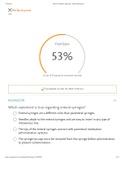
Performance
Exit
Final Score
53%
16 out of 30 questions answered correctly
Completed on Mar 18, 2021 12:05 pm
Incorrect (14)
Which statement is true regarding enteral syringes?
Enteral syringes are a different color than parenteral syringes.
Needles attach to the enteral syringes and are easy to insert in any type of
intravenous line.
The tips of the enteral syringes connect with parenteral medication
administration systems.
The syringe tip caps must be removed from the syringe before administration
to prevent contamination.
https://eaqng.elsevier.com/#/quizPerformance/17085367 1/19
, 3/18/2021 Elsevier Adaptive Quizzing - Quiz performance
Rationale
The enteral syringes are often a different color than the parenteral syringes and must
be labeled for oral or enteral use. Needles of the enteral syringes do not attach to the
syringes and cannot be inserted into any type of intravenous line. The tips of the
enteral syringes will not connect with parenteral medication administration systems.
The nurse must remove the tip cap of the syringe before administering the medication
because there are chances of tracheal blockage caused by aspiration of the cap, but this
does not prevent contamination.
p. 609
The nurse provides education about intravenous (IV) medication
administration to a group of nursing students and includes which
information?
Occlude the IV line by pinching the tubing just above the injection port.
Insert the needle of the syringe containing the medication through the center
of the port.
If a blood transfusion is being given, flush the line with 30 mL of saline before
administering the medication.
If there is no blood return with a smaller-gauge peripheral needle, do not give
the IV medication.
Rationale
The nurse should occlude the IV line by pinching tubing just above injection port. The
nurse should insert a needleless tip of syringe containing medication through the
center of the port. The nurse should never administer IV medications through tubing
that is infusing blood, blood products, or parenteral nutrition solutions. In the case of
smaller-gauge IV needles, blood return sometimes is not aspirated even if the IV line is
patent. If the IV site does not show signs of infiltration and IV fluid is infusing without
difficulty, give the IV push medication.
p. 664
https://eaqng.elsevier.com/#/quizPerformance/17085367 2/19


