

SUBJECT : SCIENCE
MATTER IN OUR SURROUNDINGS
States of Matter:
Matter can be classified as solid, liquid and gas on the basis of interparticle
forces and the arrangement of particles.
These three forms of matter are interconvertible by increasing or decreasing
pressure and temperature. For example, ice can be converted from solid to a
liquid by increasing the temperature.
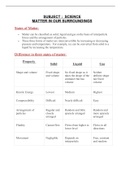
Difference in three states of matter:
Property
Solid Liquid Gas
Shape and volume Fixed shape No fixed shape as it Neither
and volume takes the shape of the definite shape
container but has nor fixed
volume volume
Kinetic Energy Lowest Medium Highest
Compressibility Difficult Nearly difficult Easy
Arrangement of Regular and Random and little Random and
particles closely sparsely arranged more sparsely
arranged arranged
Fluidity Cannot flow Flows from higher to Flows in all
lower level directions
Movement Negligible Depends on Free, constant
interparticle and random
, attraction
Interparticle space Very less More Large
Interparticle attraction Maximum Medium Minimum
Density(Mass/volume) Maximum Medium Minimum
Rate of diffusion Negligible It depends on Maximum
interparticle
attraction.
Evaporation
The phenomenon by which molecules in liquid state undergo a spontaneous
transition to the gaseous phase at any temperature below its boiling point is called
evaporation.
For example, the gradual drying of damp clothes is caused by the
evaporation of water to water vapour.
Factors affecting evaporation
Temperature: The rate of evaporation increases with an increase in
temperature.
Surface area: The rate of evaporation increases with an increase in surface
area.
Humidity: The rate of evaporation decreases with an increase in humidity.
Wind speed: The rate of evaporation increases with an increase in wind
speed.
Cooling due to evaporation
MATTER IN OUR SURROUNDINGS
States of Matter:
Matter can be classified as solid, liquid and gas on the basis of interparticle
forces and the arrangement of particles.
These three forms of matter are interconvertible by increasing or decreasing
pressure and temperature. For example, ice can be converted from solid to a
liquid by increasing the temperature.
Difference in three states of matter:
Property
Solid Liquid Gas
Shape and volume Fixed shape No fixed shape as it Neither
and volume takes the shape of the definite shape
container but has nor fixed
volume volume
Kinetic Energy Lowest Medium Highest
Compressibility Difficult Nearly difficult Easy
Arrangement of Regular and Random and little Random and
particles closely sparsely arranged more sparsely
arranged arranged
Fluidity Cannot flow Flows from higher to Flows in all
lower level directions
Movement Negligible Depends on Free, constant
interparticle and random
, attraction
Interparticle space Very less More Large
Interparticle attraction Maximum Medium Minimum
Density(Mass/volume) Maximum Medium Minimum
Rate of diffusion Negligible It depends on Maximum
interparticle
attraction.
Evaporation
The phenomenon by which molecules in liquid state undergo a spontaneous
transition to the gaseous phase at any temperature below its boiling point is called
evaporation.
For example, the gradual drying of damp clothes is caused by the
evaporation of water to water vapour.
Factors affecting evaporation
Temperature: The rate of evaporation increases with an increase in
temperature.
Surface area: The rate of evaporation increases with an increase in surface
area.
Humidity: The rate of evaporation decreases with an increase in humidity.
Wind speed: The rate of evaporation increases with an increase in wind
speed.
Cooling due to evaporation



