RESEARCH METHODOLOGY FOR NUTRITION AND HEALTH I HNE-25806
HC Introductie in de voedingswetenschap
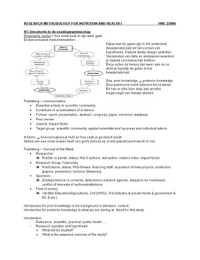
Empirische cyclus = hoe onderzoek in zijn werk gaat.
Evidence-based medicine/nutrition
Kijken wat de gaten zijn in het onderzoek
(bewijsmateriaal) en het vormen van
hypotheses. Daarna studie design opstellen.
Verzamelen van data en analyseren waardoor
je daarna conclusies kan trekken.
Deze vullen de kennis dan weer aan en zo
dicht je hopelijk de gaten in het
bewijsmateriaal.
Dus: prior knowledge posterior knowledge
Door publiceren komt iedereen het te weten.
En kan er elke keer data aan worden
toegevoegd van nieuwe studies.
Publishing – communication
Essential activity in scientific community
Contribute to accumulation of evidence
Format: report, presentation, abstract, congress, paper, electronic database
Peer review
Journal, impact factor
Target group: scientific community, applied scientists and lay-press and individual advice
A-factor hoeveel papers je hebt en hoe vaak je geciteerd wordt.
Status van een onderzoeker heeft een grote invloed op of iets gepubliceerd wordt of niet.
Publishing – Survival of the fittest
Researcher
Publish or perish, status, first 3 authors, last author, citation index, impact factor
Research Group / University
Publications, status, PhD-theses, financing staff, acquistion of new projects, production
(papers, promotion), turnover (finances).
Sponsors
(In)dependence re contents, determines research agenda, always to be mentioned,
conflict of interests of authors/institutions
Flow of money
1st (Min Education/Agriculture), 2nd (NWO), 3rd (industry & private funds & government &
EC & etc.)
Introduction for prior knowledge is the background in literature, context.
Introduction for posterior knowledge is what we are aiming at. Need for this study.
Introduction
- Relevance: scientific, practical, public health, ….
- Research question and hypothesis
What will be studied?
What is the assumed outcome of the study?
, - What is the scientific background of the hypothesis?
- From which theoretical framework has the scientific background been interpreted?
Medical doctor, researcher, public health worker, policy maker, economist, commercial
company
Material and methods: the data from a new study:
- Design, exposure, outcome, methods, data analysis
- Operationalization, quality of conduct. Well described?
Materials and methods
Are the materials and methods “fit” to answer the research question?
Has the research question be adequately operationalized (proper design choice, proper
methods)?
What are the consequences of suboptimal choices?
Has the study been conducted well?
Data collection well done? (validity, reproducibility, what information is provided).
Has the comparability of study groups been guaranteed? (selection-, information-, and
confounding bias?)
Results: Prior knowledge: Background in literature, context used adequately?
Posterior knowledge: Did they answer the research question. Adequate use of prior
knowledge? Adequate discussion of design and conduct?
Results
Do the results answer the research question?
If yes, in which way? If not, why?
Is the way in which the design, outcomes, and exposures have been operationalized, clearly
visible in the results?
In what manner? (text, tables?)
Consider validity and accuracy of design, population and methods.
What is your opinion about the choices made by the investigators?
Would you have done it similarly, or would you have done it differently?
Discussion: Data from a new study: How to weigh your own new results
Prior knowledge: How to weigh knowledge that was present beforehand?
Posterior knowledge: A reasoned and balances presentation on the way in which the
new study results have modified our previous ideas.
Discussion – usual structure
Summary most important facts ….
Internal validity …
External validity …
Biological plausibility (for humans)
Generalizability
In conclusion “.. what you really belief in .. want to defend.”
Discussion
Validity – internal
Proper design, conduct and analysis; exposure, outcome assessment?
Validity – external
, Can the results of this study be generalized to other cells, organs, populations?
Generalization – model systems
Model system may lack comparability with intact human system
Extra/Interpolation: Exposures may not be physiologic
Generalization individual mankind: Biological interactions (Total > Sum of all parts)
Generalization between approaches: Metabolism may differ, effects may be system
specific, or context dependent
Discussion – generalisation
In vitro: vaak bewerkte cellijnen, waardoor er dus weinig
over te zeggen is.
Animal model: hoe goed is dit te vertalen naar de mens?
Study designs: measurement schemes – de
pijltjes geven aan wanneer dat er gemeten
wordt
Cross-over design
Stable condition
Wash-out (soms niet mogelijk, dus dan gelijk doorgaan)
2 x 2 design
Advantages
Within-subject comparisons er zijn minder mensen nodig, aangezien er geen between-
subject bias is
Limitations
Inconvenience
Longer period
Carryover / period effect volgorde van behandeling kan carry-over veroorzaken
Randomized double-blind placebo-controlled trial = “Gold Standard”
Deze komt veel voor en is belangrijk in voedingsonderzoek.
Causale relaties zijn aan te tonen met RDP trial
Key issues of an experiment:
- Good hypothesis
HC Introductie in de voedingswetenschap
Empirische cyclus = hoe onderzoek in zijn werk gaat.
Evidence-based medicine/nutrition
Kijken wat de gaten zijn in het onderzoek
(bewijsmateriaal) en het vormen van
hypotheses. Daarna studie design opstellen.
Verzamelen van data en analyseren waardoor
je daarna conclusies kan trekken.
Deze vullen de kennis dan weer aan en zo
dicht je hopelijk de gaten in het
bewijsmateriaal.
Dus: prior knowledge posterior knowledge
Door publiceren komt iedereen het te weten.
En kan er elke keer data aan worden
toegevoegd van nieuwe studies.
Publishing – communication
Essential activity in scientific community
Contribute to accumulation of evidence
Format: report, presentation, abstract, congress, paper, electronic database
Peer review
Journal, impact factor
Target group: scientific community, applied scientists and lay-press and individual advice
A-factor hoeveel papers je hebt en hoe vaak je geciteerd wordt.
Status van een onderzoeker heeft een grote invloed op of iets gepubliceerd wordt of niet.
Publishing – Survival of the fittest
Researcher
Publish or perish, status, first 3 authors, last author, citation index, impact factor
Research Group / University
Publications, status, PhD-theses, financing staff, acquistion of new projects, production
(papers, promotion), turnover (finances).
Sponsors
(In)dependence re contents, determines research agenda, always to be mentioned,
conflict of interests of authors/institutions
Flow of money
1st (Min Education/Agriculture), 2nd (NWO), 3rd (industry & private funds & government &
EC & etc.)
Introduction for prior knowledge is the background in literature, context.
Introduction for posterior knowledge is what we are aiming at. Need for this study.
Introduction
- Relevance: scientific, practical, public health, ….
- Research question and hypothesis
What will be studied?
What is the assumed outcome of the study?
, - What is the scientific background of the hypothesis?
- From which theoretical framework has the scientific background been interpreted?
Medical doctor, researcher, public health worker, policy maker, economist, commercial
company
Material and methods: the data from a new study:
- Design, exposure, outcome, methods, data analysis
- Operationalization, quality of conduct. Well described?
Materials and methods
Are the materials and methods “fit” to answer the research question?
Has the research question be adequately operationalized (proper design choice, proper
methods)?
What are the consequences of suboptimal choices?
Has the study been conducted well?
Data collection well done? (validity, reproducibility, what information is provided).
Has the comparability of study groups been guaranteed? (selection-, information-, and
confounding bias?)
Results: Prior knowledge: Background in literature, context used adequately?
Posterior knowledge: Did they answer the research question. Adequate use of prior
knowledge? Adequate discussion of design and conduct?
Results
Do the results answer the research question?
If yes, in which way? If not, why?
Is the way in which the design, outcomes, and exposures have been operationalized, clearly
visible in the results?
In what manner? (text, tables?)
Consider validity and accuracy of design, population and methods.
What is your opinion about the choices made by the investigators?
Would you have done it similarly, or would you have done it differently?
Discussion: Data from a new study: How to weigh your own new results
Prior knowledge: How to weigh knowledge that was present beforehand?
Posterior knowledge: A reasoned and balances presentation on the way in which the
new study results have modified our previous ideas.
Discussion – usual structure
Summary most important facts ….
Internal validity …
External validity …
Biological plausibility (for humans)
Generalizability
In conclusion “.. what you really belief in .. want to defend.”
Discussion
Validity – internal
Proper design, conduct and analysis; exposure, outcome assessment?
Validity – external
, Can the results of this study be generalized to other cells, organs, populations?
Generalization – model systems
Model system may lack comparability with intact human system
Extra/Interpolation: Exposures may not be physiologic
Generalization individual mankind: Biological interactions (Total > Sum of all parts)
Generalization between approaches: Metabolism may differ, effects may be system
specific, or context dependent
Discussion – generalisation
In vitro: vaak bewerkte cellijnen, waardoor er dus weinig
over te zeggen is.
Animal model: hoe goed is dit te vertalen naar de mens?
Study designs: measurement schemes – de
pijltjes geven aan wanneer dat er gemeten
wordt
Cross-over design
Stable condition
Wash-out (soms niet mogelijk, dus dan gelijk doorgaan)
2 x 2 design
Advantages
Within-subject comparisons er zijn minder mensen nodig, aangezien er geen between-
subject bias is
Limitations
Inconvenience
Longer period
Carryover / period effect volgorde van behandeling kan carry-over veroorzaken
Randomized double-blind placebo-controlled trial = “Gold Standard”
Deze komt veel voor en is belangrijk in voedingsonderzoek.
Causale relaties zijn aan te tonen met RDP trial
Key issues of an experiment:
- Good hypothesis