
• Falsches Dokument? Kostenlos tauschen
  • Geschrieben von Student*innen, die bestanden haben
  • Sofort verfügbar nach Zahlung
  • Online lesen oder als PDF
Verkaufen
Wo studierst du
Deine Sprache
Document preview thumbnail
Vorschau 1 aus 4 Seiten
Zusammenfassung

Summary Psychoanalysis vs Humanistic Approach

Document preview thumbnail
Vorschau 1 aus 4 Seiten

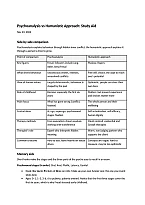
This study aid compares the psychoanalytic and humanistic approaches in psychology, and it is built for quick exam revision. It includes a side-by-side comparison table covering key figures, view of human nature, role of childhood, therapy methods and criticisms, along with memory hooks for Freud's psychosexual stages and the id, ego and superego. It also gives everyday examples for fixation, transference, free association, self-actualization and client-centred therapy, 10 practice questions with model answers, and a list of common exam mistakes. It is suited to first- and second-year psychology students preparing for exams on the schools of thought in psychology, and it follows Ciccarelli, White and Misra, *Psychology* (7th ed., Pearson India).

Inhaltsvorschau

Psychoanalysis vs Humanistic Approach: Study Aid
Nov 23, 2026


Side-by-side comparison
Psychoanalysis explains behaviour through hidden inner conflict; the humanistic approach explains it
through a person's drive to grow.

Point of comparison Psychoanalysis Humanistic approach

Key figures Freud; followers include Jung, Maslow, Rogers
Adler, Anna Freud

What drives behaviour Unconscious wishes, instincts, Free will, choice, the urge to reach
unresolved conflicts one's potential

View of human nature Largely deterministic; behaviour is Optimistic; people can steer their
shaped by the past own lives

Role of childhood Decisive, especially the first six Matters, but present experience
years and choices matter more

Main focus What has gone wrong (conflict, The whole person and their
fixation) wellbeing

Central ideas Id, ego, superego; psychosexual Self-actualization, self-efficacy,
stages; fixation human dignity

Therapy methods Free association, dream analysis, Client-centred, existential and
working with transference Gestalt therapies

Therapist's role Expert who interprets hidden Warm, non-judging partner who
meaning supports the client

Common criticisms Hard to test; leans heavily on sexual Concepts are vague; hard to
drives measure; may be too optimistic


Memory aids
Short hooks make the stages and the three parts of the psyche easy to recall in an exam.

Psychosexual stages (in order): Oral, Anal, Phallic, Latency, Genital.

• Hook: Our Aunts Put Lots of Ghee on rotis. Make up your own funnier one; the one you invent
sticks best.
• Ages: 0–1, 1–3, 3–6, 6 to puberty, puberty onward. Notice that the first three stages cover the
first six years, which is why Freud stressed early childhood.


Dokument Information

Hochgeladen auf
23. november 2026
Anzahl der Seiten
4
geschrieben in
2026/2027
Typ
Zusammenfassung
$11.39

Falsches Dokument? Kostenlos tauschen Innerhalb von 14 Tagen nach dem Kauf und vor dem Herunterladen kannst du ein anderes Dokument wählen. Du kannst den Betrag einfach neu ausgeben.
Geschrieben von Student*innen, die bestanden haben
Sofort verfügbar nach Zahlung
Online lesen oder als PDF

Verkauft
0
Anhänger
0
Sachen
1
Zuletzt verkauft
-


Warum sich Studierende für Stuvia entscheiden

on Mitstudent*innen erstellt, durch Bewertungen verifiziert

Geschrieben von Student*innen, die bestanden haben und bewertet von anderen, die diese Studiendokumente verwendet haben.

Nicht zufrieden? Wähle ein anderes Dokument

Kein Problem! Du kannst direkt ein anderes Dokument wählen, das besser zu dem passt, was du suchst.

Bezahle wie du möchtest, fange sofort an zu lernen

Kein Abonnement, keine Verpflichtungen. Bezahle wie gewohnt per Kreditkarte oder Sofort und lade dein PDF-Dokument sofort herunter.

Student with book image

“Gekauft, heruntergeladen und bestanden. So einfach kann es sein.”

Alisha Student

Arbeitest du an deiner Quellenangabe?

Erstelle korrekte Quellenangaben in APA, MLA und Harvard mit unserem kostenlosen Zitiergenerator.

Arbeitest du an deiner Quellenangabe?

Häufig gestellte Fragen
