

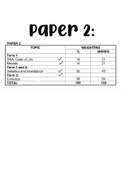
Paper 2:
:
,Topic 1:
DNA:
LOCATION :
→ in the nucleus $ forms part of the chromosome
structure
→ in the mitochondria in animals
→ chloroplasts in plants .
formed from DNA 31 form
>
WHAT IS DNA : pro ties called histones .
↳ large
→ Attached to chromosomes protien molecule
↳ long
strands of DNA $ protiens
they contain certain genetic info
that is found in the nucleus
THE NUCLEUS :
The structure :
→ double nuclear mem .
NUCLEAR
with pores
①
MEMBRANE
B@8ѧf@y
→ Nucleoplasm DNA
→ Nucleolus NUCLEOLUS
→ Chromatin network NUCLEOPLASM
NUCLEAR
functions :
PORE
→ stores genetic material of the nucleus
Diagram
→
regulates structure
and metabolism of cell
DNA
NUCLEIC ACIDS :
RNA
→
organic molecule in the cell
→ consist of nucleotides
, HISTORY AND DISCOVERY OF DNA :
→
Discovered genetic material in cells are responsible
for inheritance of characteristics
→ scientist found out DNA consists of phosphate
sugar ,
and 4 nitrogenous bases .
→ Rosalind Franklin and Maurice Watkins found a
method
using x-rays to determine the shape $
structure of large DNA molecules .
( spiral shape )
→ Franklins photos showed a double helix structure .
→ later Watkins showed Crick the
photographs and
Watson $ Crick formulated the double helix structure
→ Watson Crick and Wilkins relieved a Nobel
,
prize for Franklins work .
STRUCTURE OF DNA :
p
spiral ladder
molecule $ twisted double helix
→ DNA
long
= =
→
Building blocks for DNA is nucleotides .
→ Each strand of helix is made up of a
sequence
of DNA nucleotides .
NUCLEOTIDES :
NITROGENOUS BASES
SUGAR ( Deoxyribose )
I 1
-
-
-
- -
g
P
WEAK HYDROGEN BOND
1
PHOSPHATE of a nucleotide
Diagram
, Types of bases
nitrogenous
:
1 Adenine (A)
purines ( long )
.
2. Guanine (G)
3 .
Thymine ( T )
pyrimidines ( short )
4 .
Cytosine (C)
the chain to which
→
sugar and the phosphate make
nitrogenous bases attach to .
Diagram of DNA molecule :
:
,Topic 1:
DNA:
LOCATION :
→ in the nucleus $ forms part of the chromosome
structure
→ in the mitochondria in animals
→ chloroplasts in plants .
formed from DNA 31 form
>
WHAT IS DNA : pro ties called histones .
↳ large
→ Attached to chromosomes protien molecule
↳ long
strands of DNA $ protiens
they contain certain genetic info
that is found in the nucleus
THE NUCLEUS :
The structure :
→ double nuclear mem .
NUCLEAR
with pores
①
MEMBRANE
B@8ѧf@y
→ Nucleoplasm DNA
→ Nucleolus NUCLEOLUS
→ Chromatin network NUCLEOPLASM
NUCLEAR
functions :
PORE
→ stores genetic material of the nucleus
Diagram
→
regulates structure
and metabolism of cell
DNA
NUCLEIC ACIDS :
RNA
→
organic molecule in the cell
→ consist of nucleotides
, HISTORY AND DISCOVERY OF DNA :
→
Discovered genetic material in cells are responsible
for inheritance of characteristics
→ scientist found out DNA consists of phosphate
sugar ,
and 4 nitrogenous bases .
→ Rosalind Franklin and Maurice Watkins found a
method
using x-rays to determine the shape $
structure of large DNA molecules .
( spiral shape )
→ Franklins photos showed a double helix structure .
→ later Watkins showed Crick the
photographs and
Watson $ Crick formulated the double helix structure
→ Watson Crick and Wilkins relieved a Nobel
,
prize for Franklins work .
STRUCTURE OF DNA :
p
spiral ladder
molecule $ twisted double helix
→ DNA
long
= =
→
Building blocks for DNA is nucleotides .
→ Each strand of helix is made up of a
sequence
of DNA nucleotides .
NUCLEOTIDES :
NITROGENOUS BASES
SUGAR ( Deoxyribose )
I 1
-
-
-
- -
g
P
WEAK HYDROGEN BOND
1
PHOSPHATE of a nucleotide
Diagram
, Types of bases
nitrogenous
:
1 Adenine (A)
purines ( long )
.
2. Guanine (G)
3 .
Thymine ( T )
pyrimidines ( short )
4 .
Cytosine (C)
the chain to which
→
sugar and the phosphate make
nitrogenous bases attach to .
Diagram of DNA molecule :


