

HC 11 + 12 27-05-2014
Thyroid gland
Thyroid gland produces thyroxin (T4), has 4 iodine and triiodothryonine (T3, has 3
iodine). T4 is an inactive hormone, a prohormone for T3.
The effects of thyroid hormone is:
- Thermogenesis
- Oxygen consumption
- Basal metabolic rate
- Synergism with various other hormones
Thyroid hormones are essential for normal growth and development (cell differentiation).
Thyroid hormones are needed for growth; they affect different stages of the growth plate.
Lack of thyroid hormone results in mental retardation.
Thermogenesis:
- Thyroid hormone stimulates the production/secretion of uncoupling enzymes.
- The enzymes uncouple the production of ATP from the electron transport chain in
mito’s.
- The electrochemical gradient is now used for the production of heat.
- Takes place in brown adipose tissue and muscle.
- ATP turnover can also be increased more ATP converted into ADP, energy
converted into heat.
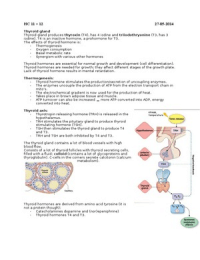
Thyroid axis:
- Thyrotropin releasing hormone (TRH) is released in the
hypothalamus.
- TRH stimulates the pituitary gland to produce thyroid
stimulating hormone (TSH).
- TSH then stimulates the thyroid gland to produce T4
and T3.
- TRH and TSH are both inhibited by T4 and T3.
The thyroid gland contains a lot of blood vessels with high
blood flow.
Consists of a lot of thyroid follicles with thyroid secreting cells,
filled with a fluid; colloid (contains a lot of glycoproteins and
thyroglobulin). C-cells in the corners secrete calcitonin (calcium
metabolism).
Thyroid hormones are derived from amino acid tyrosine (it is
not a protein though):
- Catecholamines dopamine and (nor)epeniphrine)
- Thyroid hormones T4 and T3.
,Synthesis of thyroid hormones:
- Two transporters in the thyrocides to transport iodine (iodine is needed for T4 and
T3):
o NIS (Na/I symporter)
Need Na+ because the [I] in thyrocides is usually higher than in the
bloodstream.
o Pendrin (Na-independent Cl/I transporter)
Transports the iodine from the thyrocides into
the colloid.
- Free iodine in the thyrocides is incorporated in the
tyrosine residues of thyroglobulin:
o I + tyrosine Mono-iodotyrosine (MIT)
done by thyroid peroxidase + H2O2
o MIT + I DIT
o Within the thyroglobulin the iodotyrosines are
coupled:
DIT + DIT T4
DIT + MIT T3
- Thyroglobulin is taken back from colloid into the cell
through endocytosis.
- It fuses with a lysosome lysosomal enzymes
separate T4 and T3 from thyroglobulin.
- Free T4 and T3 enter the circulation.
- All these processes are stimulated by TSH.
(thyroglobulin, NIS, TPO and H2O2)
- Each individual has its own optimal concentration of T4
and T3.
When the thyroid gland is overly active, its cells hypertrofiate
(cells become bigger, the amount is the same).
Iodotyrosines in the circulation:
- T4 and T3 in the circulation are bound to carrier proteins. They regulate the
transport of these hormones toward the target tissues and regulate the bioactivity
of these hormones.
- Carrier proteins:
o Thyroxine binding globulin (TBG) (highest affinity, is bound to about
75% of the T4 and T3)
o Thyroxine binding prealbumine (TBPA)
o Human serum albumin (HSA)
- Concentration free hormone is very low, though the directly available hormones
are the free hormones in the circulation. They are biologically readily available:
free hormone concept.
Uptake of thyroid hormones by target cells:
- Through membrane carrier-mediated transport (because the side chains are
hydrophilic.
- This transport process is also involved in the regulation of intracellular T4 and T3
pools.
- Two families of transporters for T4 and T3:
o OATPs (organic anion transporting polypeptides)
o Amino acid transporters
MCTs (monocarboxylate transporters)
They transport also pyruvate, lactate, acetoacetate,
hydroxybutyrate, acetate etc). Such as MCT-8.
- MCT-8 specific for transport of T3, expressed in the brain, liver, kidney and heart.
The MCT-8 gene is localized on X-chromosome. When you have a mutation, you
have elevated serum T3 levels and pshycomotoric retardation. T3 transport into
neurons differentiation and formation of myelin (cannot take place now).
, Thyroid hormone metabolism:
- Enzymatic deiodination of T4 takes place in liver, kidney and skeletal muscle.
Produces about 80% of the T3 in the circulation.
- Three different types of diodinases: D1, D2 and D3
- D1: plays an important role in the regulation of serum T4 and T3 levels. Most of
the T3 produced is released into the circulation. D1 is expressed in the liver and
kidney.
- D2: local activity controls the intracellular T3 pool. D2 is expressed in the brain
pituitary and brown fat.
- D3: involved in intracellular degration of T4 and T3. D3 is expressed in the brain,
liver and skin. Deionises the inner ring, making inactive T3 or T2.
- The biologically active T3 is mainly derived locally from outer ring deiodination of
T4 by D1 and D2.
- T4 and T3 levels in the circulation are regulated by D1 and D3 activities, especially
in liver and kidney.
- Intracellular T3 content of brain tissue must remain nearly constant, through
adequate changes in the local activities of D2 and D3.
Levels of regulation of thyroid hormones:
- Hypothalamus-pituitary-thyroid axis
- Binding proteins in serum (TBG)
- Cellular uptake through specific transporters
- Deiodination (D1, D2 and D3)
Biological activity of T3:
- When T3 is in a cel, it goes into the nucleus.
- T3 receptors are already bound to the DNA: RXR TR
- The receptor interacts with the thyroid hormone responsive element (TRE) in the
DNA. Mainly the receptor forms a heterodimer with retinoid X receptor.
Hypothyroidism (reduced activity of the thyroid gland)
- Decreased BMR and oxygen consumption, cold intolerance
- Decreased protein synthesis
- Slowed reflexes, sluggish speech, fatigue
- Down regulation of β-adrenergic receptors in myocardium low heartbeat
Thyroid gland
Thyroid gland produces thyroxin (T4), has 4 iodine and triiodothryonine (T3, has 3
iodine). T4 is an inactive hormone, a prohormone for T3.
The effects of thyroid hormone is:
- Thermogenesis
- Oxygen consumption
- Basal metabolic rate
- Synergism with various other hormones
Thyroid hormones are essential for normal growth and development (cell differentiation).
Thyroid hormones are needed for growth; they affect different stages of the growth plate.
Lack of thyroid hormone results in mental retardation.
Thermogenesis:
- Thyroid hormone stimulates the production/secretion of uncoupling enzymes.
- The enzymes uncouple the production of ATP from the electron transport chain in
mito’s.
- The electrochemical gradient is now used for the production of heat.
- Takes place in brown adipose tissue and muscle.
- ATP turnover can also be increased more ATP converted into ADP, energy
converted into heat.
Thyroid axis:
- Thyrotropin releasing hormone (TRH) is released in the
hypothalamus.
- TRH stimulates the pituitary gland to produce thyroid
stimulating hormone (TSH).
- TSH then stimulates the thyroid gland to produce T4
and T3.
- TRH and TSH are both inhibited by T4 and T3.
The thyroid gland contains a lot of blood vessels with high
blood flow.
Consists of a lot of thyroid follicles with thyroid secreting cells,
filled with a fluid; colloid (contains a lot of glycoproteins and
thyroglobulin). C-cells in the corners secrete calcitonin (calcium
metabolism).
Thyroid hormones are derived from amino acid tyrosine (it is
not a protein though):
- Catecholamines dopamine and (nor)epeniphrine)
- Thyroid hormones T4 and T3.
,Synthesis of thyroid hormones:
- Two transporters in the thyrocides to transport iodine (iodine is needed for T4 and
T3):
o NIS (Na/I symporter)
Need Na+ because the [I] in thyrocides is usually higher than in the
bloodstream.
o Pendrin (Na-independent Cl/I transporter)
Transports the iodine from the thyrocides into
the colloid.
- Free iodine in the thyrocides is incorporated in the
tyrosine residues of thyroglobulin:
o I + tyrosine Mono-iodotyrosine (MIT)
done by thyroid peroxidase + H2O2
o MIT + I DIT
o Within the thyroglobulin the iodotyrosines are
coupled:
DIT + DIT T4
DIT + MIT T3
- Thyroglobulin is taken back from colloid into the cell
through endocytosis.
- It fuses with a lysosome lysosomal enzymes
separate T4 and T3 from thyroglobulin.
- Free T4 and T3 enter the circulation.
- All these processes are stimulated by TSH.
(thyroglobulin, NIS, TPO and H2O2)
- Each individual has its own optimal concentration of T4
and T3.
When the thyroid gland is overly active, its cells hypertrofiate
(cells become bigger, the amount is the same).
Iodotyrosines in the circulation:
- T4 and T3 in the circulation are bound to carrier proteins. They regulate the
transport of these hormones toward the target tissues and regulate the bioactivity
of these hormones.
- Carrier proteins:
o Thyroxine binding globulin (TBG) (highest affinity, is bound to about
75% of the T4 and T3)
o Thyroxine binding prealbumine (TBPA)
o Human serum albumin (HSA)
- Concentration free hormone is very low, though the directly available hormones
are the free hormones in the circulation. They are biologically readily available:
free hormone concept.
Uptake of thyroid hormones by target cells:
- Through membrane carrier-mediated transport (because the side chains are
hydrophilic.
- This transport process is also involved in the regulation of intracellular T4 and T3
pools.
- Two families of transporters for T4 and T3:
o OATPs (organic anion transporting polypeptides)
o Amino acid transporters
MCTs (monocarboxylate transporters)
They transport also pyruvate, lactate, acetoacetate,
hydroxybutyrate, acetate etc). Such as MCT-8.
- MCT-8 specific for transport of T3, expressed in the brain, liver, kidney and heart.
The MCT-8 gene is localized on X-chromosome. When you have a mutation, you
have elevated serum T3 levels and pshycomotoric retardation. T3 transport into
neurons differentiation and formation of myelin (cannot take place now).
, Thyroid hormone metabolism:
- Enzymatic deiodination of T4 takes place in liver, kidney and skeletal muscle.
Produces about 80% of the T3 in the circulation.
- Three different types of diodinases: D1, D2 and D3
- D1: plays an important role in the regulation of serum T4 and T3 levels. Most of
the T3 produced is released into the circulation. D1 is expressed in the liver and
kidney.
- D2: local activity controls the intracellular T3 pool. D2 is expressed in the brain
pituitary and brown fat.
- D3: involved in intracellular degration of T4 and T3. D3 is expressed in the brain,
liver and skin. Deionises the inner ring, making inactive T3 or T2.
- The biologically active T3 is mainly derived locally from outer ring deiodination of
T4 by D1 and D2.
- T4 and T3 levels in the circulation are regulated by D1 and D3 activities, especially
in liver and kidney.
- Intracellular T3 content of brain tissue must remain nearly constant, through
adequate changes in the local activities of D2 and D3.
Levels of regulation of thyroid hormones:
- Hypothalamus-pituitary-thyroid axis
- Binding proteins in serum (TBG)
- Cellular uptake through specific transporters
- Deiodination (D1, D2 and D3)
Biological activity of T3:
- When T3 is in a cel, it goes into the nucleus.
- T3 receptors are already bound to the DNA: RXR TR
- The receptor interacts with the thyroid hormone responsive element (TRE) in the
DNA. Mainly the receptor forms a heterodimer with retinoid X receptor.
Hypothyroidism (reduced activity of the thyroid gland)
- Decreased BMR and oxygen consumption, cold intolerance
- Decreased protein synthesis
- Slowed reflexes, sluggish speech, fatigue
- Down regulation of β-adrenergic receptors in myocardium low heartbeat


