AQA-7405-1-W-MS ALL ANSWERS 100% CORRECT AID GRADE A+ IN ALL SOLUTION
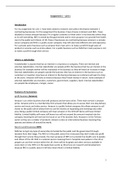
AS and A-Level Chemistry Mark Scheme Instructions for Examiners 1. General The mark scheme for each question shows: • the marks available for each part of the question • the total marks available for the question • the typical answer or answers which are expected • extra information to help the examiner make his or her judgement and help to delineate what is acceptable or not worthy of credit or, in discursive answers, to give an overview of the area in which a mark or marks may be awarded. The extra information in the ‘Comments’ column is aligned to the appropriate answer in the left-hand part of the mark scheme and should only be applied to that item in the mark scheme. You should mark according to the contents of the mark scheme. If you are in any doubt about applying the mark scheme to a particular response, consult your Team Leader. At the beginning of a part of a question a reminder may be given, for example: where consequential marking needs to be considered in a calculation; or the answer may be on the diagram or at a different place on the script. In general the right-hand side of the mark scheme is there to provide those extra details which might confuse the main part of the mark scheme yet may be helpful in ensuring that marking is straightforward and consistent. The use of M1, M2, M3 etc in the right-hand column refers to the marking points in the order in which they appear in the mark scheme. So, M1 refers to the first marking point, M2 the second marking point etc. 2. Emboldening 2.1 In a list of acceptable answers where more than one mark is available ‘any two from’ is used, with the number of marks emboldened. Each of the following bullet points is a potential mark. 2.2 A bold and is used to indicate that both parts of the answer are required to award the mark. 2.3 Alternative answers acceptable for a mark are indicated by the use of OR. Different terms in the mark scheme are shown by a / ; eg allow smooth / free movement. 3. Marking points 3.1 Marking of lists This applies to questions requiring a set number of responses, but for which students have provided extra responses. The general ‘List’ principle to be followed in such a situation is that ‘right + wrong = wrong’. Each error / contradiction negates each correct response. So, if the number of error / contradictions equals or exceeds the number of marks available for the question, no marks can be awarded. However, responses considered to be neutral (often prefaced by ‘Ignore’ in the mark scheme) are not penalised. For example, in a question requiring 2 answers for 2 marks: Correct answers Incorrect answers (ie incorrect rather than neutral) Mark (2) Comment 1 0 1 1 1 1 They have not exceeded the maximum number of responses so there is no penalty. 1 2 0 They have exceeded the maximum number of responses so the extra incorrect response cancels the correct one. 2 0 2 2 1 1 2 2 0 3 0 2 The maximum mark is 2 3 1 1 The incorrect response cancels out one of the two correct responses that gained credit. 3 2 0 Two incorrect responses cancel out the two marks gained. 3 3 0 3.2 Marking procedure for calculations Full marks should be awarded for a correct numerical answer, without any working shown, unless the question states ‘Show your working’ or ‘justify your answer’. In this case, the mark scheme will clearly indicate what is required to gain full credit. If an answer to a calculation is incorrect and working is shown, process mark(s) can usually be gained by correct substitution / working and this is shown in the ‘Comments’ column or by each stage of a longer calculation. 3.3 Errors carried forward, consequential marking and arithmetic errors Allowances for errors carried forward are most likely to be restricted to calculation questions and should be shown by the abbreviation ECF or consequential in the marking scheme. An arithmetic error should be penalised for one mark only unless otherwise amplified in the marking scheme. Arithmetic errors may arise from a slip in a calculation or from an incorrect transfer of a numerical value from data given in a question. 3.4 Equations In questions requiring students to write equations, state symbols are generally ignored unless otherwise stated in the ‘Comments’ column. Examiners should also credit correct equations using multiples and fractions unless otherwise stated in the ‘Comments’ column. 3.5 Oxidation states In general, the sign for an oxidation state will be assumed to be positive unless specifically shown to be negative. 3.6 Interpretation of ‘it’ Answers using the word ‘it’ should be given credit only if it is clear that the ‘it’ refers to the correct subject.
Written for
- Institution
-
University Of California - Berkeley
- Course
-
MBA 1 (MBA1)
Document information
- Uploaded on
- October 3, 2021
- Number of pages
- 29
- Written in
- 2021/2022
- Type
- Exam (elaborations)
- Contains
- Questions & answers
Subjects
-
1 general the mark scheme for each question shows
-
2 emboldening
-
3 marking points 31 marking of lists
-
32 marking procedure for calculations
-
33 errors carried forward
-
consequential marking and a