FINC3017 NOTES
WEEK 1: INTRODUCTION
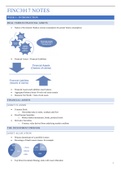
REAL VERSUS FINANCIAL ASSETS
• Nature of Investment: Reduce current consumption for greater future consumption
• Financial Assets = Financial Liabilities
• Financial Assets and Liabilities must balance.
• Aggregated balance sheets à only real assets remain
• Domestic Net Worth = Sum of real assets
FINANCIAL ASSETS
ASSET CLASSES
• Common Stock
o Ownership stake in entity, residual cash flow
• Fixed Income Securities
o Money market instruments, bonds, preferred stock
• Derivative Securities
o Contract, value derived from underlying market condition
THE INVESTMENT PROCESS
ASSET ALLOCATION
• Primary determinant of a portfolio's return
• Percentage of fund in asset classes, for example:
• Top Down Investment Strategy starts with Asset Allocation
1
,SECURITY SELECTION
• Choice of particular securities within asset class
• Security Analysis
o Analysis of the value of securities
• Bottom Up Investment Strategy starts with Security Selection
MARKETS ARE COMPETITIVE
• Risk-Return Trade-Off
o Assets with higher expected returns have higher risk
Average Annual Return Minimum (1931) Maximum (1933)
Stocks About 12% −46% 55%
o Stock portfolios lose money 1 in 4 years on average
o Bonds
§ Lower average rates of return (under 6%)
§ Not lost more than 13% of value in any one year
• Risk-Return Trade-Off
o How do we measure risk?
o How does diversification affect risk?
• In Efficient Markets Securities should
o Be neither under-priced nor overpriced on average
o Reflect all information available to investors
• Your Belief in Market Efficiency à Choice of Investment Management Style
Active Management Passive Management
Markets are... Inefficient Efficient
Security Selection: Actively Seek Undervalued Stocks No Attempt to Find Undervalued Securities
Asset Allocation Market Timing No Attempt to Time Market
THE FINANCIAL CRISIS OF 2008
CHANGES IN HOUSING FINANCE
• Old Way
o Local thrift institutions made mortgage loans to homeowners
o Thrifts possessed a portfolio of long-term mortgage loans
o Thrifts’ main liabilities: Deposits
o “Originate to hold”
• New Way
o Securitisation: Fannie Mae and Freddie Mac bought mortgage loans and bundled them into large pools
o Mortgage-backed securities are tradable claims against the underlying mortgage pool
o “Originate to distribute”
• Securitisation:
• Inclusion of nonconforming “subprime” loans
• Low/No-documentation loans
• Rising loan-to-value ratio
• Adjustable-Rate Mortgages
2
,CASE-SHILLER INDEX OF U.S. HOUSING PRICES
THE FINANCIAL CRISIS OF 2008
• The Shoe Drops
o September 7: Fannie Mae and Freddie Mac put into conservatorship
o Lehman Brothers and Merrill Lynch verged on bankruptcy
o September 17: Government lends $85 billion to AIG
o Money market panic freezes short-term financing market
LIBOR, T-BILL RATES AND THE TED SPREAD
CUMULATIVE RETURNS
Cumulative returns on a $1 investment in the S&P 500 index
THE MONEY MARKET
• Subsector of the fixed-income market
o Short-term
o Liquid
o Low risk
o Often have large denominations
3
, TREASURY BILLS
Treasury Bills
Issuer: Federal Government
Denomination: Commonly $10,000; $1,000
Maturity: 4, 13, 26 or 52 weeks
Liquidity: High
Default Risk: None
Interest Type: Discount
Taxation: Owed: Federal; Exempt: State, Local
CERTIFICATES OF DEPOSIT (CDS)
Certificates of Deposit
Issuer: Depository Institutions
Denomination: Any, $100,000 or more marketable
Maturity: Varies, Typically 14-day Minimum
Liquidity: High for CDs <3 months, if marketable
Default Risk: First $250,000 FDIC insured
Interest Type: Add on
COMMERCIAL PAPER
Commercial Paper
Issuer: Large creditworthy corps., financial institutions
Denomination: Minimum $100,000
Maturity: Maximum 270 days, usually 1-2 months
Liquidity: CP < 3 months liquid if marketable
Default Risk: Unsecured, rated, mostly high quality
Interest Type: Discount
Taxation: Owed: Federal, State, Local
• New innovation: Asset-backed commercial paper
INSTRUMENTS
• Bankers’ Acceptances
o Purchaser authorises a bank to pay a seller for goods at later date (time draft)
o When purchaser’s bank “accepts” draft, it becomes contingent liability of the bank (and marketable)
• Eurodollars
o Dollar-denominated time deposits held outside U.S.
o Pay higher interest rate than U.S. deposits
• Federal Funds
o Trading in reserves held at the Federal Reserve*
o Key interest rate for economy
• LIBOR (London Interbank Offer Rate)
o Rate at which large banks in London (and elsewhere) lend to each other
o Base rate for many loans and derivatives
• *Depository institutions must maintain deposits with Federal Reserve Bank
4
WEEK 1: INTRODUCTION
REAL VERSUS FINANCIAL ASSETS
• Nature of Investment: Reduce current consumption for greater future consumption
• Financial Assets = Financial Liabilities
• Financial Assets and Liabilities must balance.
• Aggregated balance sheets à only real assets remain
• Domestic Net Worth = Sum of real assets
FINANCIAL ASSETS
ASSET CLASSES
• Common Stock
o Ownership stake in entity, residual cash flow
• Fixed Income Securities
o Money market instruments, bonds, preferred stock
• Derivative Securities
o Contract, value derived from underlying market condition
THE INVESTMENT PROCESS
ASSET ALLOCATION
• Primary determinant of a portfolio's return
• Percentage of fund in asset classes, for example:
• Top Down Investment Strategy starts with Asset Allocation
1
,SECURITY SELECTION
• Choice of particular securities within asset class
• Security Analysis
o Analysis of the value of securities
• Bottom Up Investment Strategy starts with Security Selection
MARKETS ARE COMPETITIVE
• Risk-Return Trade-Off
o Assets with higher expected returns have higher risk
Average Annual Return Minimum (1931) Maximum (1933)
Stocks About 12% −46% 55%
o Stock portfolios lose money 1 in 4 years on average
o Bonds
§ Lower average rates of return (under 6%)
§ Not lost more than 13% of value in any one year
• Risk-Return Trade-Off
o How do we measure risk?
o How does diversification affect risk?
• In Efficient Markets Securities should
o Be neither under-priced nor overpriced on average
o Reflect all information available to investors
• Your Belief in Market Efficiency à Choice of Investment Management Style
Active Management Passive Management
Markets are... Inefficient Efficient
Security Selection: Actively Seek Undervalued Stocks No Attempt to Find Undervalued Securities
Asset Allocation Market Timing No Attempt to Time Market
THE FINANCIAL CRISIS OF 2008
CHANGES IN HOUSING FINANCE
• Old Way
o Local thrift institutions made mortgage loans to homeowners
o Thrifts possessed a portfolio of long-term mortgage loans
o Thrifts’ main liabilities: Deposits
o “Originate to hold”
• New Way
o Securitisation: Fannie Mae and Freddie Mac bought mortgage loans and bundled them into large pools
o Mortgage-backed securities are tradable claims against the underlying mortgage pool
o “Originate to distribute”
• Securitisation:
• Inclusion of nonconforming “subprime” loans
• Low/No-documentation loans
• Rising loan-to-value ratio
• Adjustable-Rate Mortgages
2
,CASE-SHILLER INDEX OF U.S. HOUSING PRICES
THE FINANCIAL CRISIS OF 2008
• The Shoe Drops
o September 7: Fannie Mae and Freddie Mac put into conservatorship
o Lehman Brothers and Merrill Lynch verged on bankruptcy
o September 17: Government lends $85 billion to AIG
o Money market panic freezes short-term financing market
LIBOR, T-BILL RATES AND THE TED SPREAD
CUMULATIVE RETURNS
Cumulative returns on a $1 investment in the S&P 500 index
THE MONEY MARKET
• Subsector of the fixed-income market
o Short-term
o Liquid
o Low risk
o Often have large denominations
3
, TREASURY BILLS
Treasury Bills
Issuer: Federal Government
Denomination: Commonly $10,000; $1,000
Maturity: 4, 13, 26 or 52 weeks
Liquidity: High
Default Risk: None
Interest Type: Discount
Taxation: Owed: Federal; Exempt: State, Local
CERTIFICATES OF DEPOSIT (CDS)
Certificates of Deposit
Issuer: Depository Institutions
Denomination: Any, $100,000 or more marketable
Maturity: Varies, Typically 14-day Minimum
Liquidity: High for CDs <3 months, if marketable
Default Risk: First $250,000 FDIC insured
Interest Type: Add on
COMMERCIAL PAPER
Commercial Paper
Issuer: Large creditworthy corps., financial institutions
Denomination: Minimum $100,000
Maturity: Maximum 270 days, usually 1-2 months
Liquidity: CP < 3 months liquid if marketable
Default Risk: Unsecured, rated, mostly high quality
Interest Type: Discount
Taxation: Owed: Federal, State, Local
• New innovation: Asset-backed commercial paper
INSTRUMENTS
• Bankers’ Acceptances
o Purchaser authorises a bank to pay a seller for goods at later date (time draft)
o When purchaser’s bank “accepts” draft, it becomes contingent liability of the bank (and marketable)
• Eurodollars
o Dollar-denominated time deposits held outside U.S.
o Pay higher interest rate than U.S. deposits
• Federal Funds
o Trading in reserves held at the Federal Reserve*
o Key interest rate for economy
• LIBOR (London Interbank Offer Rate)
o Rate at which large banks in London (and elsewhere) lend to each other
o Base rate for many loans and derivatives
• *Depository institutions must maintain deposits with Federal Reserve Bank
4