
PYC3703 – COGNITIVE PSYCHOLOGY
CHAPTER 12: PROBLEM SOLVING
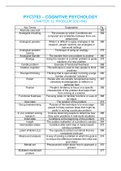
Key Terms Explanation Pg.
Alternate uses test 395
Analogical encoding The process by which 2 problems are 384
compared and similarities between them are
determined
Analogical paradox While it is difficult to apply analogies in lab 386
research, people routinely use analogies in
real-world settings
Analogical problem Technique of using an analogy 379
solving
Analogical transfer The transfer from one problem to another 380
Analogy Using the solution to a similar problem to guide 379
solutions of a new problem
Candle problem Example of functional fixedness 368
Creative cognition This technique is used to train people to think 393
creatively
Divergent thinking Thinking that is open-ended, involving a large 390
number of potential “solutions”
Expert People who are socially recognised as being 387
extremely knowledgeable or skilled in a
particular field
Fixation People’s tendency to focus on a specific 368
characteristic of the problem that keeps them
from arriving at a solution
Functional fixedness Focusing solely on familiar functions or uses of 368
an object
Goal state The solution of the problem 372
Group brainstorming Purpose of this technique is to encourage 392
people to freely express ideas that might be
useful in solving a particular problem
In vivo problem solving Involves observing people to determine how 386
research they solve problems in real-world situations
Initial state Conditions at the beginning of the problem 372
Insight The sudden realisation of a problem’s solution 364
Intermediate states Condition after each step is made toward 373
solving a problem
Latent inhibition (LI) The capacity to screen out stimuli that are 396
considered irrelevant
Means-end analysis A way of solving a problem in which the goal is 374
to reduce the difference between the initial and
goal states
Mental set Preconceived notion about how to approach a 370
problem
Mutilated checkboard 377
problem
, Operators Actions that take the problem from one state to 372
another, usually governed by rules
Pre-inventive forms Ideas that precede the creating of a finished 394
creative product
Problem Occurs when there is an obstacle between a 363
present state and a goal, and it is not
immediately obvious how to get around the
obstacle
Problem space All possible states that could occur when 373
solving a problem
Radiation problem 380
Restructuring Changing the problem’s representation 364
Savant syndrome In which people with autism or other mental 397
disorders are able to achieve extraordinary
feats, or exhibit great artistic talent or
mathematical ability
Source problem A similar type of problem in the recent past 380
that illustrates a way to solve the target
problem
Structural features The underlying principle that governs the 383
solution
Subgoals Small goals that help create intermediate 374
states that are closer to the goal
Surface features 382
Target problem The problem the person is trying to solve 380
Think-aloud protocol Participants are asked to say out loud what 378
they are thinking while solving a problem
Tower of Hanoi problem 372
Two-string problem Example of functional fixedness 369
Water jug problem Example of how mental set can arise out of the 370
problem-solving situation itself
What Is A Problem?
A problem occurs when there is an obstacle between a present state and a
goal
Not immediately obvious how to get around it
The Gestalt Approach: Problem Solving as Representation and Restructuring
Problem solving was about how people represent a problem in their mind and
how solving a problem involves a reorganisation or restructuring of this
representation
Representing a Problem In the Mind:
How problems are represented in the mind is different for different people
Success in solving a problem is influenced by how it is represented in the
person’s mind
The circle problem – pg. 364
Restructuring – the process of changing the problem’s representation
CHAPTER 12: PROBLEM SOLVING
Key Terms Explanation Pg.
Alternate uses test 395
Analogical encoding The process by which 2 problems are 384
compared and similarities between them are
determined
Analogical paradox While it is difficult to apply analogies in lab 386
research, people routinely use analogies in
real-world settings
Analogical problem Technique of using an analogy 379
solving
Analogical transfer The transfer from one problem to another 380
Analogy Using the solution to a similar problem to guide 379
solutions of a new problem
Candle problem Example of functional fixedness 368
Creative cognition This technique is used to train people to think 393
creatively
Divergent thinking Thinking that is open-ended, involving a large 390
number of potential “solutions”
Expert People who are socially recognised as being 387
extremely knowledgeable or skilled in a
particular field
Fixation People’s tendency to focus on a specific 368
characteristic of the problem that keeps them
from arriving at a solution
Functional fixedness Focusing solely on familiar functions or uses of 368
an object
Goal state The solution of the problem 372
Group brainstorming Purpose of this technique is to encourage 392
people to freely express ideas that might be
useful in solving a particular problem
In vivo problem solving Involves observing people to determine how 386
research they solve problems in real-world situations
Initial state Conditions at the beginning of the problem 372
Insight The sudden realisation of a problem’s solution 364
Intermediate states Condition after each step is made toward 373
solving a problem
Latent inhibition (LI) The capacity to screen out stimuli that are 396
considered irrelevant
Means-end analysis A way of solving a problem in which the goal is 374
to reduce the difference between the initial and
goal states
Mental set Preconceived notion about how to approach a 370
problem
Mutilated checkboard 377
problem
, Operators Actions that take the problem from one state to 372
another, usually governed by rules
Pre-inventive forms Ideas that precede the creating of a finished 394
creative product
Problem Occurs when there is an obstacle between a 363
present state and a goal, and it is not
immediately obvious how to get around the
obstacle
Problem space All possible states that could occur when 373
solving a problem
Radiation problem 380
Restructuring Changing the problem’s representation 364
Savant syndrome In which people with autism or other mental 397
disorders are able to achieve extraordinary
feats, or exhibit great artistic talent or
mathematical ability
Source problem A similar type of problem in the recent past 380
that illustrates a way to solve the target
problem
Structural features The underlying principle that governs the 383
solution
Subgoals Small goals that help create intermediate 374
states that are closer to the goal
Surface features 382
Target problem The problem the person is trying to solve 380
Think-aloud protocol Participants are asked to say out loud what 378
they are thinking while solving a problem
Tower of Hanoi problem 372
Two-string problem Example of functional fixedness 369
Water jug problem Example of how mental set can arise out of the 370
problem-solving situation itself
What Is A Problem?
A problem occurs when there is an obstacle between a present state and a
goal
Not immediately obvious how to get around it
The Gestalt Approach: Problem Solving as Representation and Restructuring
Problem solving was about how people represent a problem in their mind and
how solving a problem involves a reorganisation or restructuring of this
representation
Representing a Problem In the Mind:
How problems are represented in the mind is different for different people
Success in solving a problem is influenced by how it is represented in the
person’s mind
The circle problem – pg. 364
Restructuring – the process of changing the problem’s representation



