

CH-1: MATTER IN OUR SURROUNDING CHEMISTRY / CLASS-IX
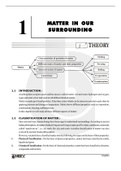
MATTER IN OUR
SURROUNDING
Melting
Characteristics of particles of matter
Different states of matter and their properties Freezing
Matter
Interconversion of matter Boiling
Latent heat Evaporation
Condensation
1.1 INTRODUCTION :
Anything that occupies space and has mass is called matter.Air and water, hydrogen and oxygen,
sugar and sand, silver and steel are all different kind of matter.
Matter is made up of small particles. It has three states which can be interconverted into each other by
applying pressure and change in temperature. Matter shows different properties such as evaporation,
condensation, freezing, sublimation etc.
In this chapter we will study all these different aspects of matter.
1.2 CLASSIFICATION OF MATTER :
Since ancient times, human beings have been eager to understand surroundings.According to ancient
Indian philosophers,all matterwhetherlivingornon-livingis madeupoffivebasicconstituentscommonly
called “panch tatvas”, i.e., air, earth, fire, sky and water.A similar classification of matter was also
evolved by ancient Greek philosophers.
However, scientists have classified matter into the following two types on the basis of their properties.
1. Physical Classification : On the basis of physical properties, matter has been classified as solids,
liquids and gases.
2. Chemical Classification : On the basis of chemical properties, matter has been classified as elements,
compounds and mixture.
PAGE#1
A Pre-Foundation Program
,CH-1: MATTER IN OUR SURROUNDING CHEMISTRY / CLASS-IX
Classification of Matter
Matter
Physical classification Chemical classification
Solids Liquids Gases Mixtures Pure
(copper, iron, stone, (Water, petrol, (Nitrogen, oxygen, substances
wood etc.) kerosene oil, etc.) hydrogen etc.)
Homogeneous Heterogeneous Compounds Elements
mixture mixture (Water, salt, sugar,
(Sugar solution, (Soil, blood, dirt, etc.)
air, saline, etc.)
water, etc.) Non-metals Metalloids
Metals
(Gold, iron, copper, (Sulphur, (Boron, arsenic
silver, etc.) Phosphorous, Iodine) germanium, silicon,
etc.)
1.3 PHYSICAL NATURE OF MATTER :
Matter canbeclassifiedinanumberofways.Ancient Indianphilosophers saidthat allthematter(padarth),
living or non-living was made up of five basic elements, air, earth, sky, fire and water. Modern day
scientists classifymatter in two ways, on the basis of physical properties and on the basis of its chemical
properties. On the basis of physical properties matter is classified as solid, liquid and gas.
Matter is made up of particles :
The universe in made up of matter and energy and the presence of which can be realised by one or
more of our five senses.
Anything that we can see or the presence of which can be felt by touching, smelling, hearing or taste
is called matter.
All matter is composed of submicroscopic particles called molecules.
How small are these particles of matter?
The particles of matter are very, very small. The very, very small size of the particles of matter can be
shown by performing the following experiment. Potassium permanganate is a kind of matter. We take
2 or 3 small crystals of it and dissolve in 100 ml of water in a beaker. We will get a deep purple
coloured solution of potassium permanganate in water. Take 10 ml of deep purple solution of it and
mix with 90 ml of water in another beaker, to dilute it. Due to this dilution, the colour of potassium
permanganate solution becomes lighter. Now take 10 ml of solution from this beaker and repeat the
same procedure. In this way, we get a very dilute solution of potassium permangnate in water but the
water is still coloured (it has a light pink colour now).
This experiment shows that just 2 or 3 tiny crystals of potassium permanganate can impart colour to
a large volume of water. From this we can conclude that each potassium permanganate crystal itself
must be made up of millions of small particles which keep on spreading and imparting colour to more
and more water (on dilution).
Very dark Light Lighter Lightest
Figure. With each dilution, though the colour becomes light, it is still visible.
PAGE#2
A Pre-Foundation Program
,CH-1: MATTER IN OUR SURROUNDING CHEMISTRY / CLASS-IX
1.4 CHARACTERISTICS OF PARTICLES OF MATTER :
According to Kinetic Theory of Matter, the particles of matter have the following four characteristics.
(i) The particles of matter are very, very small :
The Matteris composed of small particles :To understandparticle nature, let us perform one experiment.
Take a beaker full of water. Now place a small crystal of blue vitriol (copper sulphate) in the water.
You will observe that the water begins to become blue coloured and slowly the size of the crystal
becomes smallerand smaller.The crystal has divideditself intonumber of smaller particles and ultimately
it dissolves in water. This experiment suggests that matter is composed of small particles.
(ii) The particles of matter have spaces between them :
There are present spaces in between the particles of matter. The size and number of these spaces,
however, differ from one kind of matter to the other.
Experiment (1) – Take a piece of chalk (used for writting on black board) and dip it into water. Some
water is absorbed bythe chalk. There are vacant spaces or pores in the chalk which are occupied by the
water.
Experiment (2) – Take a wide mouthed test tube, almost half filled with water. Now put a sugar cube
in the test tube and mark the water level with a glass marking pencil. The sugar cube will dissolve in
water and the level of water will go down to a small extent. Why it so happened? There are vacant
spaces between the particles of water. This vacant space is occupied by the particles of the sugar and
water level goes down.
Water level
mark Beaker
100 ml water stirring with Sugar
(A) 50 g sugar (B) glass rod (C) solution
......
............
......
......
......
............ ......
......
......
......
......
......
............ Sugar getting
dissolved
(iii) The particles of matter are constantly moving :
The best evidence for the existence and movement of particles in liquids was given by Robert Brown
in 1827. Robert Brown suspended extremely small pollen grains in water. On looking through the
microscope, it was found that the pollen grains were moving rapidly throughout water in a very
irregular manner (or zig-zag way) see Figure. It was also observed that warmer the water, faster the
pollen grains move on the surface of water.
The movement of pollen grains on the surface of water can
Pollen grains
be explained as follows : Water is made up of tiny particles
which are moving very fast (The water particles or water
molecules themselves are invisible under the microscope
because they are very, very small). The pollen grains move
Invisible moving
on the surface of water because they are constantly being hit particles of water
by the fast moving particles of water. So, through the water
particles (or water molecules) are too small to be seen, but Figure : Brownian Motion
their effect on the pollen grains can be seen clearly.
The random motion of visible particles (pollen grains) caused bythe much smaller invisible particles of
water is an example of Brownainmotion (after the nameof the scientist Robert Brown who firstobserved
this phenomenon).
Brownian motion can also be observed in gases. Sometimes, when a beam of sunlight enters a room, we
can see tinydust particles suspended in air which are moving in gases (because air is a gas). The tinydust
particles move here and there because they are constantly hit bythe fast moving particles of air.
PAGE#3
A Pre-Foundation Program
, CH-1: MATTER IN OUR SURROUNDING CHEMISTRY / CLASS-IX
Though we cannot see the particles (or molecules) of air which are extremely small, but we can see
the effect produced by their continuous and fast motion. The rapid and random movement of tiny dust
particles (or smoke) suspended in air shows that air is made up of particles of air are moving constantly.
We can now define Brownian motion as follow. The zig-zag movement of the small particles
suspendecd in a liquid (or gas) is called Brownian motion. Brownian motion increases on
increasing the temperature.
Kinetic energy :- Kinetic energy is energy of motion and is usually defined as the
work that will be done by the body possessing the energy when it is brought to rest.
or
Energy which a body possesses by virtue of being in motion.
1
For a body of mass m having a speed v, the kinetic energy is = mν 2 .
2
Activity :–
(a) If an incense stick (Agarbatti) is lighted and placed in one corner of a room, its pleasant smell spreads
in the whole room quickly. It demonstrates that the particles of matter possess motion.A burning
incense stick produces some gases (vapour) having pleasant smell. The particles of these gases due to
motion spread in the entire room and their presence can be felt by sensing the smell.
(b) To demonstrate that kinetic Energy of particles increases with increase in temperature.
(i) Take two beakers. To one beaker add 100 ml of cold water and to the other beaker add
100 ml of hot water.
(ii) Now add a crystal of potassium permanganate to both the beakers.
Conclusion :–
It is observed that purple colour of potassium permanganate starts spreading and after sometime the
entire solution become purple. The rate of mixing is faster in case of hot water. This experiment
demonstrates that the particle of matter possess motion and that the kinetic energy of the particles
increase with increase in temperature.
Form these activities it is observed that when two different forms of matter are brought in contact,
they intermix spontaneously. This intermixing is possible due to motion of the particles of matter and
also due to the spaces between them. The intermixing takes place due to movement of particles of
one form into the spaces between the particles of the other form of matter.
"This spontaneous intermixing of particles of two different types of matter is called diffusion".
The rate of diffusion becomes faster with increase in temperature because at higher temperature, the
particles have more energy and hence move faster.
Illustration 1 : What happens to the sugar when it dissolves in water? Where
does the sugar go? What information do you get about the nature of
matter from the dissolution of sugar in water?
Solution
(a) When sugar dissolves in water, its tinyparticles break off from the solid ‘sugar
crystals’
(b) The sugar particles go into the space between the particles of water and mix
with them (to form sugar solution)
(c) The dissolution of sugar tells us that :
(i) The matter (here sugar and water) is made up of small particles.
(ii) The particles of matter (here water) have space between them.
PAGE#4
A Pre-Foundation Program
MATTER IN OUR
SURROUNDING
Melting
Characteristics of particles of matter
Different states of matter and their properties Freezing
Matter
Interconversion of matter Boiling
Latent heat Evaporation
Condensation
1.1 INTRODUCTION :
Anything that occupies space and has mass is called matter.Air and water, hydrogen and oxygen,
sugar and sand, silver and steel are all different kind of matter.
Matter is made up of small particles. It has three states which can be interconverted into each other by
applying pressure and change in temperature. Matter shows different properties such as evaporation,
condensation, freezing, sublimation etc.
In this chapter we will study all these different aspects of matter.
1.2 CLASSIFICATION OF MATTER :
Since ancient times, human beings have been eager to understand surroundings.According to ancient
Indian philosophers,all matterwhetherlivingornon-livingis madeupoffivebasicconstituentscommonly
called “panch tatvas”, i.e., air, earth, fire, sky and water.A similar classification of matter was also
evolved by ancient Greek philosophers.
However, scientists have classified matter into the following two types on the basis of their properties.
1. Physical Classification : On the basis of physical properties, matter has been classified as solids,
liquids and gases.
2. Chemical Classification : On the basis of chemical properties, matter has been classified as elements,
compounds and mixture.
PAGE#1
A Pre-Foundation Program
,CH-1: MATTER IN OUR SURROUNDING CHEMISTRY / CLASS-IX
Classification of Matter
Matter
Physical classification Chemical classification
Solids Liquids Gases Mixtures Pure
(copper, iron, stone, (Water, petrol, (Nitrogen, oxygen, substances
wood etc.) kerosene oil, etc.) hydrogen etc.)
Homogeneous Heterogeneous Compounds Elements
mixture mixture (Water, salt, sugar,
(Sugar solution, (Soil, blood, dirt, etc.)
air, saline, etc.)
water, etc.) Non-metals Metalloids
Metals
(Gold, iron, copper, (Sulphur, (Boron, arsenic
silver, etc.) Phosphorous, Iodine) germanium, silicon,
etc.)
1.3 PHYSICAL NATURE OF MATTER :
Matter canbeclassifiedinanumberofways.Ancient Indianphilosophers saidthat allthematter(padarth),
living or non-living was made up of five basic elements, air, earth, sky, fire and water. Modern day
scientists classifymatter in two ways, on the basis of physical properties and on the basis of its chemical
properties. On the basis of physical properties matter is classified as solid, liquid and gas.
Matter is made up of particles :
The universe in made up of matter and energy and the presence of which can be realised by one or
more of our five senses.
Anything that we can see or the presence of which can be felt by touching, smelling, hearing or taste
is called matter.
All matter is composed of submicroscopic particles called molecules.
How small are these particles of matter?
The particles of matter are very, very small. The very, very small size of the particles of matter can be
shown by performing the following experiment. Potassium permanganate is a kind of matter. We take
2 or 3 small crystals of it and dissolve in 100 ml of water in a beaker. We will get a deep purple
coloured solution of potassium permanganate in water. Take 10 ml of deep purple solution of it and
mix with 90 ml of water in another beaker, to dilute it. Due to this dilution, the colour of potassium
permanganate solution becomes lighter. Now take 10 ml of solution from this beaker and repeat the
same procedure. In this way, we get a very dilute solution of potassium permangnate in water but the
water is still coloured (it has a light pink colour now).
This experiment shows that just 2 or 3 tiny crystals of potassium permanganate can impart colour to
a large volume of water. From this we can conclude that each potassium permanganate crystal itself
must be made up of millions of small particles which keep on spreading and imparting colour to more
and more water (on dilution).
Very dark Light Lighter Lightest
Figure. With each dilution, though the colour becomes light, it is still visible.
PAGE#2
A Pre-Foundation Program
,CH-1: MATTER IN OUR SURROUNDING CHEMISTRY / CLASS-IX
1.4 CHARACTERISTICS OF PARTICLES OF MATTER :
According to Kinetic Theory of Matter, the particles of matter have the following four characteristics.
(i) The particles of matter are very, very small :
The Matteris composed of small particles :To understandparticle nature, let us perform one experiment.
Take a beaker full of water. Now place a small crystal of blue vitriol (copper sulphate) in the water.
You will observe that the water begins to become blue coloured and slowly the size of the crystal
becomes smallerand smaller.The crystal has divideditself intonumber of smaller particles and ultimately
it dissolves in water. This experiment suggests that matter is composed of small particles.
(ii) The particles of matter have spaces between them :
There are present spaces in between the particles of matter. The size and number of these spaces,
however, differ from one kind of matter to the other.
Experiment (1) – Take a piece of chalk (used for writting on black board) and dip it into water. Some
water is absorbed bythe chalk. There are vacant spaces or pores in the chalk which are occupied by the
water.
Experiment (2) – Take a wide mouthed test tube, almost half filled with water. Now put a sugar cube
in the test tube and mark the water level with a glass marking pencil. The sugar cube will dissolve in
water and the level of water will go down to a small extent. Why it so happened? There are vacant
spaces between the particles of water. This vacant space is occupied by the particles of the sugar and
water level goes down.
Water level
mark Beaker
100 ml water stirring with Sugar
(A) 50 g sugar (B) glass rod (C) solution
......
............
......
......
......
............ ......
......
......
......
......
......
............ Sugar getting
dissolved
(iii) The particles of matter are constantly moving :
The best evidence for the existence and movement of particles in liquids was given by Robert Brown
in 1827. Robert Brown suspended extremely small pollen grains in water. On looking through the
microscope, it was found that the pollen grains were moving rapidly throughout water in a very
irregular manner (or zig-zag way) see Figure. It was also observed that warmer the water, faster the
pollen grains move on the surface of water.
The movement of pollen grains on the surface of water can
Pollen grains
be explained as follows : Water is made up of tiny particles
which are moving very fast (The water particles or water
molecules themselves are invisible under the microscope
because they are very, very small). The pollen grains move
Invisible moving
on the surface of water because they are constantly being hit particles of water
by the fast moving particles of water. So, through the water
particles (or water molecules) are too small to be seen, but Figure : Brownian Motion
their effect on the pollen grains can be seen clearly.
The random motion of visible particles (pollen grains) caused bythe much smaller invisible particles of
water is an example of Brownainmotion (after the nameof the scientist Robert Brown who firstobserved
this phenomenon).
Brownian motion can also be observed in gases. Sometimes, when a beam of sunlight enters a room, we
can see tinydust particles suspended in air which are moving in gases (because air is a gas). The tinydust
particles move here and there because they are constantly hit bythe fast moving particles of air.
PAGE#3
A Pre-Foundation Program
, CH-1: MATTER IN OUR SURROUNDING CHEMISTRY / CLASS-IX
Though we cannot see the particles (or molecules) of air which are extremely small, but we can see
the effect produced by their continuous and fast motion. The rapid and random movement of tiny dust
particles (or smoke) suspended in air shows that air is made up of particles of air are moving constantly.
We can now define Brownian motion as follow. The zig-zag movement of the small particles
suspendecd in a liquid (or gas) is called Brownian motion. Brownian motion increases on
increasing the temperature.
Kinetic energy :- Kinetic energy is energy of motion and is usually defined as the
work that will be done by the body possessing the energy when it is brought to rest.
or
Energy which a body possesses by virtue of being in motion.
1
For a body of mass m having a speed v, the kinetic energy is = mν 2 .
2
Activity :–
(a) If an incense stick (Agarbatti) is lighted and placed in one corner of a room, its pleasant smell spreads
in the whole room quickly. It demonstrates that the particles of matter possess motion.A burning
incense stick produces some gases (vapour) having pleasant smell. The particles of these gases due to
motion spread in the entire room and their presence can be felt by sensing the smell.
(b) To demonstrate that kinetic Energy of particles increases with increase in temperature.
(i) Take two beakers. To one beaker add 100 ml of cold water and to the other beaker add
100 ml of hot water.
(ii) Now add a crystal of potassium permanganate to both the beakers.
Conclusion :–
It is observed that purple colour of potassium permanganate starts spreading and after sometime the
entire solution become purple. The rate of mixing is faster in case of hot water. This experiment
demonstrates that the particle of matter possess motion and that the kinetic energy of the particles
increase with increase in temperature.
Form these activities it is observed that when two different forms of matter are brought in contact,
they intermix spontaneously. This intermixing is possible due to motion of the particles of matter and
also due to the spaces between them. The intermixing takes place due to movement of particles of
one form into the spaces between the particles of the other form of matter.
"This spontaneous intermixing of particles of two different types of matter is called diffusion".
The rate of diffusion becomes faster with increase in temperature because at higher temperature, the
particles have more energy and hence move faster.
Illustration 1 : What happens to the sugar when it dissolves in water? Where
does the sugar go? What information do you get about the nature of
matter from the dissolution of sugar in water?
Solution
(a) When sugar dissolves in water, its tinyparticles break off from the solid ‘sugar
crystals’
(b) The sugar particles go into the space between the particles of water and mix
with them (to form sugar solution)
(c) The dissolution of sugar tells us that :
(i) The matter (here sugar and water) is made up of small particles.
(ii) The particles of matter (here water) have space between them.
PAGE#4
A Pre-Foundation Program


