
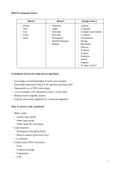
IB ESS command terms:
Group 1 Group 2 Groups 3 and 4
- Define - Annotate - Analyse
- State - Apply - Comment
- List - Calculate - Compare and contrast
- Label - Describe - Construct
- Draw - Distinguish - Demonstrate
- Identify/interpret - Design
- Outline - Determine
- Discuss
- Evaluate
- Explain
- Examine
- Justify
- Suggest
- To what extent?
Evaluation criteria for long answer questions:
- Knowledge and understanding of issues and concepts
- Knowledge statements linked to the question and each other
- Appropriate use of ESS terminology
- Use of examples with explanation (why is it relevant?)
- Balanced and insightful analysis
- Explicit conclusions supported by a balanced argument
How to answer essay questions?
- Make a plan:
- Outline main points
- Order these points
- Think about the conclusion
- Good structure:
- Introduction (should be brief)
- Body/evaluation (pros and cons)
- Conclusion
- Cohesiveness (PEEL structure)
- Point
- Evidence/example
- Explanation
- Link
1

, 1.1 Environmental value systems
- Environmental value system: worldview or paradigm that shapes the way an individual or
group of people perceive and evaluate environmental issues.
- Ecocentrists: put ecology and nature as central to humanity and emphasize a less materialistic
approach to life with greater self-sufficiency of societies.
- Anthropocentric: humans must sustainable manage the global system.
- Technocentric: technological developments can provide solutions to environmental problems.
1.2 Systems and models
- System: set of inter-related parts working together to make a complex whole.
- Open systems: exchange matter and energy with its surroundings (e.g. ecosystems).
- Steady-state equilibrium: continuous inout and output of matter and energy, for which the
system remains more-or-less in constant state.
- Closed system: exchanges energy but not matter with the environment (e.g. Earth).
- Isolated system: exchanges neither matter nor energy with its environment (e.g. The Universe).
- Both matter and energy flow through ecosystems as:
- Transfers: when energy or matter flow and change location, without changing state.
- Transformations: when energy or matter flows and changes its state.
- Model: simplified version of a system. Useful to understand how a system works and predict
what happens in case of change.
1.3 Energy and equilibria
- First law of thermodynamics (principle of conservation of energy): energy in an isolated system
can be transformed, but cannot be created or destroyed.
- Second law of thermodynamics: the entropy of a system increases over time. An increase in
entropy arising from energy transformations reduces the energy available to do work.
- Entropy: measure of the amount of disorder in a system.
2

, - Equilibrium: tendency of a system to return to an original state following disturbance. A state of
balance exists among the components of the system.
- Stable equilibrium: system returns to the same equilibrium after disturbance.
- Unstable equilibrium: system returns to a new equilibrium after disturbance.
- Feedback loop: when information that starts a reaction in turn may input more information,
starting another reaction.
- Positive feedback: changes a system to a new state, destabilizing, as they increase in change.
- Negative feedback: return the system to its original state, stabilizing. as they reduce change.
- Resilience of a system: measures how a system responds to a disturbance. The higher the
resilience, the more disturbance it can deal with. Diversity and the size of storages within
systems can contribute to their resilience.
- Tipping point: when the changes in a system tip the equilibrium over a threshold, transforming it
into a different system.
1.4 Sustainability
- Sustainability: use and management of resources at a rate that allows full natural replacement of
the resources exploited and full recovery of the ecosystems affected by their use and extraction.
- Natural capital: natural resources that can produce a sustainable natural income.
- Natural income: yield obtained from natural resources.
- Environmental impact assessment (EIA): report prepared before a development project to change
the use of land. They assess the environmental, social, and economic impacts of the project—
predicting and evaluating possible impacts.
- Ecological footprints: area of land and water required to sustainably provide all resources at the
rate at which they are being consumed by given population. If it is greater than the area available
to the population, there is unsustainability. It consists of three main tasks:
- Identifying impacts
- Predicting the scale of potential impact
3



