

Unit 1: Circular Flow models, National Account Aggregates and the Multiplier
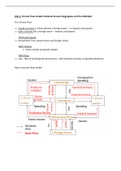
The Circular Flow
Þ closed economy is a flow without a foreign sector – no imports and exports.
Þ open economy has a foreign sector – imports and exports.
FOUR participants
Þ Households, firms, government, and foreign sector.
TWO markets
Þ factor market and goods market.
TWO flows
Þ real – flow of actual goods and services - and monetary (money) in opposite directions.
Open economic flow model
, Leakages: Injections:
money that flows out of the system, e.g. Injections (J) = money that flows into the
Savings (S), Tax (T) and Imports M. system, e.g. Investment (I), Government
spending (G) and Exports (X).
To maintain equilibrium: (S + T + M) = (I + G + X)
If L=J: Then Expenditure/Total Spending = C + I + G + (X-Z)
If (S + T + M) > ( I + G + X) then: Money flows out
• Fewer goods and services are produced
• Fewer people are employed
• Businesses operate below capacity
• National Income decreases
If (S + T + M) < ( I + G + X) then: Money flows in
• More goods and services are produced
• More people are employed
• Capacity of businesses are expanded
• National Income Increases
GDP
The total value of final goods and services produced within the borders of a country in a specific
time period, usually 1 year
Real vs. Nominal GDP
When you want to determine economic growth= USE REAL FIGURES
Nominal vs. Real:
- Inflation causes prices of goods & services to increase annually
- Nominal values include inflation, leading to a misleading figure
- Real values are the correct values, without the effect of inflation
Formula: Nominal value x 100/CPI
E.g. 250 000 million x 100/115 = 217 391 million Real Value
Economic growth
Real GDP current – Real GDP previous / Real GDP previous x 100
The Circular Flow
Þ closed economy is a flow without a foreign sector – no imports and exports.
Þ open economy has a foreign sector – imports and exports.
FOUR participants
Þ Households, firms, government, and foreign sector.
TWO markets
Þ factor market and goods market.
TWO flows
Þ real – flow of actual goods and services - and monetary (money) in opposite directions.
Open economic flow model
, Leakages: Injections:
money that flows out of the system, e.g. Injections (J) = money that flows into the
Savings (S), Tax (T) and Imports M. system, e.g. Investment (I), Government
spending (G) and Exports (X).
To maintain equilibrium: (S + T + M) = (I + G + X)
If L=J: Then Expenditure/Total Spending = C + I + G + (X-Z)
If (S + T + M) > ( I + G + X) then: Money flows out
• Fewer goods and services are produced
• Fewer people are employed
• Businesses operate below capacity
• National Income decreases
If (S + T + M) < ( I + G + X) then: Money flows in
• More goods and services are produced
• More people are employed
• Capacity of businesses are expanded
• National Income Increases
GDP
The total value of final goods and services produced within the borders of a country in a specific
time period, usually 1 year
Real vs. Nominal GDP
When you want to determine economic growth= USE REAL FIGURES
Nominal vs. Real:
- Inflation causes prices of goods & services to increase annually
- Nominal values include inflation, leading to a misleading figure
- Real values are the correct values, without the effect of inflation
Formula: Nominal value x 100/CPI
E.g. 250 000 million x 100/115 = 217 391 million Real Value
Economic growth
Real GDP current – Real GDP previous / Real GDP previous x 100


