Problem 2 – focus on specific experiment articles and their details
Cognitive and emotional control of pain and its disruption in chronic pain (Bushnell)
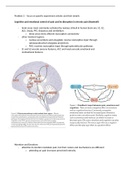
- brain areas most commonly activated by noxious stimuli in human brain are: S1, S2,
ACC, insula, PFC, thalamus and cerebellum
o these areas show afferent nociceptive connectivity
- other involved regions:
o nucleus accumbens and amygdala: receive nociceptive input through
spinoparabrachial-amygdala projections
o PAG: receives nociceptive input through spinoreticular pathways
- S1 and S2 encode sensory features, ACC and insula encode emotional and
motivational features
Attention and Emotions
- attention & emotion modulate pain, but their nature and mechanisms are different:
o attending on pain increases perceived intensity
, o negative emotional state increases perceived unpleasantness without altering
intensity
- studies that varied attention while controlling for emotional state found that pain-
evoked activity was modulated by attention in insula and S1
- effects of emotional states are mostly seen in ACC
- separate modulatory systems for attention and emotions:
o fronto-PAG-brainstem (most commonly studied)
output from forebrain regions (ACC, PFC, amygdala) reach PAG
(suggesting that descending systems could be activated by
psychological factors) and project to brainstem nuclei
o when emotion and attention are dissociated:
emotion: ACC-fronto-PAG circuit activated
attention: insula and superior parietal cortex activated
Anticipation of pain relief activated descending pathways
- anticipation of pain relief causes activation in the ACC-fronto-PAG pathway and
activates similar regions that’re activated when a positive emotional state reduces
pain
- placebo treatment alters endogenous opioid activity in this pathway
- descending modulatory pathways involved in placebo analgesia overlap with the
pathways involved in emotional modulation of pain
- but attentional modulation of pain is independent from placebo analgesia
Cognitive and emotional control of pain and its disruption in chronic pain (Bushnell)
- brain areas most commonly activated by noxious stimuli in human brain are: S1, S2,
ACC, insula, PFC, thalamus and cerebellum
o these areas show afferent nociceptive connectivity
- other involved regions:
o nucleus accumbens and amygdala: receive nociceptive input through
spinoparabrachial-amygdala projections
o PAG: receives nociceptive input through spinoreticular pathways
- S1 and S2 encode sensory features, ACC and insula encode emotional and
motivational features
Attention and Emotions
- attention & emotion modulate pain, but their nature and mechanisms are different:
o attending on pain increases perceived intensity
, o negative emotional state increases perceived unpleasantness without altering
intensity
- studies that varied attention while controlling for emotional state found that pain-
evoked activity was modulated by attention in insula and S1
- effects of emotional states are mostly seen in ACC
- separate modulatory systems for attention and emotions:
o fronto-PAG-brainstem (most commonly studied)
output from forebrain regions (ACC, PFC, amygdala) reach PAG
(suggesting that descending systems could be activated by
psychological factors) and project to brainstem nuclei
o when emotion and attention are dissociated:
emotion: ACC-fronto-PAG circuit activated
attention: insula and superior parietal cortex activated
Anticipation of pain relief activated descending pathways
- anticipation of pain relief causes activation in the ACC-fronto-PAG pathway and
activates similar regions that’re activated when a positive emotional state reduces
pain
- placebo treatment alters endogenous opioid activity in this pathway
- descending modulatory pathways involved in placebo analgesia overlap with the
pathways involved in emotional modulation of pain
- but attentional modulation of pain is independent from placebo analgesia