
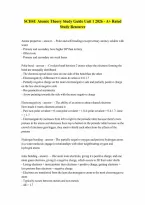
SCH4U Atomic Theory Study Guide Unit 1 2026 - A+ Rated Study Resource
SCH4U Atomic Theory Study Guide Unit 1 2026 - A+ Rated Study Resource Amine properties - answer - - Polar and self-bonding (except tertiary amine), soluble with water - Primary and secondary have higher BP than tertiary - Often toxic - Primary and secondary are weak bases Polar bond - answer - - Covalent bond between 2 atoms where the electrons forming the bond are unequally distributed - The electrons spend more time on one side of the bond than the other - Electronegativity difference b/w anion & cation is 0.4-1.7 - Partially negative charge on the more electronegative side and partially positive charge on the less electronegative side - Has geometrical asymmetry - Arrow pointing towards the side with the more negative charge Electronegativity - answer - - The ability of an atom to attract shared electrons How much it wants electrons around it - Pure non-polar covalent = 0; non-polar covalent = ≤ 0,4; polar covalent = 0.4-1.7; ionic = ≥ 1.7 - Electronegativity increases from left to right in the periodic table because there's more protons in the atoms and decreases from top to bottom in the periodic table because as the crowd of electrons gets bigger, they start to shield each other from the effects of the protons Hydrogen bonding - answer - The partially negative oxygen and positive hydrogen atoms in a water molecule engage in relationships with other neighbouring oxygen and hydrogen atoms Ionic bonding - answer - - One atom loses electrons, giving it a positive charge, and one atom gains electrons, giving it a negative charge, which occurs to fill their outer shells - Losing electrons = more protons then electrons = positive charge; gaining electrons = less protons then electrons = negative charge - Electrons are transferred from the least electronegative atom to the most electronegative atom - Typically occurs between metals and non-metals - ∆E 1.7 - Made of lattice structures: organized structure of atoms stuck together Ion - answer - Charged atom, ends in suffix "ide", different number of protons and electrons Electron shells - answer - - First shell = 2 electrons; second shell = 8 electrons; third shell = 8 electrons - Valence shell = outermost shell that contains electrons - Every atom wants to have a full valence shell - The closer it is to a full valence shell the more unstable it is Covalent bonding - answer - - Electrons are shared between 2 atoms, which occurs between nonmetals - Forms clumps of atoms in a disorganized structure - Non-polar covalent bond: electrons are shared equally (∆E = 0) - Polar covalent bond: electrons are shared unequally 1. Electrons collect closer to the more electronegative atom making it slightly negative and thus creating a dipole 2. 1.7 ∆E 0 3. Ex. Between O and H in H2O) Hydrocarbons - answer - - Molecules that consist of only carbon and hydrogen - Saturated hydrocarbons = single bonds only, 4 bonds - Van der waals are the main intermolecular forces in hydrocarbons - suffix "yl" = branched attachment - Named based on the longest possible continuous chain in their structure - Numbered to give attachments the lowest number possible - Di and tri are used to indicate multiple attachments Alkanes - answer - - Hydrocarbons with no double bonds between carbon molecules - Saturated because of no double bonds - Suffix "ane" - Formula: CnH2n+2 - Low boiling and melting points 3 types of alkane reactions - answer - 1. Combustion: burning: - Requires a hydrocarbon, oxygen, and a source of heat - Products are CO2 and H2O (gas) 2. Halogenation: replacement of hydrogen atoms with halogens (ex. F or Cl) 3. Dehydrogenation: removal of hydrogen atoms from alkanes Alkenes - answer - - Hydrocarbons with at least 1 double bond - Suffix "ene" - Not saturated because they have double bonds - Formula: CnH2n Alkynes - answer - - Hydrocarbons that contain at least 1 triple bond - Suffix "yne" - Formula: C2H2n-2 Naming hydrocarbons - answer - 1. Find the longest carbon chain that conta
Información del documento
- Subido en
- 29 de octubre de 2026
- Número de páginas
- 10
- Escrito en
- 2026/2027
- Tipo
- Examen
- Contiene
- Preguntas y respuestas

