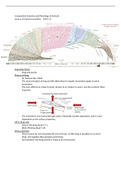
Comparative Anatomy and Physiology
Lecture 12 Thermoregulatory Responses 18/11/20
Reasons to changes in temperature
- Over the course of a day, animals experience changes in temperature.
- Similarly, over the course of a year, animals experience changes in temperature.
- Acute responses – quick adaptations in response to fast changes in temperature.
- Chronic responses – stable adaptations acquired during prolonged periods after
temperature changes.
- Evolutionary responses – adaptations observed in most individuals in a population acquired
over many generations.
Ectotherms- acute responses
- Ectotherms exhibit curvilinear changes in performance as body temperature increases to an
optimal level
- Small changes at high temperatures are more problematic
- Acute physiological responses largely determined by physical properties of the molecular
interactions
- Metabolic rate increases exponentially just like any other chemical reaction – Arrhenius
principle
- Quantified by determining the Q10 value for a response
- Q10 = RT/R(T-10)
- RT is the rate at any given body temperature
- R(T-10) is the rate at the temperature at a body temperature 10 °C lower
- Effectively the slope of regression line on a semi-logarithmic plot
-
- Tiger beetles maintain body temperature between 33 and 38°C while searching for prey and
mates
- High ambient temperature elicits behavioural responses
- As ectothermic vertebrates, lizards thermoregulate to maintain a narrow range of body
temperatures
- Use: behaviour, posture, increased surface area and colour to absorb sun’s radiation
Homeotherms
- Homeotherms (endotherms) maintain a near constant, high body temperature by utilising
heat generated by metabolism (energy cost = high)
- Can regulate temperature with little change to metabolism for a thermoneutral zone
Lecture 12 Thermoregulatory Responses 18/11/20
Reasons to changes in temperature
- Over the course of a day, animals experience changes in temperature.
- Similarly, over the course of a year, animals experience changes in temperature.
- Acute responses – quick adaptations in response to fast changes in temperature.
- Chronic responses – stable adaptations acquired during prolonged periods after
temperature changes.
- Evolutionary responses – adaptations observed in most individuals in a population acquired
over many generations.
Ectotherms- acute responses
- Ectotherms exhibit curvilinear changes in performance as body temperature increases to an
optimal level
- Small changes at high temperatures are more problematic
- Acute physiological responses largely determined by physical properties of the molecular
interactions
- Metabolic rate increases exponentially just like any other chemical reaction – Arrhenius
principle
- Quantified by determining the Q10 value for a response
- Q10 = RT/R(T-10)
- RT is the rate at any given body temperature
- R(T-10) is the rate at the temperature at a body temperature 10 °C lower
- Effectively the slope of regression line on a semi-logarithmic plot
-
- Tiger beetles maintain body temperature between 33 and 38°C while searching for prey and
mates
- High ambient temperature elicits behavioural responses
- As ectothermic vertebrates, lizards thermoregulate to maintain a narrow range of body
temperatures
- Use: behaviour, posture, increased surface area and colour to absorb sun’s radiation
Homeotherms
- Homeotherms (endotherms) maintain a near constant, high body temperature by utilising
heat generated by metabolism (energy cost = high)
- Can regulate temperature with little change to metabolism for a thermoneutral zone