

PYC3701
CHAPTER 7 – LIKING, LOVE AND OTHER
CLOSE RELATIONSHIPS
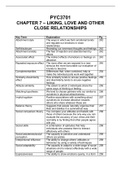
Key Term Explanation Pg.
Attachment style The ways in which we form emotional bonds 242
and regulate our emotions in close
relationships
Self-disclosure Revealing our innermost thoughts and feelings 242
Attachment anxiety The fear of rejection and abandonment by 242
others
Associated effect The indirect effects of emotions or feelings on 243
attraction
Repeated exposure effect The more often we are exposed to a new 245
stimulus the more favourable our evaluation of
it tends to become
Complementarities Differences that, when combined, help to 254
make the individual parts work well together
Similarity-dissimilarity How similarity tends to arouse positive feelings 255
effect and dissimilarity tends to arouse negative
feelings
Attitude similarity The extent to which 2 individuals share the 255
same ways of thinking or feeling
Matching hypothesis We tend to choose partners who our similar to 256
ourselves in physical attractiveness
Implicit egotism Positive associations with something about 257
ourselves do increase attraction towards
others who share whatever these are
Balance theory Suggests that people naturally organise their 257
likes and dislikes in a symmetrical way
Social comparison theory You compare your attitudes and beliefs with 258
those of others because the only way you can
evaluate the accuracy of your views and their
normality is by finding that other people agree
with you
Social skills A combination of aptitudes that help 258
individuals who possess them to interact
effectively with others
Social astuteness/social The capacity to perceive and understand 259
perception others accurately
Interpersonal influence The ability to change others’ attitudes or 259
behaviour by using a variety of techniques
Social adaptability The capacity to adapt to a wide range of social 259
situations and to interact effectively with a wide
range of people
Expressiveness The ability to show emotions openly, in a form 259
, others can readily perceive
Internal Sources of Liking Others: The Role of Needs and Emotions
Interpersonal attraction – why people like or dislike one another
The importance of affiliation in human existence – the need to belong:
People differ greatly in the strength of this need of affiliation
o We tend to seek the amount of social contact that is optimal for us
External events can temporarily boost or reduce this need
Social comparison – people want to be with others – even strangers – to
communicate about what is going on, to compare their perceptions and to
make decisions about what to do
The role of affect – do our moods play a role in liking others?
Positive and negative affect (moods and emotions) vary in intensity (valence)
and arousal
A positive affect often leads to positive evaluations of other people
Negative affect leads to negative evaluations
These 2 effects occur in 2 different ways – directly and indirectly
Indirect – associated effect (definition in table)
o Liking or disliking someone you meet is influenced by unrelated events
or people in your life
The other person is simply present at the same time your
emotional state is aroused by something or someone else
External Sources of Attraction: The Effects of Proximity, Familiarity and
Physical Beauty
The power of proximity – unplanned contacts:
Physical proximity may no longer be a requirement for interpersonal attraction
– social media etc
Repeated exposure effect – explanation in table
Social networks make it possible for people to interact and form initial feelings
of liking or disliking without physical proximity, but using social media sites
has the potential for both positive and negative effects
o Pg. 247
Physical beauty:
It is a powerful factor in our liking for others, whether we want it to or not
Attractive people are judged to be healthier, more intelligent and more
trustworthy
What is beautiful is good effect
o Stereotyping (why attractive people are generally viewed as
possessing desirable characteristics)
o Interpretation for this effect propose 3 steps
We desire to form relationships with attractive people
CHAPTER 7 – LIKING, LOVE AND OTHER
CLOSE RELATIONSHIPS
Key Term Explanation Pg.
Attachment style The ways in which we form emotional bonds 242
and regulate our emotions in close
relationships
Self-disclosure Revealing our innermost thoughts and feelings 242
Attachment anxiety The fear of rejection and abandonment by 242
others
Associated effect The indirect effects of emotions or feelings on 243
attraction
Repeated exposure effect The more often we are exposed to a new 245
stimulus the more favourable our evaluation of
it tends to become
Complementarities Differences that, when combined, help to 254
make the individual parts work well together
Similarity-dissimilarity How similarity tends to arouse positive feelings 255
effect and dissimilarity tends to arouse negative
feelings
Attitude similarity The extent to which 2 individuals share the 255
same ways of thinking or feeling
Matching hypothesis We tend to choose partners who our similar to 256
ourselves in physical attractiveness
Implicit egotism Positive associations with something about 257
ourselves do increase attraction towards
others who share whatever these are
Balance theory Suggests that people naturally organise their 257
likes and dislikes in a symmetrical way
Social comparison theory You compare your attitudes and beliefs with 258
those of others because the only way you can
evaluate the accuracy of your views and their
normality is by finding that other people agree
with you
Social skills A combination of aptitudes that help 258
individuals who possess them to interact
effectively with others
Social astuteness/social The capacity to perceive and understand 259
perception others accurately
Interpersonal influence The ability to change others’ attitudes or 259
behaviour by using a variety of techniques
Social adaptability The capacity to adapt to a wide range of social 259
situations and to interact effectively with a wide
range of people
Expressiveness The ability to show emotions openly, in a form 259
, others can readily perceive
Internal Sources of Liking Others: The Role of Needs and Emotions
Interpersonal attraction – why people like or dislike one another
The importance of affiliation in human existence – the need to belong:
People differ greatly in the strength of this need of affiliation
o We tend to seek the amount of social contact that is optimal for us
External events can temporarily boost or reduce this need
Social comparison – people want to be with others – even strangers – to
communicate about what is going on, to compare their perceptions and to
make decisions about what to do
The role of affect – do our moods play a role in liking others?
Positive and negative affect (moods and emotions) vary in intensity (valence)
and arousal
A positive affect often leads to positive evaluations of other people
Negative affect leads to negative evaluations
These 2 effects occur in 2 different ways – directly and indirectly
Indirect – associated effect (definition in table)
o Liking or disliking someone you meet is influenced by unrelated events
or people in your life
The other person is simply present at the same time your
emotional state is aroused by something or someone else
External Sources of Attraction: The Effects of Proximity, Familiarity and
Physical Beauty
The power of proximity – unplanned contacts:
Physical proximity may no longer be a requirement for interpersonal attraction
– social media etc
Repeated exposure effect – explanation in table
Social networks make it possible for people to interact and form initial feelings
of liking or disliking without physical proximity, but using social media sites
has the potential for both positive and negative effects
o Pg. 247
Physical beauty:
It is a powerful factor in our liking for others, whether we want it to or not
Attractive people are judged to be healthier, more intelligent and more
trustworthy
What is beautiful is good effect
o Stereotyping (why attractive people are generally viewed as
possessing desirable characteristics)
o Interpretation for this effect propose 3 steps
We desire to form relationships with attractive people


