
PHYSICS
REQUIRED PRACTICALS
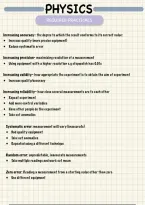
Increasing accuracy- the degree to which the result conforms to its correct value:
• Increase quality (more precise equipment)
• Reduce systematic error
Increasing precision- maximizing resolution of a measurement
• Using equipment with a higher resolution e.g stopwatch has 0.01s
Increasing validity- how appropriate the experiment is to obtain the aim of experiment
• Increase quality/accuracy
Increasing reliability- how close several measurements are to each other
• Repeat experiment
• Add more control variables
• Have other people do the experiment
• Take out anomalies
Systematic error: measurement will vary (inaccurate)
• Bad quality equipment
• Take out anomalies
• Repeated using a different technique
Random error: unpredictable, inaccurate measurements
• Take multiple readings and work out mean
Zero error: Reading a measurement from a starting value other than zero
• Use different equipment
, Required practical 1
1) Set up the apparatus by placing a small beaker inside the larger beaker
2) Fill the small beaker with boiling water from a kettle
3) Place a piece of cardboard over the beakers as a lid. It should have a hole suitable for a
thermometer and place it through this hole and into the water
4) Record the temperature of the water and start the stopwatch
5) Record the temperature of the water every 2 minutes for 20 minutes, or until the water
reaches room temperature
6) Repeat the experiment, recording the mean
Independent variable: Time, (s)
Dependent variable:
Temperature, (°C)
Control variables: Volume of
water, temperature of the
water at the start, thickness
of each material


