A. 2015:
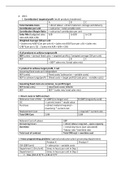
1. Contribution/ targeted profit (multi products breakeven)
A B C
Total Variable Costs = direct labour + direct material + storage and delivery
Contribution per unit = sale price – total variable costs
Contribution Margin Ratio = sale price/ contribution per unit
Sales Mix (budgeted sales A/B to B/B to C/B
ratio A/B, B/B, C/B)
Weighted Average CM per unit
= [(sales mix A/B)*(Con per unit A) + (sales mix B/B)*(con per u B) + (sales mix
C/B)*(con per u C)] / (sales mix A/B + B/B + C/B)
If all products to achieve target profit
BEP (units) = (annual fixed costs + targeted profits) / (weigted average CM per unit)
BEP A B C
= BEP* sales mix / (total sales mix)
1 product to achieve target profit, 1 not
Assuming fixed costs are independent
BEP (units) Fixed costs/ (sales price – variable costs)
BEP to achieve targetprofit (Fixed costs + target profit)/ (sale price – variable costs)
Assuming fixed costs are common, no profit target
BEP (total units) total fixed costs/ WACM
BEP BEP * (sales mix/ total sales mix)
2. Direct costs to fulfil contract
Relevance Cost of DM A (GBP) (no longer use) B (GBP) (regularly used)
OC = current invent * resale value
Purchase = (direct material required –
inventory) * current cost
Replacement Cost = required * current cost
Total DM Cost SUM SUM
Relevant Cost of Labour GBP
Remaining Hours = direct labour required – spare capacity
Overtime = remaining hours (just calculated)
*labour rate *overtime rate
Total cost of contract Total DM cost + overtime cost
3. linear programming problem/ optimal production plan/ processing departments
Product X Product Y
CM (GBP/unit) = sales price – variable costs
Department 1 (hrs/unit) times in hours per unit in Dep 1
Department 2 times in hours per unit in Dep 2
Max (CM of X)*X + (CM of Y)*Y
, s/t (times in hours per unit dep 1 of X)*X + (of Y)*Y <= maximum hours in Dep 1
(times in hours per unit dep 2 of X)*X + (of Y)*Y <= maximum hours in Dep 2
X,Y >= 0
(X or Y > or < = ??? ) (if prov in question)
Big question: Optimal Production Plan
Intercepts
X Y X Y
Dep. 1 0 (Maximum hr in Same method 0
dep1)/ [Dep 1 for X
(hr/unit)]
Dep. 2 0 (Maximum hr in Same method 0
dep2) [Dep 2 for X
(hr/unit)]
Demand Maximum unit 0 na na
of X
➔ Draw a graph with Dep 1 line, Dep 2 line, demand limit line (using figures just cal.)
Objective Function:
Slope (CM of X)*X + (CM of Y)*Y = 0 -> Y/X ratio =
-> assume sample x and y intercept for that ratio to draw an objective function line
Optimal Point:
(times in hours per unit dep 1 of X)*X + (of Y)*Y = maximum hours in Dep 1
(times in hours per unit dep 2 of X)*X + (of Y)*Y = maximum hours in Dep 2
-> X = ?, Y = ?
Look at the graph, the cross point of Dep 1 and Dep 2 is the optimal point
4. High/Low method:
Variable cost per unit = (highest total cost – lowest total cost)/ (highest output – lowest)
Fixed costs = highest total cost – (variable cost per unit* highest output)
5. Optimal production plan/ maximum profit
A B C
Sales price prov prov prov
Management cost = management time * cost per hour for managers
Staff cost = staff time * cost per hour for staff
Other costs = variable overheads prov.
Contribution per = sales price - management cost - staff cost - other costs
unit
Rank per CM/unit 1st or 2nd or 3rd
Binding Constraints
Management hours = sales demand per unit * management hours demand per unit
demand total
Staff hours demand = sales demand per unit * staff hours demand per unit
total
1. Contribution/ targeted profit (multi products breakeven)
A B C
Total Variable Costs = direct labour + direct material + storage and delivery
Contribution per unit = sale price – total variable costs
Contribution Margin Ratio = sale price/ contribution per unit
Sales Mix (budgeted sales A/B to B/B to C/B
ratio A/B, B/B, C/B)
Weighted Average CM per unit
= [(sales mix A/B)*(Con per unit A) + (sales mix B/B)*(con per u B) + (sales mix
C/B)*(con per u C)] / (sales mix A/B + B/B + C/B)
If all products to achieve target profit
BEP (units) = (annual fixed costs + targeted profits) / (weigted average CM per unit)
BEP A B C
= BEP* sales mix / (total sales mix)
1 product to achieve target profit, 1 not
Assuming fixed costs are independent
BEP (units) Fixed costs/ (sales price – variable costs)
BEP to achieve targetprofit (Fixed costs + target profit)/ (sale price – variable costs)
Assuming fixed costs are common, no profit target
BEP (total units) total fixed costs/ WACM
BEP BEP * (sales mix/ total sales mix)
2. Direct costs to fulfil contract
Relevance Cost of DM A (GBP) (no longer use) B (GBP) (regularly used)
OC = current invent * resale value
Purchase = (direct material required –
inventory) * current cost
Replacement Cost = required * current cost
Total DM Cost SUM SUM
Relevant Cost of Labour GBP
Remaining Hours = direct labour required – spare capacity
Overtime = remaining hours (just calculated)
*labour rate *overtime rate
Total cost of contract Total DM cost + overtime cost
3. linear programming problem/ optimal production plan/ processing departments
Product X Product Y
CM (GBP/unit) = sales price – variable costs
Department 1 (hrs/unit) times in hours per unit in Dep 1
Department 2 times in hours per unit in Dep 2
Max (CM of X)*X + (CM of Y)*Y
, s/t (times in hours per unit dep 1 of X)*X + (of Y)*Y <= maximum hours in Dep 1
(times in hours per unit dep 2 of X)*X + (of Y)*Y <= maximum hours in Dep 2
X,Y >= 0
(X or Y > or < = ??? ) (if prov in question)
Big question: Optimal Production Plan
Intercepts
X Y X Y
Dep. 1 0 (Maximum hr in Same method 0
dep1)/ [Dep 1 for X
(hr/unit)]
Dep. 2 0 (Maximum hr in Same method 0
dep2) [Dep 2 for X
(hr/unit)]
Demand Maximum unit 0 na na
of X
➔ Draw a graph with Dep 1 line, Dep 2 line, demand limit line (using figures just cal.)
Objective Function:
Slope (CM of X)*X + (CM of Y)*Y = 0 -> Y/X ratio =
-> assume sample x and y intercept for that ratio to draw an objective function line
Optimal Point:
(times in hours per unit dep 1 of X)*X + (of Y)*Y = maximum hours in Dep 1
(times in hours per unit dep 2 of X)*X + (of Y)*Y = maximum hours in Dep 2
-> X = ?, Y = ?
Look at the graph, the cross point of Dep 1 and Dep 2 is the optimal point
4. High/Low method:
Variable cost per unit = (highest total cost – lowest total cost)/ (highest output – lowest)
Fixed costs = highest total cost – (variable cost per unit* highest output)
5. Optimal production plan/ maximum profit
A B C
Sales price prov prov prov
Management cost = management time * cost per hour for managers
Staff cost = staff time * cost per hour for staff
Other costs = variable overheads prov.
Contribution per = sales price - management cost - staff cost - other costs
unit
Rank per CM/unit 1st or 2nd or 3rd
Binding Constraints
Management hours = sales demand per unit * management hours demand per unit
demand total
Staff hours demand = sales demand per unit * staff hours demand per unit
total