
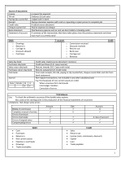
Source of documents
Invoice a request for payment
Till roll Evidence of cash sales
Paying slip counterfoil Lodged cash in bank
Receipt Paying a business expense with cash or requesting a repair person to complete job.
Credit note A refund source document
Cheque counter foil Paid an expense via cheque
Bank statement Paid business expense such as rent via direct debit or standing order.
Statement of account A summary of the transactions that have taken place since the previous statement and show
how much is currently owed
Debit T- account Credit
o Drawings o Commission received
o Returns In o Discount received
o Carriage In o Returns out
o Discount allowed o Bank Loan
o Purchases o Carriage out
o Revenue
Sales day book Credit sales made (source document: invoices )
Purchases day book Credit purchases (S.D: copy invoices)
Sales return day book Returns inwards (S.D: Copy credit note)
Purchases return day book Returns outwards (S.D: Credit note)
Cash book From cash receipts, till rolls, paying-in slip counterfoils, cheque counterfoils and info from
bank statements
Journal Non-regular transactions, not included in any other subsidiary book
E.g: Purchase/sale of non-current assets on credit
Date Details Dr Cr When a business first starts/ends
£ £ Inter-ledger transfers
Correction of errors
Trial balance
Use: To check the arithmetic accuracy of the double-entry system,
Also used as the starting point in the production of the financial statements of a business
Limitations: Not shown some errors
Amount Side Account
Errors of commission X
Complete reversal of entries X
Errors of omission
Errors of principle X class of account
Errors of original entry X
Compensating errors X
Debit Credit
Cash Sales
Purchases Returns out
Returns in Income (rent, commission, discount)
Non current assets Capital
Expenses / overheads Loan
Drawings Trade payables
Trade receivables
1
, Special errors correction
Undercast A by £200 Overcast A by £200
Debit : A account Credit : Suspense account Debit: Suspense account Credit : A account
Division of the ledger
Sales ledger Purchases ledger General ledger
NO cash sales Credit purchases from suppliers Cash, credit sales, sales returns
Credit sales to customers Returns out Cash, credit purchases, purchases returns
Returns in Payments to trade payables Expenses, income, loan, capital, drawings
Payments received from debtors Cash discount received Income statement
Cash discount allowed NO cash purchases Non-current assets
Bad debts written off Main cash book
Inventory
Cash book
A subsidiary book for cash/bank transactions
It forms part of the double-entry book-keeping system
To check cash column D D Fo Discou C B D D Fo Discou C B
1. Balance the cash column a et lio nt a a a et lio nt a a
2. Add up the cash in hand t ail Allowe s n t ail receive s n
3. Compare cash in hand and balance in cash book e s d h k e s d h k
4. The two should be equal DON’T balance discount column
Debit Credit
Cash receipts issued Cash receipts received
Till roll totals Cheque counterfoils
Paying-in slip counterfoils Standing orders
Credit transfers received Direct debits
BACS payments received Bank charges and interest
Dishonoured cheque
BACS payment schedules
Notes:
- Banked £100 cash from the till => cash lose , bank gain
- All cash in hand, except a float of £200 , was paid into the bank => Bank gain A ( cash column in debit side – cash
column in credit side – £200 = A ), cash lose A
- Overdraft -> why need a copy of year-end financial statements for the bank -> Answer: A’s bank account is
overdrawn. The bank is a stakeholder and will wish to consider her profitability and liquidity and thus ensure that
their investment is safe.
Standing order Regular payments (monthly, weekly) made by the bank from the account of their customer.
Payments are for fixed amounts, on the written instructions of the bank’s customer
Debit: Expenses (eg maintenance) , Credit: Bank
Direct debit (doc: An automatic payment made by the bank on behalf of the customer. The payee can change the
bank statement) amount. Direct debit can be for fixed or variable amounts, and the payment dates can alter
Bank charges Changes made by the bank to maintain the account
Interest on overdrafts The interest charged by banks when an bank account is overdrawn
Credit transfers Amounts paid directly through the banking system (e.g. electronic banking, credit card )
Debit: bank , Credit : Debtor’s account
Dishonoured cheque A cheque which has not gone through the drawer’s bank account. This is often due to insufficient
funds
Lodgements Funds (that have been debited) in the cash book that have not yet been processed by the bank
Unpresented cheque A cheque drawn (and credited) in the cash book that has not yet been processed by the bank
Clearing a cheque The cheque goes through the banking system. Money is transferred from one account to another.
This can take a few days
2
Invoice a request for payment
Till roll Evidence of cash sales
Paying slip counterfoil Lodged cash in bank
Receipt Paying a business expense with cash or requesting a repair person to complete job.
Credit note A refund source document
Cheque counter foil Paid an expense via cheque
Bank statement Paid business expense such as rent via direct debit or standing order.
Statement of account A summary of the transactions that have taken place since the previous statement and show
how much is currently owed
Debit T- account Credit
o Drawings o Commission received
o Returns In o Discount received
o Carriage In o Returns out
o Discount allowed o Bank Loan
o Purchases o Carriage out
o Revenue
Sales day book Credit sales made (source document: invoices )
Purchases day book Credit purchases (S.D: copy invoices)
Sales return day book Returns inwards (S.D: Copy credit note)
Purchases return day book Returns outwards (S.D: Credit note)
Cash book From cash receipts, till rolls, paying-in slip counterfoils, cheque counterfoils and info from
bank statements
Journal Non-regular transactions, not included in any other subsidiary book
E.g: Purchase/sale of non-current assets on credit
Date Details Dr Cr When a business first starts/ends
£ £ Inter-ledger transfers
Correction of errors
Trial balance
Use: To check the arithmetic accuracy of the double-entry system,
Also used as the starting point in the production of the financial statements of a business
Limitations: Not shown some errors
Amount Side Account
Errors of commission X
Complete reversal of entries X
Errors of omission
Errors of principle X class of account
Errors of original entry X
Compensating errors X
Debit Credit
Cash Sales
Purchases Returns out
Returns in Income (rent, commission, discount)
Non current assets Capital
Expenses / overheads Loan
Drawings Trade payables
Trade receivables
1
, Special errors correction
Undercast A by £200 Overcast A by £200
Debit : A account Credit : Suspense account Debit: Suspense account Credit : A account
Division of the ledger
Sales ledger Purchases ledger General ledger
NO cash sales Credit purchases from suppliers Cash, credit sales, sales returns
Credit sales to customers Returns out Cash, credit purchases, purchases returns
Returns in Payments to trade payables Expenses, income, loan, capital, drawings
Payments received from debtors Cash discount received Income statement
Cash discount allowed NO cash purchases Non-current assets
Bad debts written off Main cash book
Inventory
Cash book
A subsidiary book for cash/bank transactions
It forms part of the double-entry book-keeping system
To check cash column D D Fo Discou C B D D Fo Discou C B
1. Balance the cash column a et lio nt a a a et lio nt a a
2. Add up the cash in hand t ail Allowe s n t ail receive s n
3. Compare cash in hand and balance in cash book e s d h k e s d h k
4. The two should be equal DON’T balance discount column
Debit Credit
Cash receipts issued Cash receipts received
Till roll totals Cheque counterfoils
Paying-in slip counterfoils Standing orders
Credit transfers received Direct debits
BACS payments received Bank charges and interest
Dishonoured cheque
BACS payment schedules
Notes:
- Banked £100 cash from the till => cash lose , bank gain
- All cash in hand, except a float of £200 , was paid into the bank => Bank gain A ( cash column in debit side – cash
column in credit side – £200 = A ), cash lose A
- Overdraft -> why need a copy of year-end financial statements for the bank -> Answer: A’s bank account is
overdrawn. The bank is a stakeholder and will wish to consider her profitability and liquidity and thus ensure that
their investment is safe.
Standing order Regular payments (monthly, weekly) made by the bank from the account of their customer.
Payments are for fixed amounts, on the written instructions of the bank’s customer
Debit: Expenses (eg maintenance) , Credit: Bank
Direct debit (doc: An automatic payment made by the bank on behalf of the customer. The payee can change the
bank statement) amount. Direct debit can be for fixed or variable amounts, and the payment dates can alter
Bank charges Changes made by the bank to maintain the account
Interest on overdrafts The interest charged by banks when an bank account is overdrawn
Credit transfers Amounts paid directly through the banking system (e.g. electronic banking, credit card )
Debit: bank , Credit : Debtor’s account
Dishonoured cheque A cheque which has not gone through the drawer’s bank account. This is often due to insufficient
funds
Lodgements Funds (that have been debited) in the cash book that have not yet been processed by the bank
Unpresented cheque A cheque drawn (and credited) in the cash book that has not yet been processed by the bank
Clearing a cheque The cheque goes through the banking system. Money is transferred from one account to another.
This can take a few days
2


