York UniversityMATHEMATIC 3410RootsQuadraticSE.
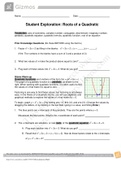
Prior Knowledge Questions (Do these BEFORE using the Gizmo.) 1. Factor x 2 + 3x + 2 by filling in the blanks: x 2 + 3x + 2 = (x + )(x + ) (Hint: The numbers in the blanks have a sum of 3 and a product of 2.) 2. What two values of x make the product above equal to zero? 3. Plug each of these values into x 2 + 3x + 2. What do you get? Gizmo Warm-up Quadratic functions are functions of the form f(x) = ax2 + bx + c. The graph of a quadratic function is a parabola, as shown to the right. When working with quadratic functions, it is often useful to find the values of x that make f(x) equal to zero. Factoring is one way to find these values, but factoring is not always easy. In the Roots of a Quadratic Gizmo, you will use algebraic and graphical methods to explore the values of x that make f(x) = 0. To begin, graph y = x 2 + 3x + 2 by setting a to 1.0, b to 3.0, and c to 2.0. (Change the values by dragging the sliders, or by clicking in the text field, typing in a value, and hitting Enter.) 1. The blue points are x-intercepts of the parabola. They are the points where y = 0. Mouseover the blue points. What is the x-coordinate of each point? 2. The x-intercepts are solutions, or real roots, of the quadratic equation x 2 + 3x + 2 = 0. A. Plug each solution into x 2 + 3x + 2. What do you get? B. Recall that x 2 + 3x + 2 = (x + 1)(x + 2). How do these factors relate to the x-intercepts of y = x 2 + 3x + 2? This study source was downloaded by from CourseH on :37:11 GMT -05:00 This study resource was shared via CourseH 2019 Activity A: Roots and the line of symmetry Get the Gizmo ready: Set a to 1.0, b to –4.0, and c to 3.0. 1. The roots of a quadratic equation are the values of x that make the related function zero. The real roots are also the x-intercepts of the parabola. Look at the graph of y = x 2 – 4x + 3. A. How many roots does x 2 – 4x + 3 = 0 have? What are the roots? B. Change c to 4.0. How many roots does x 2 – 4x + 4 = 0 have? 2. Now graph y = x 2 – 4x + 8 in the Gizmo, and look at the resulting parabola. Do you think x 2 – 4x + 8 = 0 has any real roots? Explain. 3. Vary the values of a, b, and c. In general, how many real roots are possible for a quadratic equation? 4. Graph y = x 2 + 6x + 5. Turn on Show axis of symmetry x = –b/(2a). The axis of symmetry is a line that divides a parabola into two halves that are mirror images. A. How does the location of the axis of symmetry relate to the location of the two x-intercepts? B. Move the a, b, and c sliders. Which values affect the axis of symmetry? C. The equation of the axis of symmetry is x = a b 2 . How does this explain what you observed above? 5. Suppose you know the line of symmetry for a quadratic function. A. From just this information, can you find the x-intercepts? Explain. B. Suppose the axis of symmetry of the graph of a quadratic function is at x = 6. If one root of the related quadratic equation is –1.5, what is the other root?
Document information
- Uploaded on
- September 12, 2021
- Number of pages
- 6
- Written in
- 2021/2022
- Type
- Exam (elaborations)
- Contains
- Questions & answers