Localisation of Function
LOCALISATION OF FUNCTION
Belief that specific areas of the brain are associated with specific cognitive processes
Case Study: Phineas Gage
• In 1848, while working on a rail line, Gage experienced a drastic accident in which a piece of
iron went through his skull
• He experienced a change in personality, such as loss of inhibition and anger
• Area that was damaged was responsible for his personality
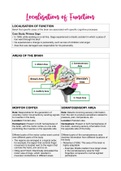
AREAS OF THE BRAIN
MORTOR CORTEX SOMATOSENSORY AREA
Role: Responsible for the generation of Role: Detects incoming sensory information
voluntary motor movements by sending signals from the skin to produce sensations related to
to muscles in the body pressure, pain, temperature, etc
Location: Frontal Lobe Location: Parietal Lobe
Hemisphere: Present in both hemispheres of Hemisphere: Present in both hemispheres of
the brain, with the motor cortex on one side the brain, receiving sensory information from
controlling the muscles on the opposite side the opposite side of the body
Different parts of the motor cortex exert control Different parts of the somatosensory area
over different parts of the body receives information from different locations of
• The regions are arranged in a logical order, the body
for example, the region that controls finger • Robertson (1995): This area of the brain is
movement is located next to the region that highly adaptable
controls the hand, arm and so on. • Example: Braille readers have larger areas
• Hitzig and Fritsch: Electrically stimulated the in the somatosensory area for their
motor area of dogs, which resulted in fingertips compared to normal sighted
muscular contractions in different areas participants
, VISUAL AREA AUDITORY AREA
Role: Receives and processes visual Role: Analyses and processes acoustic
information information
Location: Occipital Lobe Location: Temporal Lobe
Hemisphere: Present in both hemispheres of Hemisphere: Present in both hemispheres of
the brain, and information from the right-hand the brain, and information from the left ear
side visual field is processed in the left goes primarily to the right hemisphere, and
hemisphere, and vice versa vice versa
Contains different areas that process different Contains different areas, with the primary
types of visual information, including colour, auditory area being involved in processing
shape or movement simple features of sound, including volume,
tempo and pitch
LANGUAGE CENTRES
BROCA’S AREA WERNICKE’S AREA
Role: Responsible for speech production Role: Involved in language production
Location: Left Frontal Lobe Location: Left Temporal Lobe
Discovery: Discovered by Paul Broca while Discovery: Discovered by Carl Wernicke
while treating a patient named Leborgne (Tan)
• Tan could understand spoken language but Wernicke’s Aphasia: Patients with lesions in
was unable to produce any coherent words the Wenicke’s area were still able to speak, but
except for “Tan” were unable to comprehend language, often
producing sentences that are fluent or
• Post-mortem examination showed that Tan meaningless
had a lesion in the left frontal lob
• Led Broca to conclude that this area was Arcuate Fasciculus: A neural loop that runs
responsible for speech production between Broca’s area and Wernicke’s area
Broca’s Aphasia: slow and inarticulate speech
as a result of damage to Broca’s area
EVALUATION
Strengths
Application to treatment of OCD and mental disorders
Dougherty et al.: 44 OCD sufferers removed their cingulate gyrus in order to control their
symptoms
• Following up assessment found that 32-45% of patients previously unresponsive to medication
and behavioural treatments for OCD were at least partly improved after the operation
• Suggests that certain areas of the brain are linked to OCD
Limitations
LOCALISATION OF FUNCTION
Belief that specific areas of the brain are associated with specific cognitive processes
Case Study: Phineas Gage
• In 1848, while working on a rail line, Gage experienced a drastic accident in which a piece of
iron went through his skull
• He experienced a change in personality, such as loss of inhibition and anger
• Area that was damaged was responsible for his personality
AREAS OF THE BRAIN
MORTOR CORTEX SOMATOSENSORY AREA
Role: Responsible for the generation of Role: Detects incoming sensory information
voluntary motor movements by sending signals from the skin to produce sensations related to
to muscles in the body pressure, pain, temperature, etc
Location: Frontal Lobe Location: Parietal Lobe
Hemisphere: Present in both hemispheres of Hemisphere: Present in both hemispheres of
the brain, with the motor cortex on one side the brain, receiving sensory information from
controlling the muscles on the opposite side the opposite side of the body
Different parts of the motor cortex exert control Different parts of the somatosensory area
over different parts of the body receives information from different locations of
• The regions are arranged in a logical order, the body
for example, the region that controls finger • Robertson (1995): This area of the brain is
movement is located next to the region that highly adaptable
controls the hand, arm and so on. • Example: Braille readers have larger areas
• Hitzig and Fritsch: Electrically stimulated the in the somatosensory area for their
motor area of dogs, which resulted in fingertips compared to normal sighted
muscular contractions in different areas participants
, VISUAL AREA AUDITORY AREA
Role: Receives and processes visual Role: Analyses and processes acoustic
information information
Location: Occipital Lobe Location: Temporal Lobe
Hemisphere: Present in both hemispheres of Hemisphere: Present in both hemispheres of
the brain, and information from the right-hand the brain, and information from the left ear
side visual field is processed in the left goes primarily to the right hemisphere, and
hemisphere, and vice versa vice versa
Contains different areas that process different Contains different areas, with the primary
types of visual information, including colour, auditory area being involved in processing
shape or movement simple features of sound, including volume,
tempo and pitch
LANGUAGE CENTRES
BROCA’S AREA WERNICKE’S AREA
Role: Responsible for speech production Role: Involved in language production
Location: Left Frontal Lobe Location: Left Temporal Lobe
Discovery: Discovered by Paul Broca while Discovery: Discovered by Carl Wernicke
while treating a patient named Leborgne (Tan)
• Tan could understand spoken language but Wernicke’s Aphasia: Patients with lesions in
was unable to produce any coherent words the Wenicke’s area were still able to speak, but
except for “Tan” were unable to comprehend language, often
producing sentences that are fluent or
• Post-mortem examination showed that Tan meaningless
had a lesion in the left frontal lob
• Led Broca to conclude that this area was Arcuate Fasciculus: A neural loop that runs
responsible for speech production between Broca’s area and Wernicke’s area
Broca’s Aphasia: slow and inarticulate speech
as a result of damage to Broca’s area
EVALUATION
Strengths
Application to treatment of OCD and mental disorders
Dougherty et al.: 44 OCD sufferers removed their cingulate gyrus in order to control their
symptoms
• Following up assessment found that 32-45% of patients previously unresponsive to medication
and behavioural treatments for OCD were at least partly improved after the operation
• Suggests that certain areas of the brain are linked to OCD
Limitations