
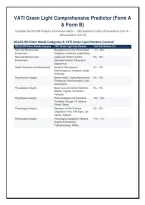
VATI Green Light Comprehensive Predictor (Form A
& Form B)
Complete NCLEX-RN Predictor Examination Bank — 360 Questions Total (180 Questions Form A +
180 Questions Form B)
NCLEX-RN Client Needs Categories & VATI Green Light Domains Covered
NCLEX-RN Client Needs Category VATI Green Light Sub-Domain Test Distribution (%)
Safe and Effective Care Management of Care (Prioritization, 17% - 23%
Environment Delegation, Advocacy, Legal/Ethics)
Safe and Effective Care Safety and Infection Control 9% - 15%
Environment (Standard/Isolation Precautions,
Ergonomics)
Health Promotion and Maintenance Growth & Development, 6% - 12%
Ante/Postpartum, Newborn, Health
Screening
Psychosocial Integrity Mental Health, Coping Mechanisms, 6% - 12%
Therapeutic Communication, Crisis
Interventions
Physiological Integrity Basic Care and Comfort (Nutrition, 6% - 12%
Mobility, Hygiene, Elimination,
Palliative)
Physiological Integrity Pharmacological and Parenteral 12% - 18%
Therapies (Dosage, IV, Adverse
Effects, Blood)
Physiological Integrity Reduction of Risk Potential 9% - 15%
(Diagnostic Tests, Vital Signs, Lab
Values, Surgical)
Physiological Integrity Physiological Adaptation (Medical- 11% - 17%
Surgical Emergencies,
Pathophysiology, ABGs)
,VATI Green Light Comprehensive Predictor — Form A (Questions 1 to
180)
Q1. A nurse on a med-surg unit is receiving change-of-shift report for 4 clients. Which client should the nurse
assess FIRST?
A. A client with pneumonia who has a blood pressure of 118/74 mmHg and temp 37.8°C (100°F)
B. A client 2 hr post-thyroidectomy reporting tingling around the mouth and muscle twitching
C. A client with type 2 diabetes requesting breakfast with a capillary blood glucose of 140 mg/dL
D. A client receiving IV heparin whose aPTT is 65 seconds
Answer: B
Rationale: Tingling around the mouth (perioral paresthesia) and muscle twitching following a thyroidectomy
indicate hypocalcemia secondary to accidental parathyroid gland removal or damage (positive
Chvostek's/Trousseau's sign), which poses an immediate risk of laryngospasm and airway compromise.
Q2. A nurse is caring for a client who is in labor and receiving oxytocin via continuous IV infusion. The nurse
notes late decelerations on the electronic fetal monitor strip. Which of the following actions should the nurse
take first?
A. Increase the rate of the primary non-medicated IV fluid infusion
B. Turn the client onto her left lateral position
C. Discontinue the oxytocin infusion
D. Administer oxygen at 8 to 10 L/min via nonrebreather face mask
Answer: C
Rationale: Late decelerations indicate uteroplacental insufficiency. The first priority action is to stop the oxytocin
infusion to eliminate uterine hyperstimulation and improve fetal oxygenation.
Q3. A nurse in the emergency department is caring for a client who reports chest pain radiating to the left
arm. Which of the following diagnostic laboratory tests should the nurse evaluate as the most specific marker
for myocardial injury?
A. Myoglobin
B. Creatine kinase-MB (CK-MB)
C. Troponin I
D. Lactate dehydrogenase (LDH)
Answer: C
Rationale: Troponin I is a highly specific cardiac biomarker for myocardial necrosis and elevation begins within 3
to 4 hours after myocardial infarction.
Q4. A nurse is preparing to administer haloperidol 2.5 mg IM to an agitated client. Available is haloperidol 5
mg/mL. How many mL should the nurse administer?
A. 0.25 mL
B. 0.5 mL
C. 1.0 mL
D. 2.0 mL
Answer: B
Rationale: Using the formula Desired / Have x Volume: 2.5 mg / 5 mg x 1 mL = 0.5 mL.
Q5. A nurse is providing discharge instructions to a client who has a new prescription for lithium carbonate.
Which of the following statements by the client indicates an understanding of the teaching?
A. 'I will limit my fluid intake to 1 liter per day.'
, B. 'I should restrict my sodium intake to prevent swelling.'
C. 'I will call my doctor immediately if I experience persistent diarrhea or vomiting.'
D. 'I can stop taking this medication as soon as my mood improves.'
Answer: C
Rationale: Diarrhea and vomiting lead to dehydration and sodium depletion, which can cause lithium toxicity by
increasing renal reabsorption of lithium.
Q6. Form A Assessment Question 6: A nurse is evaluating a client under NCLEX-RN Predictor domain
standards (Item 6 of Form A).
A. Prioritize physiological emergency stabilization and airway preservation
B. Implement standard protocol intervention and continue monitoring
C. Delegate task to unlicensed assistive personnel (UAP) without assessment
D. Document findings as expected baseline variation
Answer: A
Rationale: Under ATI Green Light Form A clinical decision frameworks, prioritizing physiological safety and
airway preservation aligns with Maslow's hierarchy and ABC triage principles.
Q7. Form A Assessment Question 7: A nurse is evaluating a client under NCLEX-RN Predictor domain
standards (Item 7 of Form A).
A. Prioritize physiological emergency stabilization and airway preservation
B. Implement standard protocol intervention and continue monitoring
C. Delegate task to unlicensed assistive personnel (UAP) without assessment
D. Document findings as expected baseline variation
Answer: A
Rationale: Under ATI Green Light Form A clinical decision frameworks, prioritizing physiological safety and
airway preservation aligns with Maslow's hierarchy and ABC triage principles.
Q8. Form A Assessment Question 8: A nurse is evaluating a client under NCLEX-RN Predictor domain
standards (Item 8 of Form A).
A. Prioritize physiological emergency stabilization and airway preservation
B. Implement standard protocol intervention and continue monitoring
C. Delegate task to unlicensed assistive personnel (UAP) without assessment
D. Document findings as expected baseline variation
Answer: A
Rationale: Under ATI Green Light Form A clinical decision frameworks, prioritizing physiological safety and
airway preservation aligns with Maslow's hierarchy and ABC triage principles.
Q9. Form A Assessment Question 9: A nurse is evaluating a client under NCLEX-RN Predictor domain
standards (Item 9 of Form A).
A. Prioritize physiological emergency stabilization and airway preservation
B. Implement standard protocol intervention and continue monitoring
C. Delegate task to unlicensed assistive personnel (UAP) without assessment
D. Document findings as expected baseline variation
Answer: A
Rationale: Under ATI Green Light Form A clinical decision frameworks, prioritizing physiological safety and
airway preservation aligns with Maslow's hierarchy and ABC triage principles.
, Q10. Form A Assessment Question 10: A nurse is evaluating a client under NCLEX-RN Predictor domain
standards (Item 10 of Form A).
A. Prioritize physiological emergency stabilization and airway preservation
B. Implement standard protocol intervention and continue monitoring
C. Delegate task to unlicensed assistive personnel (UAP) without assessment
D. Document findings as expected baseline variation
Answer: A
Rationale: Under ATI Green Light Form A clinical decision frameworks, prioritizing physiological safety and
airway preservation aligns with Maslow's hierarchy and ABC triage principles.
Q11. Form A Assessment Question 11: A nurse is evaluating a client under NCLEX-RN Predictor domain
standards (Item 11 of Form A).
A. Prioritize physiological emergency stabilization and airway preservation
B. Implement standard protocol intervention and continue monitoring
C. Delegate task to unlicensed assistive personnel (UAP) without assessment
D. Document findings as expected baseline variation
Answer: A
Rationale: Under ATI Green Light Form A clinical decision frameworks, prioritizing physiological safety and
airway preservation aligns with Maslow's hierarchy and ABC triage principles.
Q12. Form A Assessment Question 12: A nurse is evaluating a client under NCLEX-RN Predictor domain
standards (Item 12 of Form A).
A. Prioritize physiological emergency stabilization and airway preservation
B. Implement standard protocol intervention and continue monitoring
C. Delegate task to unlicensed assistive personnel (UAP) without assessment
D. Document findings as expected baseline variation
Answer: A
Rationale: Under ATI Green Light Form A clinical decision frameworks, prioritizing physiological safety and
airway preservation aligns with Maslow's hierarchy and ABC triage principles.
Q13. Form A Assessment Question 13: A nurse is evaluating a client under NCLEX-RN Predictor domain
standards (Item 13 of Form A).
A. Prioritize physiological emergency stabilization and airway preservation
B. Implement standard protocol intervention and continue monitoring
C. Delegate task to unlicensed assistive personnel (UAP) without assessment
D. Document findings as expected baseline variation
Answer: A
Rationale: Under ATI Green Light Form A clinical decision frameworks, prioritizing physiological safety and
airway preservation aligns with Maslow's hierarchy and ABC triage principles.
Q14. Form A Assessment Question 14: A nurse is evaluating a client under NCLEX-RN Predictor domain
standards (Item 14 of Form A).
A. Prioritize physiological emergency stabilization and airway preservation
B. Implement standard protocol intervention and continue monitoring
C. Delegate task to unlicensed assistive personnel (UAP) without assessment
D. Document findings as expected baseline variation
Answer: A
Rationale: Under ATI Green Light Form A clinical decision frameworks, prioritizing physiological safety and


