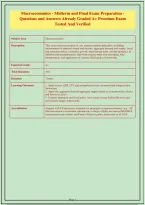
Macroeconomics - Midterm and Final Exam Preparation -
Questions and Answers Already Graded A+ Premium Exam
Tested And Verified
Subject Area Macroeconomics
Description This exam assesses mastery of core macroeconomic principles, including
measurement of national output and income, aggregate demand and supply, fiscal
and monetary policy, economic growth, international trade, and the dynamics of
inflation and unemployment. Questions require multi-step reasoning, data
interpretation, and application of current (2026) policy frameworks.
Expected Grade A+
Total Questions 100
Duration 3 hours
Learning Outcomes 1. Analyze how GDP, CPI, and unemployment are measured and interpret their
limitations.
2. Apply the aggregate demand-aggregate supply model to evaluate policy shocks
and business cycles.
3. Evaluate monetary and fiscal policy tools using current Federal Reserve and
government budget frameworks.
Accreditation Aligned with US university standards for principles of macroeconomics (e.g., AP
Macroeconomics curriculum, introductory college syllabi) and current BEA/BLS
measurement conventions and Federal Reserve policy framework as of 2026.
Page 1
,Question 1 of 100
If nominal GDP grows 6% while the GDP deflator rises 4%, real GDP growth is approximately:
A. 10%
B. 2%
C. 1.5%
D. 24%
The correct answer is:
Correct Action: 2%
Rationales
• 2% (Correct):
This is the correct action. Real GDP growth nominal growth minus inflation (deflator growth): 6% - 4% = 2%. The other
options incorrectly add, multiply, or divide the rates, which is not the standard approximation for small changes.
• 10% (Incorrect):
This option is not appropriate. The other options incorrectly add, multiply, or divide the rates, which is not the standard
approximation for small changes.
• 1.5% (Incorrect):
This option is not appropriate. The other options incorrectly add, multiply, or divide the rates, which is not the standard
approximation for small changes.
• 24% (Incorrect):
This option is not appropriate. The other options incorrectly add, multiply, or divide the rates, which is not the standard
approximation for small changes.
Page 2
,Question 2 of 100
A negative supply shock shifts SRAS left. In the long run, absent policy, what primarily happens?
A. Output remains permanently below potential.
B. Price level returns to original as wages fall.
C. AD shifts right to restore full employment.
D. Potential GDP permanently decreases.
The correct answer is:
Correct Action: Price level returns to original as wages fall.
Rationales
• Price level returns to original as wages fall. (Correct):
This is the correct action. In the long run, nominal wages and input prices adjust downward, shifting SRAS right until
output returns to potential and the price level returns to its original level. Output does not remain permanently below
potential, AD does not automatically shift, and potential GDP is unaffected by a temporary supply shock.
• Output remains permanently below potential. (Incorrect):
This option is not appropriate. Output does not remain permanently below potential, AD does not automatically shift, and
potential GDP is unaffected by a temporary supply shock.
• AD shifts right to restore full employment. (Incorrect):
This option is not appropriate. Output does not remain permanently below potential, AD does not automatically shift, and
potential GDP is unaffected by a temporary supply shock.
• Potential GDP permanently decreases. (Incorrect):
This option is not appropriate. Output does not remain permanently below potential, AD does not automatically shift, and
potential GDP is unaffected by a temporary supply shock.
Page 3
, Question 3 of 100
If the required reserve ratio is 10% and banks hold no excess reserves, a $1,000 open-market sale by
the Fed reduces the money supply by at most:
A. $1,000
B. $9,000
C. $10,000
D. $100
The correct answer is:
Correct Action: $10,000
Rationales
• $10,000 (Correct):
This is the correct action. The simple money multiplier is 1 / reserve ratio = .10 = 10. A $1,000 sale removes $1,000 of
reserves, so the maximum reduction in the money supply is $1,000 × 10 = $10,000. The other options either ignore the
multiplier or misapply it.
• $1,000 (Incorrect):
This option is not appropriate. 10 = 10. A $1,000 sale removes $1,000 of reserves, so the maximum reduction in the money
supply is $1,000 × 10 = $10,000
• $9,000 (Incorrect):
This option is not appropriate. 10 = 10. A $1,000 sale removes $1,000 of reserves, so the maximum reduction in the money
supply is $1,000 × 10 = $10,000
• $100 (Incorrect):
This option is not appropriate. 10 = 10. A $1,000 sale removes $1,000 of reserves, so the maximum reduction in the money
supply is $1,000 × 10 = $10,000
Page 4