
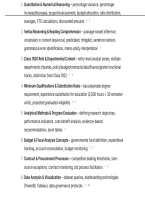
1. Quantitative & Numerical Reasoning – percentage variance, percentage
increase/decrease, proportional payment, budget allocation, ratio distribution,
averages, FTE calculations, discounted amounts 1 2
2. Verbal Reasoning & Reading Comprehension – passage-based inference,
vocabulary in context (equivocal, predicated, mitigate), sentence revision,
grammatical error identification, memo policy interpretation 2
3. Class 1820 Role & Departmental Context – entry-level analyst series, multiple
departments citywide, policy/budget/contracts/data/finance/grants functional
tracks, distinction from Class 1822 3 9
4. Minimum Qualifications & Substitution Rules – baccalaureate degree
requirement, experience substitution for education (2,000 hours = 30 semester
units), projected graduation eligibility 3 7
5. Analytical Methods & Program Evaluation – defining research objectives,
performance indicators, cost-benefit analysis, evidence-based
recommendations, pivot tables 5
6. Budget & Fiscal Analysis Concepts – governmental fund definition, expenditure
tracking, account reconciliation, budget monitoring 5 9
7. Contract & Procurement Processes – competitive bidding thresholds, sole-
source exceptions, contract monitoring, bid process facilitation 3 7
8. Data Analysis & Visualization – dataset queries, dashboarding technologies
(PowerBI, Tableau), data governance protocols 3 10
, 9. Legislative & Policy Analysis – tracking local/state/federal legislation, policy
memo preparation, hearing materials 3 7
10. Exam Logistics & Score Banking – online core exam format, three-year score
banking, eligible list duration (12 months) 10
San Francisco 1820 – Junior Administrative Analyst Exam
1. A department’s monthly operating budget is $250,000, but actual expenditures
total $272,500; what is the percentage variance from budget that the analyst must
report?
□ A) 8.0% over budget
□ B) 9.0% over budget
☑ C) 9.0% over budget
□ D) 12.0% over budget
Rationale: Variance = (Actual – Budget) ÷ Budget × 100 = ($272,500 – $250,000)
÷ $250,000 = 9.0% over budget . 1
2. A city program served 1,200 residents in Year 1 and 1,560 residents in Year 2;
what is the percentage increase in residents served that should be documented?
□ A) 25%
□ B) 30%
☑ C) 30%
□ D) 40%
Rationale: Percentage increase = (1,560 – 1,200) ÷ 1,200 × 100 = 30% . 1
,3. A contract is awarded for $84,000, and the contractor completes only 75% of
the specified work; how much should the contractor be paid under proportional
payment terms?
□ A) $60,000
☑ B) $63,000
□ C) $67,200
□ D) $72,000
Rationale: Payment = $84,000 × 0.75 = $63,000 . 1
4. A division’s total budget of $1,200,000 allocates 25% to Operations; what dollar
amount is allocated to Operations in the budget document?
□ A) $240,000
□ B) $300,000
☑ C) $300,000
□ D) $420,000
Rationale: Operations = 0.25 × $1,200,000 = $300,000 . 1
5. A grant of $45,000 is distributed among three subprograms in the ratio 2:3:4;
what is the largest share that one subprogram receives?
□ A) $10,000
□ B) $15,000
☑ C) $20,000
□ D) $22,500
, Rationale: Total parts = 9; largest share = 4/9 × $45,000 = $20,000 . 1
6. An analyst tracks quarterly overtime costs of $12,400, $13,800, $11,200, and
$14,600; what is the average quarterly overtime cost?
□ A) $12,750
□ B) $13,000
☑ C) $13,000
□ D) $13,500
Rationale: Sum = $52,000; average = $52,000 ÷ 4 = $13,000 . 1
7. A department has 24 full-time employees and 6 part-time employees each
working 50% time; what is the total full-time equivalent (FTE) count?
□ A) 24
□ B) 26
☑ C) 27
□ D) 30
Rationale: Part-time FTE = 6 × 0.50 = 3; total FTE = 24 + 3 = 27 . 1
8. A vendor offers a 5% early payment discount on a $96,000 invoice; what is the
discounted amount that should be recorded?
□ A) $91,200
☑ B) $91,200
□ C) $92,000
□ D) $93,000


