
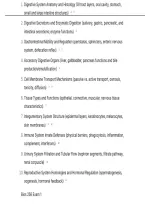
1. Digestive System Anatomy and Histology (GI tract layers, oral cavity, stomach,
small and large intestine structures) 2 5
2. Digestive Secretions and Enzymatic Digestion (salivary, gastric, pancreatic, and
intestinal secretions; enzyme functions) 2
3. Gastrointestinal Motility and Regulation (peristalsis, sphincters, enteric nervous
system, defecation reflex) 2 5
4. Accessory Digestive Organs (liver, gallbladder, pancreas functions and bile
production/emulsification) 5
5. Cell Membrane Transport Mechanisms (passive vs. active transport, osmosis,
tonicity, diffusion) 3 9
6. Tissue Types and Functions (epithelial, connective, muscular, nervous tissue
characteristics) 3
7. Integumentary System Structure (epidermal layers, keratinocytes, melanocytes,
skin membranes) 9 13
8. Immune System Innate Defenses (physical barriers, phagocytosis, inflammation,
complement, interferons) 12
9. Urinary System Filtration and Tubular Flow (nephron segments, filtrate pathway,
renal corpuscle) 11
10. Reproductive System Homologies and Hormonal Regulation (spermatogenesis,
oogenesis, hormonal feedback) 6
Bios 256 Exam 1
,1. Which of the following sequences correctly describes the flow of filtrate
through the renal tubule structures from the initial site of filtration to the
collecting duct?
A. Renal corpuscle, proximal convoluted tubule, nephron loop, distal convoluted
tubule, collecting duct
B. Renal corpuscle, distal convoluted tubule, proximal convoluted tubule, nephron
loop, collecting duct
C. Proximal convoluted tubule, renal corpuscle, nephron loop, distal convoluted
tubule, collecting duct
D. Nephron loop, renal corpuscle, proximal convoluted tubule, collecting duct,
distal convoluted tubule
Correct Answer: A
Rationale: Filtration begins at the renal corpuscle, and filtrate then flows
sequentially through the proximal convoluted tubule, descending and ascending
limbs of the nephron loop, the distal convoluted tubule, and finally into the
collecting duct . 11
2. Which of the following statements most accurately distinguishes the
functional role of the intrinsic salivary glands from that of the extrinsic salivary
glands in the oral cavity?
A. Intrinsic glands produce lingual lipase exclusively, while extrinsic glands
produce only mucus for lubrication.
B. Intrinsic glands keep the mouth moist when not chewing, while extrinsic glands
,produce secretions that aid digestive processes.
C. Intrinsic glands are located beneath the skin anterior to the earlobes, while
extrinsic glands are found within the tongue.
D. Intrinsic glands secrete bicarbonate to neutralize acid, while extrinsic glands
secrete amylase only during meals.
Correct Answer: B
Rationale: Intrinsic salivary glands (lingual, labial, palatine, buccal) maintain
moisture when not eating, whereas extrinsic glands (parotid, submandibular,
sublingual) provide the bulk of saliva involved in digestion . 5
3. Which of the following correctly identifies the primary function of the
myenteric plexus within the gastrointestinal tract wall and its effect on digestive
motility?
A. It innervates the mucosa to stimulate enzyme secretion and decrease motility.
B. It innervates the muscularis layer and increases gastrointestinal motility.
C. It controls blood flow to the villi and reduces peristaltic waves.
D. It regulates hormonal release from enteroendocrine cells and inhibits
segmentation.
Correct Answer: B
Rationale: The myenteric plexus (Auerbach's plexus) lies between the circular and
longitudinal muscle layers and primarily controls gastrointestinal motility by
increasing muscular contractions . 5
, 4. Which of the following best describes the role of bile salts in the digestion of
lipids within the small intestine lumen?
A. They hydrolyze triglycerides into free fatty acids and monoglycerides directly.
B. They emulsify lipids using amphipathic properties to increase surface area for
lipase action.
C. They transport digested fatty acids across the apical membrane of enterocytes.
D. They neutralize gastric acid to create an optimal pH for pancreatic amylase.
Correct Answer: B
Rationale: Bile salts are amphipathic molecules that emulsify large lipid droplets
into smaller micelles, greatly increasing the surface area available for pancreatic
lipase to digest triglycerides . 5
5. A patient presents with a duodenal ulcer, and testing confirms the presence of
Helicobacter pylori. Which of the following statements best explains the
mechanism by which this organism contributes to ulcer formation?
A. It secretes large quantities of hydrochloric acid that directly erode the gastric
mucosa.
B. It is an acid-resistant bacterium that damages the gastric mucosa and causes
inflammation.
C. It blocks the secretion of intrinsic factor, leading to pernicious anemia and
mucosal atrophy.
D. It hyperstimulates the vagus nerve, causing excessive pepsinogen release and
auto-digestion.


