
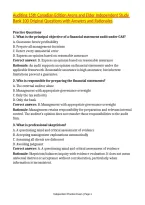
Auditing 15th Canadian Edition Arens and Elder Independent Study
Bank 100 Original Questions with Answers and Rationales
Practice Questions
1. What is the principal objective of a financial statement audit under CAS?
A. Guarantee future profitability
B. Prepare all management decisions
C. Detect every immaterial error
D. Express an opinion based on reasonable assurance
Correct answer: D. Express an opinion based on reasonable assurance
Rationale: An audit supports an opinion on financial statements under the
applicable framework. Reasonable assurance is high assurance, but inherent
limitations prevent a guarantee.
2. Who is responsible for preparing the financial statements?
A. The external auditor alone
B. Management with appropriate governance oversight
C. Only the tax authority
D. Only the bank
Correct answer: B. Management with appropriate governance oversight
Rationale: Management retains responsibility for preparation and relevant internal
control. The auditor's opinion does not transfer those responsibilities to the audit
firm.
3. What is professional skepticism?
A. A questioning mind and critical assessment of evidence
B. Accepting management explanations automatically
C. Assuming all clients are dishonest
D. Avoiding judgment
Correct answer: A. A questioning mind and critical assessment of evidence
Rationale: Skepticism balances inquiry with evidence evaluation. It does not mean
universal distrust or acceptance without corroboration, particularly when
information is inconsistent.
Independent Practice Exam | Page 1
,4. Why is independence in appearance important?
A. Users must be able to trust the auditor's objectivity
B. It applies only to clothing
C. It substitutes for technical competence
D. It eliminates every audit risk
Correct answer: A. Users must be able to trust the auditor's objectivity
Rationale: Relationships can undermine perceived objectivity even when the
auditor believes judgment is unaffected. Relevant ethical requirements address both
actual and perceived independence.
5. An audit partner owns a direct financial interest in the client. What is
appropriate?
A. Use a larger sample as a complete cure
B. Ignore it because the amount feels small
C. Disclose only after issuing the report
D. Evaluate and resolve the independence breach under applicable rules
Correct answer: D. Evaluate and resolve the independence breach under applicable
rules
Rationale: Financial interests can impair independence. Additional audit work does
not itself remove a prohibited interest or resolve the ethical and engagement
consequences.
6. Which responsibility belongs to those charged with governance?
A. Set the auditor's sample results
B. Perform every audit procedure
C. Guarantee all receivables are collected
D. Oversight of the financial reporting process
Correct answer: D. Oversight of the financial reporting process
Rationale: Governance oversight is distinct from management preparation and
external auditing. Communication with this group supports accountability without
replacing the auditor's evidence requirements.
Independent Practice Exam | Page 2
, 7. Before accepting a new audit, what should the firm assess?
A. Only the proposed fee
B. Only management's preferred opinion
C. Only office size
D. Integrity, independence, competence, resources, and engagement preconditions
Correct answer: D. Integrity, independence, competence, resources, and
engagement preconditions
Rationale: Acceptance decisions affect whether a high-quality audit is feasible. A
profitable fee does not overcome independence problems or missing engagement
preconditions.
8. What is an engagement letter intended to clarify?
A. All future business advice
B. Immunity from liability
C. Agreed scope, responsibilities, framework, and reporting terms
D. A guaranteed unmodified opinion
Correct answer: C. Agreed scope, responsibilities, framework, and reporting terms
Rationale: Written terms establish a common understanding of the audit. They do
not guarantee findings or override professional standards and legal responsibilities.
9. A predecessor auditor is being replaced. What is appropriate?
A. Communicate as permitted and required, addressing confidentiality
B. Ignore professional requirements
C. Assume there are no issues
D. Demand unrestricted disclosure without authority
Correct answer: A. Communicate as permitted and required, addressing
confidentiality
Rationale: Predecessor communication can reveal integrity or scope concerns.
Obtain appropriate authorization and follow applicable professional and
confidentiality requirements.
10. Which distinction between an audit and a review is accurate?
A. A review always provides greater assurance
B. Neither involves any evidence
C. An audit is merely bookkeeping
D. A review provides limited rather than reasonable assurance
Correct answer: D. A review provides limited rather than reasonable assurance
Rationale: Review procedures and assurance differ from an audit. Users should not
treat a limited-assurance conclusion as equivalent to an audit opinion.
Independent Practice Exam | Page 3


