
ISYE 6644 Exam 1 Exam with correct Answers
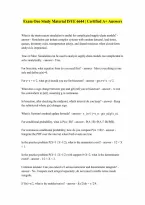
Exam One Study Material ISYE 6644 | Certified A+ Answers What is the main reason simulation is useful for complicated supply-chain models? - answer - Simulation can imitate complex systems with random demand, lead times, queues, inventory rules, transportation delays, and shared resources when closed-form analysis is impractical. True or False: Simulation can be used to analyze supply-chain models too complicated to solve analytically. - answer - True. For bisection, what equation form do you need first? - answer - Move everything to one side and define g(x)=0. For e^x = x^2, what g(x) should you use for bisection? - answer - g(x)=e^x - x^2. What does a sign change between g(a) and g(b) tell you in bisection? - answer - A root lies somewhere in [a,b], assuming g is continuous. In bisection, after checking the midpoint, which interval do you keep? - answer - Keep the subinterval where g(x) changes sign. What is Newton's method update formula? - answer - x_{n+1}=x_n - g(x_n)/g'(x_n). For conditional probability, what is P(A | B)? - answer - P(A | B)=P(A ∩ B)/P(B). For continuous conditional probability, how do you compute P(A ∩ B)? - answer - Integrate the PDF over the interval where both events are true. In the practice problem P(X1 | X1/2), what is the numerator event? - answer - 1/2 X 1. In the practice problem P(X1 | X1/2) with support 0X2, what is the denominator event? - answer - 1/2 X 2. Common mistake: Can you cancel x/2 across numerator and denominator integrals? - answer - No. Compute each integral separately; do not cancel variable terms inside integrals. If f(x)=x/2, what is the antiderivative? - answer - ∫(x/2)dx = x^2/4. For the practice conditional probability with f(x)=x/2, what is P(X1 | X1/2)? - answer - 0.2. What distribution models the trial number of the first success? - answer - Geometric distribution. For Geom(p) counting the successful trial itself, what is P(X=k)? - answer - (1-p)^{k-1}p. For Geom(p) counting the successful trial itself, what is E[X]? - answer - 1/p. If each trial succeeds with probability 0.6, what is P(first success on trial 3)? - answer - (0.4)^2(0.6)=0.096. In a geometric problem, what does q usually mean? - answer - q=1-p, the failure probability. For a 10-sided die, what is the success probability of rolling a 5? - answer - p=1/10. Expected tosses until rolling a 5 on a 10-sided die? - answer - E[X]=1/p=10. What are the possible values of a Bernoulli random variable? - answer - 0 and 1. For X~Bern(p), what are P(X=1) and P(X=0)? - answer - P(X=1)=p and P(X=0)=1-p. What does LOTUS stand for? - answer - Law of the Unconscious Statistician. For discrete X, how do you compute E[g(X)] using LOTUS? - answer - Sum g(x)P(X=x) over all possible x. If X~Bern(0.5), what is E[e^X]? - answer - (1+e)/2. For affine expectation, what is E[aX+b]? - answer - aE[X]+b. If E[X]=-2, what is E[-3X-7]? - answer - -3(-2)-7 = -1. In E[-3X-7], why is variance irrelevant? - answer - Expectation of a linear expression only needs the mean; variance is a distractor. What does 'shift happens' mean for expectation? - answer - Adding/subtracting a constant stays in the expectation: E[X+c]=E[X]+c. For variance, does shift happen? - answer - No. Var(X+c)=Var(X). What is Var(aX+b)? - answer - a^2 Var(X). If Var(X)=3, what is Var(-3X-7)? - answer - (-3)^2 * 3 = 27. What is the correlation formula? - answer - Corr(X,Y)=Cov(X,Y)/sqrt(Var(X)Var(Y)). If Cov(X,Y)=0, what is Corr(X,Y) when variances are positive? - answer - 0. What is Var(aX+bY)? - answer - a^2 Var(X)+b^2 Var(Y)+2ab Cov(X,Y). What is the special formula for Var(X-Y)? - answer - Var(X)+Var(Y)-2Cov(X,Y). What is Var(X-2Y) in terms of Var and Cov? - answer - Var(X)+4Var(Y)-4Cov(X,Y). If Var(X)=Var(Y)=10 and Cov(X,Y)=6, what is Var(X-2Y)? - answer - 10 + 4(10) - 4(6) = 26. Common mistake in Var(X-2Y): should you subtract Var(Y) because of the minus sign? - answer - No. The coefficient is squared for variance
Document information
- Uploaded on
- October 24, 2026
- Number of pages
- 11
- Written in
- 2026/2027
- Type
- Exam (elaborations)
- Contains
- Questions & answers


