
PHYSICS NOTES 4U / DETAILED TOPIC SERIES
Nuclear physics
AQA 7408 | Detailed topic revision
Detailed topic pack / AQA 7408 section 3.8
Connect evidence for a tiny nucleus to random decay, nuclear size and the mass changes that
power fission and fusion. Distinguish activity from detector count rate, and separate statistical
fluctuation from a change in decay probability.
Scattering; radiation identification and hazards; inverse-square law and practical 12; decay
models and dating; stability and nuclear equations; nuclear radius and density; mass defect
and binding energy; reactors and waste. Eighteen original tasks with worked solutions.
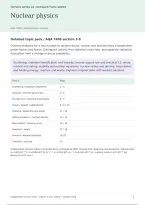
Find it Page
Scattering / radiation properties 2/3
Hazards / inverse-square law 4/5
Practical 12 / counting uncertainty 6/7
Decay / graphs / applications / 10
Stability / equations and levels
Radius evidence / nuclear density
Mass defect / binding curve
Reactors / safety
Practice / worked solutions 19–22
Checklist / sources 23
Independent revision notes, not produced or endorsed by AQA. Original text, diagrams and questions. Values used:
e=1.60×10⁻¹⁹ C, k=8.99×10⁹ N m² C⁻², c=3.00×10⁸ m s⁻¹, h=6.63×10⁻³⁴ J s, nucleon mass≈1.67×10⁻²⁷ kg,
NA=6.02×10²³ mol⁻¹.
Independent revision notes • Edition 1.0 for review • October 2026 1
,PHYSICS NOTES 4U / DETAILED TOPIC SERIES
Scattering / evidence and inference
AQA 7408 | Detailed topic revision
In the early diffuse-positive-charge model, an alpha particle should undergo mainly small
deflections through thin metal. Alpha particles are relatively massive and positively charged. A
collimated beam passes through a thin foil; a movable detector measures particles at different
scattering angles.
Observation Supported inference
Most pass with little deflection Most atomic volume is empty on the nuclear scale.
Some deflect through large angles Positive charge is concentrated enough to exert strong repulsion.
Very few scatter backward A very small, massive, positively charged region can reverse an
alpha particle.
Why thin foil and evacuation?
Thin foil reduces multiple scattering, so a large deflection is attributable mainly to a close
encounter with one nucleus. Air collisions would scatter and slow alpha particles, so the beam
path is evacuated.
The nuclear model has most atomic mass and all positive nuclear charge in a tiny nucleus;
electrons occupy the much larger surrounding region. The result did not show that electrons
sit inside the nucleus.
A nearer approach gives stronger Coulomb repulsion and generally a larger deflection. A
head-on encounter gives closest approach for the same initial kinetic energy in the
heavy-stationary-nucleus approximation.
State observation before inference. Nuclear radii are around 10⁻¹⁵–10⁻¹⁴ m; atomic radii are around 10⁻¹⁰ m.
Independent revision notes • Edition 1.0 for review • October 2026 2
, PHYSICS NOTES 4U / DETAILED TOPIC SERIES
Radiation / identify the emissions
AQA 7408 | Detailed topic revision
Emission Nature and behaviour
Alpha, α Helium-4 nucleus: charge +2e, nucleon number 4. Strongly
ionising, short range; stopped by paper or outer skin.
Beta minus, β− Fast electron created in neutron-to-proton decay. Charge −e;
moderate penetration; thin aluminium absorbs much school-source
beta radiation.
Beta plus, β+ Positron created in proton-to-neutron decay. Charge +e; annihilates
with an electron.
Gamma, γ High-energy electromagnetic photon. No charge or rest mass;
penetrating and weakly ionising indirectly. Lead/concrete reduce
intensity rather than guaranteeing zero.
Absorption identification
Measure background, then count rate at fixed geometry. Insert paper, aluminium, then
increasing dense shielding. Subtract background and compare corrected rates. A component
removed by paper suggests alpha; further reduction with aluminium suggests beta; a
penetrating remainder reduced by lead suggests gamma.
A source may emit more than one type. The detector window and air path matter:
undetected alpha may never reach the sensitive region. One absorption reading does not
prove a pure emission type.
Thickness control
Choose radiation partly absorbed by the sheet at its intended thickness. A thicker sheet gives
lower transmitted rate; feedback changes rollers. Beta can suit paper/aluminium foil; more
penetrating gamma can suit steel. Alpha is often absorbed completely and then gives little
thickness sensitivity.
Beta minus particles are not orbital electrons ejected from the atom. Gamma alone changes neither nucleon
number nor proton number.
Independent revision notes • Edition 1.0 for review • October 2026 3


