
PHYSICS NOTES 4U / DETAILED TOPIC SERIES
Circular motion and oscillations
AQA 7408 | Detailed topic revision
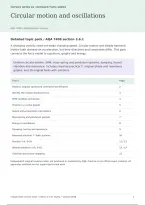
Detailed topic pack / AQA 7408 section 3.6.1
A changing velocity need not mean changing speed. Circular motion and simple harmonic
motion both demand an acceleration, but their directions and constraints differ. This pack
connects the force model to equations, graphs and energy.
Uniform circular motion, SHM, mass-spring and pendulum systems, damping, forced
vibration and resonance. Includes required practical 7, original phase and resonance
graphs, and 16 original tasks with solutions.
Find it Page
Radians, angular speed and centripetal acceleration 2
Identify the inward resultant force 3
SHM condition and phase 4
Original x-v-a time graphs 5
Speed and acceleration calculations 6
Mass-spring and pendulum periods 7
Energy in oscillations 8
Damping, forcing and resonance 9
Required practical 7 / both systems 10
Practice 1--16
Worked solutions 1--16
Checklist and source mapping 15
Independent original revision notes, not produced or endorsed by AQA. Practice is not official exam material. All
apparatus methods are for supervised school work.
Independent revision notes • Edition 1.0 for review • October 2026 1
, PHYSICS NOTES 4U / DETAILED TOPIC SERIES
Uniform circular motion / changing
direction
AQA 7408 | Detailed topic revision
Angles in radians
An angle θ in radians equals arc length s divided by radius r: θ=s/r. One full circle is 2π
rad=360°. Use radians in angular equations. Angular speed ω=2π/T=2πf=v/r, in rad s−1. v is
tangential speed.
At constant speed: acceleration points toward the circle centre because the velocity
direction changes.
a=v²/r=ω²r; inward resultant force F=ma=mv²/r=mω²r.
Velocity is tangent, so perpendicular to acceleration at every instant.
Centripetal means centre-seeking. It describes the required resultant, not a new extra force to
add alongside tension, gravity or friction. In an inertial frame, a body does not need a real
outward force to balance the inward one; it is accelerating inward, not in equilibrium.
Worked rotation
A mass moves at radius 0.40 m with frequency 2.0 Hz. ω=2πf=12.57 rad s−1; v=ωr=5.03 m
s−1; a=ω²r=63.2 m s−2. For m=0.15 kg, inward resultant=9.47 N.
Comparison Consequence
Double speed at fixed radius Acceleration and inward force become four times
larger.
Double radius at fixed speed Acceleration halves.
Double radius at fixed angular speed Acceleration doubles; speed also doubles.
The derivation of a=v²/r is not examined here. Direction of angular velocity is not required. Constant speed does
not mean zero acceleration or constant velocity.
Independent revision notes • Edition 1.0 for review • October 2026 2


