
PHYSICS NOTES 4U / DETAILED TOPIC SERIES
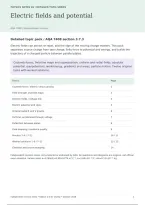
Electric fields and potential
AQA 7408 | Detailed topic revision
Detailed topic pack / AQA 7408 section 3.7.3
Electric fields can attract or repel, and the sign of the moving charge matters. This pack
separates source charge from test charge, links force to potential and energy, and builds the
trajectory of a charged particle between parallel plates.
Coulomb forces, field-line maps and superposition, uniform and radial fields, absolute
potential, equipotentials, work/energy, gradients and areas, particle motion. Twelve original
tasks with worked solutions.
Find it Page
Coulomb force / electric versus gravity 2
Field strength and field maps 3
Uniform fields / voltage link 4
Electric potential and signs 5
Original radial E and V graphs 6
Particles accelerated through voltage 7
Deflection between plates 8
Field mapping / evidence quality 9
Practice 1––12
Worked solutions 1––12
Checklist and source mapping 14
Independent revision notes, not produced or endorsed by AQA. All questions and diagrams are original, not official
exam material. Values used: k=1/(4πε0)=8.99×10⁹ N m² C⁻²; e=1.60×10⁻¹⁹ C; me=9.11×10⁻³¹ kg.
Independent revision notes • Edition 1.0 for review • October 2026 1
, PHYSICS NOTES 4U / DETAILED TOPIC SERIES
Coulomb force / source and test charge
AQA 7408 | Detailed topic revision
Magnitude of force between point charges in a vacuum:
F=k|Qq|/r², where k=1/(4πε0).
ε0≈8.85×10⁻¹² F m−1 is free-space permittivity.
Like charges repel; unlike charges attract. Direction is along the joining line.
Air can normally be treated as vacuum for these force calculations. Outside a spherically
symmetric charged sphere, treat the charge as concentrated at its centre. Do not extend that
rule automatically to arbitrary nonspherical conductors or internal points.
Worked pair
Charges +2.0 nC and −3.0 nC are 0.10 m apart.
F=8.99×10⁹×2.0×10−9×3.0×10−9/0.10²=5.39×10−6 N, attractive. Each feels the same force
magnitude, despite having different charge magnitudes.
Compare with gravity between particles
For an electron and proton: Fe/Fg=ke²/(Gmemp). The r² terms cancel. Taking mp=1.67×10⁻²⁷
kg and G=6.67×10⁻¹¹, this ratio is about 2.27×10³⁹. Both forces attract for this pair, but the
electric interaction is much larger.
Similarity Difference
Inverse-square radial point-source force; field and Gravity acts on mass and is attractive; electrostatic
potential descriptions. force acts on charge and can attract or repel.
Forces between two objects are equal and opposite. The two accelerations need not match: a=F/m.
Use charge in coulombs and centre-to-centre distance in metres. Micro (μ)=10⁻⁶ and nano (n)=10⁻⁹; squaring a
distance is a common factor-of-100 trap.
Independent revision notes • Edition 1.0 for review • October 2026 2


