
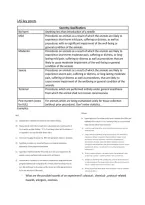
LAS key points
Severity classifica.ons
No harm Anything less than introduc4on of a needle
Mild Procedures on animals as a result of which the animals are likely to
experience short-term mild pain, suffering or distress, as well as
procedures with no significant impairment of the well-being or
general condi4on of the animals
Moderate Procedures on animals as a result of which the animals are likely to
experience short-term moderate pain, suffering or distress, or long-
las4ng mild pain, suffering or distress as well as procedures that are
likely to cause moderate impairment of the well-being or general
condi4on of the animals
Severe Procedures on animals as a result of which the animals are likely to
experience severe pain, suffering or distress, or long-las4ng moderate
pain, suffering or distress as well as procedures, that are likely to
cause severe impairment of the wellbeing or general condi4on of the
animals
Terminal Procedures which are performed en4rely under general anesthesia
from which the animal shall not recover consciousness
Post-mortem (extra For animals which are being euthanized solely for 4ssue collec4on
for KUL) (without prior procedure). Don’t enter sta4s4cs.
Examples:
- What are the possible hazards of an experiment?: physical-, chemical-, protocol-related
hazards, allergens, zoonosis.
, - A humane endpoint is a predefined point at which researchers must intervene to
prevent or relieve an animal’s pain or distress.
It is based on observable criteria, such as weight loss, reduced movement, or inability to eat or
drink. Interven4on may involve treatment, stopping the procedure, removing the animal from
the study, or euthanasia.
- The 3 Rs in animal research are:
• Replacement: use alternatives to animals whenever possible, such as cell cultures or
computer models.
• Reduction: use the fewest animals needed to obtain scientifically valid results.
• Refinement: minimise pain, suffering and distress, and improve animal welfare—for
example, through analgesia and enrichment.
Remember: Replace animals → Reduce their number → Refine their care and procedures.
Teeth formulas
Rodents 1I, 0C, 0P, 3M (! Diastema)
Guinea pig 1I, C, 1P, 3M
Rabbit I 2/1, C 0/0, PM 3/2, M 3/3
La.n names
Mouse Mus musculus
Rat Ra*us norvegicus
Hamster Mesocricetus auratus
Guinea pig Cavia porcellus
Rabbit Oryctolagus cuniculus
Xenopus Xenopus laevis
Zebrafish Brachydanio rerio
Pig Sus scrofa
Lee-Booth effect Absence of a male, females housed together evolve towards anœstrus
Whiben effect Group of females are exposed to a male: œstrus cycles are s4mulated
and synchronized
Bruce effect Acer a successful ma4ng, another male is introduced into the cage
within 24 hours à no implanta4on
Sexing
Mice and rats Anogenital distance in M is twice as long as in F
Hamsters Anogenital distance in M is twice as long as in F


