
ATLS EXAM MASTER COMPILATION & REVIEW GUIDE
2026/2027 EDITION
Executive Overview
This comprehensive document provides an exhaustive, premium collection of
Advanced Trauma Life Support (ATLS) review questions, answers, and clinical
rationales. Designed for medical professionals, emergency medicine physicians, and
trauma nurses preparing for certification or recertification, this guide synthesizes core
principles of primary and secondary surveys, airway management, shock resuscitation,
neurotrauma, musculoskeletal injuries, and specialized clinical scenarios.
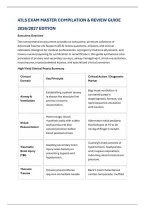
High-Yield Clinical Pearls Summary
Clinical Critical Action / Diagnostic
Key Principle
Domain Marker
Bag-mask ventilation is
Establishing a patent airway
contraindicated in
Airway & is always the absolute first
diaphragmatic hernias; use
Ventilation priority in trauma
rapid sequence intubation
resuscitation.
with caution.
Hemorrhagic shock
manifests early with subtle Administer initial pediatric
Shock
tachycardia and skin fluid boluses at 10 to 20
Resuscitation
vasoconstriction before mL/kg of Ringer's lactate.
blood pressure drops.
Cushing's triad consists of
Avoiding secondary brain
Traumatic hypertension, bradycardia,
injury relies heavily on
Brain Injury and irregular respirations
preventing hypoxia and
(TBI) indicating raised intracranial
hypotension.
pressure.
Thoracic Tension pneumothorax Beck's triad characterizes
Trauma requires immediate needle cardiac tamponade: muffled
, Clinical Critical Action / Diagnostic
Key Principle
Domain Marker
decompression followed by heart sounds, jugular venous
chest tube placement. distension, and hypotension.
Comprehensive ATLS Practice Questions (1 to 150)
1. What is the most effective method of monitoring the success of resuscitation
during CPR?
• Answer: Reactivity of pupils to light
• Explanation: Monitoring pupillary light reflex offers immediate neurological
feedback regarding brain perfusion recovery during active cardiac resuscitation
efforts.
2. Which clinical modalities are utilized to ensure correct placement of an
endotracheal tube?
• Answer: Ultrasound, bilateral breath sounds, and sustained end-tidal CO2
• Explanation: Verifying tube placement via multiple independent modalities
prevents unrecognized esophageal intubation and ensures adequate ventilation.
3. What is the estimated total body surface area (TBSA) involved in a burn affecting
the anterior chest and abdomen in an adult?
• Answer: 18%
• Explanation: According to the Rule of Nines, the anterior trunk (chest and
abdomen combined) accounts for 18% of the total body surface area in adults.
4. Which common physiological response is frequently caused by excessive
carotid massage?
• Answer: Bradycardia
• Explanation: Carotid sinus stimulation activates the vagus nerve, causing a
marked decrease in heart rate and potential transient hypotension.
5. What are the immediate sequential steps required in a patient diagnosed with a
tension pneumothorax?
, • Answer: 1. Needle decompression / thoracostomy, followed by 2. Chest tube
insertion
• Explanation: Needle decompression relieves life-threatening mediastinal shift
immediately, which is then definitively managed by inserting a chest tube.
6. What are the true clinical statements regarding diaphragmatic injuries?
• Answer: Blunt diaphragmatic injuries are usually associated with skeletal
trauma; penetrating injuries may be missed; repair usually does not require
prosthetic material.
• Explanation: High-energy blunt forces frequently fracture adjacent bony
structures, whereas small penetrating stab wounds can easily escape initial
detection.
7. What is the absolute first priority in the clinical evaluation and treatment of an
unconscious trauma patient?
• Answer: Checking the pulse (Circulation check / primary survey initiation)
• Explanation: Rapid assessment of cardiac output dictates whether immediate
life-saving chest compressions or advanced life support protocols must be
initiated.
8. A patient involved in a road accident arrives unconscious with vitals: Temp
96.4°F, RR 24 breaths/min, HR 140 beats/min, BP 80/40 mm Hg. She is cold,
shivering, and perspiring profusely with bilateral reactive pupils but no response to
pain. Physical exam reveals no external bleeding. Which of the following cannot be
the cause of hypotension in this patient?
• Answer: C. Intracranial hemorrhage
• Explanation: Acute isolated intracranial hemorrhage does not cause
hypovolemic shock or systemic hypotension in adults because the cranial vault
cannot accommodate enough blood loss to lower systemic blood pressure.
9. A patient suffers a slash to his right neck over the mid-portion of the
sternocleidomastoid with a large hematoma and brisk bleeding. He is stable. What
is the next step in management?
• Answer: C. Take him to the operating room
• Explanation: Expanding neck hematomas and active bleeding involving critical
zone vascular structures mandate immediate surgical exploration in the
operating room.


