
^*&^@*&$@$*%*$&^+*&T@$^&$@**&$@^$*&@$^*&$@@^$@&$R^RF&V&EBD*&DBN(*OIU@R)(@+_R)R_(R@))(!))*)_~)~()@(@))U89010/19/2026,
community
10/19/2026,
health nursing..pdf(*&*@T*^#&*^&$^&^&*$^*&^@*&$@$*%*$&^+*&T@$^&$@**&$@^$*&@$^*&$@@^$@&$R^RF&V&EBD*&DBN(*OIU@R)(@+_R)R_(R@))(
1:46:02 PM2026/10/19Chapter 1_ overview of community health nursing..pdf(*&*@T*^#&*^&$^&^&*$^*&^@*&$@$*%*$&^+*&T@$^&$@**&$@^$*&@$
1:39:29 PM
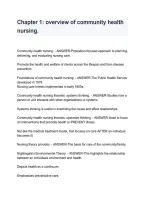
Chapter 1: overview of community health
nursing.
Community health nursing: - ANSWER-Population-focused approach to planning,
delivering, and evaluating nursing care.
Promote the health and welfare of clients across the lifespan and from disease
prevention.
Foundations of community health nursing: - ANSWER-The Public Health Service
developed in 1978.
Nursing care homes implemented in early 1800s:
Community health nursing theories: systems thinking. - ANSWER-Studies how a
person or unit interacts with other organizations or systems.
Systems thinking is useful in examining the cause and effect relationships.
Community health nursing theories: upstream thinking. - ANSWER-Used to focus
on interventions that promote health or PREVENT illness.
Not like the medical treatment model, that focuses on care AFTER an individual
becomes ill.
Nursing theory provides: - ANSWER-The basis for care of the community/family.
Nightingale's Environmental Theory: - ANSWER-This highlights the relationship
between an individuals environment and health.
Depicts health as a continuum.
Emphasizes preventative care.
ommunity
^*&^@*&$@$*%*$&^+*&T@$^&$@**&$@^$*&@$^*&$@@^$@&$R^RF&V&EBD*&DBN(*OIU@R)(@+_R)R_(R@))(!))*)_~)~()@(@))U89010/19/2026,
Page
health1 nursing..pdf(*&*@T*^#&*^&$^&^&*$^*&^@*&$@$*%*$&^+*&T@$^&$@**&$@^$*&@$^*&$@@^$@&$R^RF&V&EBD*&DBN(*OIU@R)(@+_R)R_(R@))(!))
of 162026/10/19Chapter 1_ overview of community health nursing..pdf(*&*@T*^#&*^&$^&^&*$^*&^@*&$@$*%*$&^+*&T@$^&$@**&$@^$*&@$^*&$@@^
1:39:29 PM
,^*&^@*&$@$*%*$&^+*&T@$^&$@**&$@^$*&@$^*&$@@^$@&$R^RF&V&EBD*&DBN(*OIU@R)(@+_R)R_(R@))(!))*)_~)~()@(@))U89010/19/2026,
community
10/19/2026,
health nursing..pdf(*&*@T*^#&*^&$^&^&*$^*&^@*&$@$*%*$&^+*&T@$^&$@**&$@^$*&@$^*&$@@^$@&$R^RF&V&EBD*&DBN(*OIU@R)(@+_R)R_(R@))(
1:46:02 PM2026/10/19Chapter 1_ overview of community health nursing..pdf(*&*@T*^#&*^&$^&^&*$^*&^@*&$@$*%*$&^+*&T@$^&$@**&$@^$*&@$
1:39:29 PM
Health Belief Model: - ANSWER-Purpose: to predict or explain health behaviors.
Assumes preventative health actions are taken primarily for the purpose of
AVOIDING disease.
Emphasizes change at an individual level.
Describes the likelihood of taking an action to avoid disease:
1. Perceived susceptibility, seriousness and threat of a disease.
2. Modifying factors (demographic, knowledge level).
3. Cues to action (media campaigns, disease effect on family/friends,
recommendations from health care professionals).
4. Perceived benefits minus perceived barriers to taking action.
Millo's framework for prevention: - ANSWER-Complements the health belief
model.
Emphasizes change at the community level.
Identifies relationship between health deficits and availability of health-promoting
resources.
Theorizes that behavior changes within a large number of people can ultimately
lead to social change.
Pender's health promotion model: - ANSWER-Similar to health belief model.
Does not consider health risks as a factor that provokes change.
Examines factors that affect individual actions to promote and protect health.
- personal factors (biological, psychological, sociocultural) behaviors, abilities,
self-efficacy.
ommunity
^*&^@*&$@$*%*$&^+*&T@$^&$@**&$@^$*&@$^*&$@@^$@&$R^RF&V&EBD*&DBN(*OIU@R)(@+_R)R_(R@))(!))*)_~)~()@(@))U89010/19/2026,
Page
health2 nursing..pdf(*&*@T*^#&*^&$^&^&*$^*&^@*&$@$*%*$&^+*&T@$^&$@**&$@^$*&@$^*&$@@^$@&$R^RF&V&EBD*&DBN(*OIU@R)(@+_R)R_(R@))(!))
of 162026/10/19Chapter 1_ overview of community health nursing..pdf(*&*@T*^#&*^&$^&^&*$^*&^@*&$@$*%*$&^+*&T@$^&$@**&$@^$*&@$^*&$@@^
1:39:29 PM
,^*&^@*&$@$*%*$&^+*&T@$^&$@**&$@^$*&@$^*&$@@^$@&$R^RF&V&EBD*&DBN(*OIU@R)(@+_R)R_(R@))(!))*)_~)~()@(@))U89010/19/2026,
community
10/19/2026,
health nursing..pdf(*&*@T*^#&*^&$^&^&*$^*&^@*&$@$*%*$&^+*&T@$^&$@**&$@^$*&@$^*&$@@^$@&$R^RF&V&EBD*&DBN(*OIU@R)(@+_R)R_(R@))(
1:46:02 PM2026/10/19Chapter 1_ overview of community health nursing..pdf(*&*@T*^#&*^&$^&^&*$^*&^@*&$@$*%*$&^+*&T@$^&$@**&$@^$*&@$
1:39:29 PM
- feelings, benefits, barriers, and characteristics associated with the action.
- attitudes of others, and competing demands and preferences.
Transtheoretical (TTM) of stages of change (SOC) model: - ANSWER-Theorizes
that change occurs over time, and in six distinct stages.
1. Precontemplation: an individual is unaware of the need to change.
2. Contemplation: individuals considers change, and weighs benefits with costs.
3. Preparation: individual plans to take action.
4. Action
5. Maintenance: individual implements actions to continue the behavior.
6. Termination: conscious efforts to continue the health behavior are no longer
needed because the individual is consistent. Most patients never reach this point.
The precaution adoption process model: - ANSWER-Similar to the
transtheoretical and stages of change models.
Includes a stage of being unengaged regarding an issue between the stages of
being unaware and contemplating action.
Does not include a termination stage.
Essentials of community nursing: - ANSWER-Determinate's of health.
Health indicators.
Nurses.
Community.
ommunity
^*&^@*&$@$*%*$&^+*&T@$^&$@**&$@^$*&@$^*&$@@^$@&$R^RF&V&EBD*&DBN(*OIU@R)(@+_R)R_(R@))(!))*)_~)~()@(@))U89010/19/2026,
Page
health3 nursing..pdf(*&*@T*^#&*^&$^&^&*$^*&^@*&$@$*%*$&^+*&T@$^&$@**&$@^$*&@$^*&$@@^$@&$R^RF&V&EBD*&DBN(*OIU@R)(@+_R)R_(R@))(!))
of 162026/10/19Chapter 1_ overview of community health nursing..pdf(*&*@T*^#&*^&$^&^&*$^*&^@*&$@$*%*$&^+*&T@$^&$@**&$@^$*&@$^*&$@@^
1:39:29 PM
community
10/19/2026,
health nursing..pdf(*&*@T*^#&*^&$^&^&*$^*&^@*&$@$*%*$&^+*&T@$^&$@**&$@^$*&@$^*&$@@^$@&$R^RF&V&EBD*&DBN(*OIU@R)(@+_R)R_(R@))(
1:46:02 PM2026/10/19Chapter 1_ overview of community health nursing..pdf(*&*@T*^#&*^&$^&^&*$^*&^@*&$@$*%*$&^+*&T@$^&$@**&$@^$*&@$
1:39:29 PM
Chapter 1: overview of community health
nursing.
Community health nursing: - ANSWER-Population-focused approach to planning,
delivering, and evaluating nursing care.
Promote the health and welfare of clients across the lifespan and from disease
prevention.
Foundations of community health nursing: - ANSWER-The Public Health Service
developed in 1978.
Nursing care homes implemented in early 1800s:
Community health nursing theories: systems thinking. - ANSWER-Studies how a
person or unit interacts with other organizations or systems.
Systems thinking is useful in examining the cause and effect relationships.
Community health nursing theories: upstream thinking. - ANSWER-Used to focus
on interventions that promote health or PREVENT illness.
Not like the medical treatment model, that focuses on care AFTER an individual
becomes ill.
Nursing theory provides: - ANSWER-The basis for care of the community/family.
Nightingale's Environmental Theory: - ANSWER-This highlights the relationship
between an individuals environment and health.
Depicts health as a continuum.
Emphasizes preventative care.
ommunity
^*&^@*&$@$*%*$&^+*&T@$^&$@**&$@^$*&@$^*&$@@^$@&$R^RF&V&EBD*&DBN(*OIU@R)(@+_R)R_(R@))(!))*)_~)~()@(@))U89010/19/2026,
Page
health1 nursing..pdf(*&*@T*^#&*^&$^&^&*$^*&^@*&$@$*%*$&^+*&T@$^&$@**&$@^$*&@$^*&$@@^$@&$R^RF&V&EBD*&DBN(*OIU@R)(@+_R)R_(R@))(!))
of 162026/10/19Chapter 1_ overview of community health nursing..pdf(*&*@T*^#&*^&$^&^&*$^*&^@*&$@$*%*$&^+*&T@$^&$@**&$@^$*&@$^*&$@@^
1:39:29 PM
,^*&^@*&$@$*%*$&^+*&T@$^&$@**&$@^$*&@$^*&$@@^$@&$R^RF&V&EBD*&DBN(*OIU@R)(@+_R)R_(R@))(!))*)_~)~()@(@))U89010/19/2026,
community
10/19/2026,
health nursing..pdf(*&*@T*^#&*^&$^&^&*$^*&^@*&$@$*%*$&^+*&T@$^&$@**&$@^$*&@$^*&$@@^$@&$R^RF&V&EBD*&DBN(*OIU@R)(@+_R)R_(R@))(
1:46:02 PM2026/10/19Chapter 1_ overview of community health nursing..pdf(*&*@T*^#&*^&$^&^&*$^*&^@*&$@$*%*$&^+*&T@$^&$@**&$@^$*&@$
1:39:29 PM
Health Belief Model: - ANSWER-Purpose: to predict or explain health behaviors.
Assumes preventative health actions are taken primarily for the purpose of
AVOIDING disease.
Emphasizes change at an individual level.
Describes the likelihood of taking an action to avoid disease:
1. Perceived susceptibility, seriousness and threat of a disease.
2. Modifying factors (demographic, knowledge level).
3. Cues to action (media campaigns, disease effect on family/friends,
recommendations from health care professionals).
4. Perceived benefits minus perceived barriers to taking action.
Millo's framework for prevention: - ANSWER-Complements the health belief
model.
Emphasizes change at the community level.
Identifies relationship between health deficits and availability of health-promoting
resources.
Theorizes that behavior changes within a large number of people can ultimately
lead to social change.
Pender's health promotion model: - ANSWER-Similar to health belief model.
Does not consider health risks as a factor that provokes change.
Examines factors that affect individual actions to promote and protect health.
- personal factors (biological, psychological, sociocultural) behaviors, abilities,
self-efficacy.
ommunity
^*&^@*&$@$*%*$&^+*&T@$^&$@**&$@^$*&@$^*&$@@^$@&$R^RF&V&EBD*&DBN(*OIU@R)(@+_R)R_(R@))(!))*)_~)~()@(@))U89010/19/2026,
Page
health2 nursing..pdf(*&*@T*^#&*^&$^&^&*$^*&^@*&$@$*%*$&^+*&T@$^&$@**&$@^$*&@$^*&$@@^$@&$R^RF&V&EBD*&DBN(*OIU@R)(@+_R)R_(R@))(!))
of 162026/10/19Chapter 1_ overview of community health nursing..pdf(*&*@T*^#&*^&$^&^&*$^*&^@*&$@$*%*$&^+*&T@$^&$@**&$@^$*&@$^*&$@@^
1:39:29 PM
,^*&^@*&$@$*%*$&^+*&T@$^&$@**&$@^$*&@$^*&$@@^$@&$R^RF&V&EBD*&DBN(*OIU@R)(@+_R)R_(R@))(!))*)_~)~()@(@))U89010/19/2026,
community
10/19/2026,
health nursing..pdf(*&*@T*^#&*^&$^&^&*$^*&^@*&$@$*%*$&^+*&T@$^&$@**&$@^$*&@$^*&$@@^$@&$R^RF&V&EBD*&DBN(*OIU@R)(@+_R)R_(R@))(
1:46:02 PM2026/10/19Chapter 1_ overview of community health nursing..pdf(*&*@T*^#&*^&$^&^&*$^*&^@*&$@$*%*$&^+*&T@$^&$@**&$@^$*&@$
1:39:29 PM
- feelings, benefits, barriers, and characteristics associated with the action.
- attitudes of others, and competing demands and preferences.
Transtheoretical (TTM) of stages of change (SOC) model: - ANSWER-Theorizes
that change occurs over time, and in six distinct stages.
1. Precontemplation: an individual is unaware of the need to change.
2. Contemplation: individuals considers change, and weighs benefits with costs.
3. Preparation: individual plans to take action.
4. Action
5. Maintenance: individual implements actions to continue the behavior.
6. Termination: conscious efforts to continue the health behavior are no longer
needed because the individual is consistent. Most patients never reach this point.
The precaution adoption process model: - ANSWER-Similar to the
transtheoretical and stages of change models.
Includes a stage of being unengaged regarding an issue between the stages of
being unaware and contemplating action.
Does not include a termination stage.
Essentials of community nursing: - ANSWER-Determinate's of health.
Health indicators.
Nurses.
Community.
ommunity
^*&^@*&$@$*%*$&^+*&T@$^&$@**&$@^$*&@$^*&$@@^$@&$R^RF&V&EBD*&DBN(*OIU@R)(@+_R)R_(R@))(!))*)_~)~()@(@))U89010/19/2026,
Page
health3 nursing..pdf(*&*@T*^#&*^&$^&^&*$^*&^@*&$@$*%*$&^+*&T@$^&$@**&$@^$*&@$^*&$@@^$@&$R^RF&V&EBD*&DBN(*OIU@R)(@+_R)R_(R@))(!))
of 162026/10/19Chapter 1_ overview of community health nursing..pdf(*&*@T*^#&*^&$^&^&*$^*&^@*&$@$*%*$&^+*&T@$^&$@**&$@^$*&@$^*&$@@^
1:39:29 PM


