
BIOLOGY
The study of living organisms in brief
Definition of Biology Biology refers to the science that studies living things. This branch of science
investigates the structure of living organisms, energy acquisition, reproduction processes, relationship
with the environment, and evolution.
Major areas of biology
The study of cells is known as cell biology.
Genetics – studies genes, DNA, and heredity.
Ecology – involves study of organisms and environments.
Evolution is the process by which populations evolve.
Biology of man is the study of the body of man and its functions.
Biology is linked with chemistry, physics, environmental science, and many other disciplines. Together,
all of these fields provide us with an understanding of life at all levels.
Biology • 1
, CELLS
The fundamental building blocks of life
All living things on earth are composed of one or more cells. Cells are the basic units of life as they
perform all the functions of life.
Important cell structures
Cell membrane: Controls what enters and leaves the cell.
Cytoplasm: The material inside the cell where many chemical reactions occur.
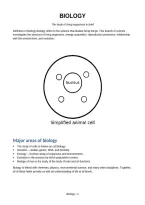
Nucleus: In animal and plant cells, it contains most of the cell's DNA.
Mitochondria: Release usable energy from food through cellular respiration.
Ribosomes: Build proteins needed by the cell.
Plant cells
Plant cells have structures such as a cell wall, chloroplasts, and a large central vacuole. Chloroplasts
contain chlorophyll and are important for photosynthesis.
Biology • 2


