Nursing Misc Hinkle & Cheever Chapter 32 Review Questions
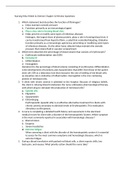
Nursing Misc Hinkle & Cheever Chapter 32 Review Questions Nursing Misc Hinkle & Cheever Chapter 32 Review Questions 1. Which statement best describes the function of fibrinogen? a. helps maintain osmotic pressure b. Functions primarily as an immunological agent c. Plays a key role in forming blood clots d. Helps prevent or modify some types of infectious diseases Hydrogen, the largest share of plasma protein, plays a role in forming blood clots. It can be transformed from liquid to fibrin, a salad that controlled bleeding. Globulins function primarily as a immunologic agents buy preventing or modifying some types of infectious diseases. On the other hand, albumin helps maintain the osmotic pressure that retains fluid in vascular compartment. 2. Which term describes the percentage of blood volume that consists of erythrocytes? a. Erythrocyte sedimentation rate (ESR) b. Hematocrit c. Differentiation d. Hemoglobin Hematocrit is the percentage of blood volume consisting of erythrocytes. Differentiation is the development of functions and characteristics that differ from those of the parent stem cell. ESR as a laboratory test that measures the rate of settling of red blood cells; an elevation rate is indicative of inflammation. Hemoglobin is the iron containing protein of red blood cells. 3. A client with severe anemia is admitted to the hospital. Because of religious beliefs, the client is refusing blood transfusions the nurse anticipates pharmacological therapy with which drug to stimulate the production of red blood cells? a. Epoetin alfa b. Filgrastim c. Sargramostin d. Eltrombopag Erythropoietin (epoetin alfa) is an effective alternative treatment for clients with chronic anemia secondary to diminish levels of Erythropoietin. This medication stimulates erythropoiesis. 4. A nurse is completing a detailed health history and assessment in the electronic medical record for client with a disorder of the hematopoietic System. Which symptom is the most commonly reported in association with hematologic diseases? a. Blurred vision b. Dyspnea c. Severe headaches d. Extreme fatigue When assessing a client with the disorder of the hematopoietic system it is essential to assess for the most common symptoms and hematologic diseases, which is extreme fatigue 5. During a blood transfusion with packed red blood cells, a client reports chills, low back pain, and nausea. What priority action should the nurse take?
Document information
- Uploaded on
- September 7, 2021
- Number of pages
- 17
- Written in
- 2021/2022
- Type
- Exam (elaborations)
- Contains
- Questions & answers