
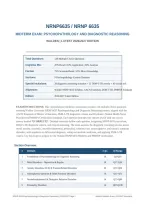
NRNP6635 / NRNP 6635
MIDTERM EXAM: PSYCHOPATHOLOGY AND DIAGNOSTIC REASONING
WALDEN | LATEST 2026/2027 EDITION
Total Questions: 130 Multiple-Choice Questions
Cognitive Mix: 20% Recall | 50% Application | 30% Analysis
Format: 75% Scenario-Based | 25% Direct Knowledge
Sections: 9 Psychopathology Content Domains
Special Inclusions: 20 diagnostic reasoning scenarios + 12 DSM-5-TR criteria + 10 suicide risk
Alignment: Walden NRNP 6635 Syllabus, AACN Essentials, DSM-5-TR, PMHNP Standards
Edition: 2026/2027 Latest Edition
EXAM INSTRUCTIONS: This comprehensive midterm examination contains 130 multiple-choice questions
covering Walden University NRNP 6635 Psychopathology and Diagnostic Reasoning content, aligned with the
AACN Essentials of Master’s Education, DSM-5-TR diagnostic criteria, and Psychiatric-Mental Health Nurse
Practitioner (PMHNP) Certification Standards. Each question provides four options (A-D) with one correct
answer marked *[CORRECT]*. Detailed rationales follow each question, integrating NRNP 6635 curriculum,
DSM-5-TR diagnostic criteria, and clinical reasoning. The exam assesses the diagnostic reasoning process across
mood, anxiety, psychotic, neurodevelopmental, personality, substance use, neurocognitive, and somatic symptom
disorders, with emphasis on differential diagnosis, ruling out medical conditions, and applying DSM-5-TR
criteria. Use this exam to prepare for the Walden NRNP 6635 Midterm and PMHNP certification.
Section Overview:
# Domain # Qs Q Range
1 Foundations of Psychopathology & Diagnostic Reasoning 16 Q1-Q16
2 Mood Disorders – Depressive & Bipolar 20 Q17-Q36
3 Anxiety Disorders, OCD, & Trauma-Related Disorders 20 Q37-Q56
4 Schizophrenia Spectrum & Other Psychotic Disorders 16 Q57-Q72
5 Neurodevelopmental & Disruptive Behavior Disorders 14 Q73-Q86
6 Personality Disorders 14 Q87-Q100
NRNP 6635 Psychopathology & Diagnostic Reasoning | 2026/2027 Page 1 Walden Midterm Exam | PMHNP Standards
, 7 Substance-Related & Addictive Disorders 14 Q101-Q114
8 Neurocognitive & Somatic Symptom Disorders 10 Q115-Q124
9 Special Populations, Ethics, & Differential Diagnosis 6 Q125-Q130
NRNP 6635 Psychopathology & Diagnostic Reasoning | 2026/2027 Page 2 Walden Midterm Exam | PMHNP Standards
, Section 1: Foundations of Psychopathology & Diagnostic
Reasoning
Questions Q1-Q16 | 16 questions | Diagnostic reasoning, mental status exam, psychiatric interview, cultural
formulation, screening tools, documentation
Q1: A 42-year-old patient presents to the psychiatric-mental health nurse practitioner (PMHNP) for the
first time. The PMHNP begins the diagnostic reasoning process. The FIRST step in this process is to:
A. Prescribe medication based on presenting symptoms
B. Gather comprehensive data, including history, mental status examination, collateral information, and
screening tools *[CORRECT]*
C. Apply DSM-5-TR criteria based on the chief complaint only
D. Refer the patient to a psychiatrist immediately
Correct Answer: B
Rationale: Per the NRNP 6635 curriculum, the diagnostic reasoning process begins with comprehensive data
gathering: history, MSE, collateral, screening tools, and medical workup. Only after sufficient data should the
PMHNP apply DSM-5-TR criteria to formulate a diagnosis. Prescribing (A) or applying criteria prematurely (C)
without data risks misdiagnosis. Referral (D) may be appropriate later but not as the first step.
Q2: During a mental status examination, the PMHNP observes that the patient’s speech is rapid,
pressured, and difficult to interrupt. The patient jumps from topic to topic with loose associations. This
finding is MOST consistent with:
A. Major depressive disorder with psychomotor retardation
B. A manic or hypomanic episode *[CORRECT]*
C. Generalized anxiety disorder
D. Schizophrenia with negative symptoms
Correct Answer: B
Rationale: Pressured speech, flight of ideas, and loose associations are hallmark positive signs of a manic or
hypomanic episode (Bipolar I or II). Depressive disorder (A) typically has slowed speech (psychomotor
retardation). GAD (C) has anxious rumination but not pressured speech. Schizophrenia negative symptoms (D)
include alogia (poverty of speech), the opposite.
Q3: A PMHNP performs a mental status examination and documents "patient demonstrates intact
insight and judgment." Which finding BEST supports this assessment?
A. Patient denies having any mental illness despite clear symptoms
B. Patient recognizes they have depression and understands the need for treatment, making reasonable
decisions about care *[CORRECT]*
C. Patient has perfect memory of remote events
D. Patient has no abnormal movements
Correct Answer: B
NRNP 6635 Psychopathology & Diagnostic Reasoning | 2026/2027 Page 3 Walden Midterm Exam | PMHNP Standards
, Rationale: Intact insight means the patient recognizes their illness and need for treatment; intact judgment means
they can make reasonable decisions. Denial of illness (A) indicates poor insight. Remote memory (C) is a cognitive
domain, not insight/judgment. Abnormal movements (D) reflect motor behavior, not insight.
Q4: A PMHNP is interviewing a patient from a different cultural background. To enhance cultural
formulation, the PMHNP should use the:
A. Mini-Mental State Examination (MMSE)
B. DSM-5-TR Cultural Formulation Interview (CFI), which uses 16 questions to assess cultural identity,
explanations of distress, psychosocial stressors, and cultural features of the patient-provider relationship
*[CORRECT]*
C. Hamilton Depression Rating Scale
D. Beck Depression Inventory
Correct Answer: B
Rationale: The DSM-5-TR Cultural Formulation Interview (CFI) is a 16-question semi-structured interview
assessing cultural identity, cultural explanations of distress, psychosocial stressors and supports, and cultural
features of the patient-provider relationship. MMSE (A) and rating scales (C, D) assess cognition or symptom
severity, not cultural formulation.
Q5: A 35-year-old presents with fatigue, low mood, and weight gain. Before diagnosing major depressive
disorder, the PMHNP should FIRST rule out:
A. Major depressive disorder with atypical features
B. Hypothyroidism through TSH testing and a comprehensive medical workup *[CORRECT]*
C. Borderline personality disorder
D. Generalized anxiety disorder
Correct Answer: B
Rationale: Per NRNP 6635, the PMHNP must rule out medical conditions that mimic psychiatric symptoms before
assigning a primary psychiatric diagnosis. Hypothyroidism can cause fatigue, low mood, and weight gain. The
DSM-5-TR requires that symptoms are not attributable to a medical condition. The other options are psychiatric
diagnoses that should not be assigned before medical mimics are ruled out.
Q6: A PMHNP conducts a psychiatric interview and uses the PHQ-9 screening tool. The PHQ-9 is used
to screen for:
A. Generalized anxiety disorder
B. Major depressive disorder *[CORRECT]*
C. Bipolar disorder
D. Schizophrenia
Correct Answer: B
Rationale: The PHQ-9 (Patient Health Questionnaire-9) is the standard screening tool for major depressive
disorder, with 9 items corresponding to DSM-5-TR criteria. Score >=10 suggests moderate depression. GAD-7
screens GAD (A); MDQ screens bipolar (C); there is no single standard screen for schizophrenia (D). Use
disorder-specific validated tools.
NRNP 6635 Psychopathology & Diagnostic Reasoning | 2026/2027 Page 4 Walden Midterm Exam | PMHNP Standards


