Summary ACCT2011 Full Semester Notes latest update
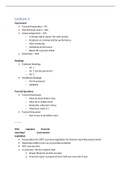
Lecture 1 Assessment • Tutorial Preparation = 5% • Mid-Semester Exam = 30% • Group Assignment = 15% ◦ 2 minute talk in week 7 for each person ◦ Emphasis on communication performance ◦ Must memorise ◦ Individual performance ◦ Based off a journal article • Final Exam = 50% Readings • Textbook Readings ◦ Ch. 1 ◦ Ch. 2 (34-38 and 44-49) ◦ Ch. 3 • Handbook Readings ◦ The Framework ◦ AASB101 Tutorial Questions • Tutorial Homework ◦ Must be done before class ◦ Must be in written form ◦ Randomly collected 6 times ◦ Maximum mark is 5 • Tutorial Discussion ◦ Don’t have to do before class ——— Who regulates financial reporting? Government Legislation • Corporations Act 2001 is primary legislation for financial reporting requirements • Reporting entities must use accounting standards • ASIC overseas this • In summary, the Act requires that 1. Proper financial records are kept 2. Financial report is prepared every half year and end of year 3. Financial report consists of ▪ Financial statements ▪ Notes ▪ Directors declarations for the above 2 4. Financial statements give true and fair view 5. Financial statements comply with accounting standards 6. Additional information is given if financial statements do not give fair and true view 7. Financial statements include an auditors report Australia Securities Exchange (ASX) Listing Rules • Only applies to entities who are listed on ASX • Public companies are on the list and listed companies need to provide financial statements Accounting Standards • Prepared by AASB • Authority provided by the Corporations Act ◦ (5) Financial statements must comply with accounting standards ◦ s226 of Australia Securities and Investments Commission Act 2001 ▪ Provides establishment of AASB ▪ Accounting standards by AASB are deemed part of Corporations Act ——— Present Institutional Arrangements for Setting Accounting Standards • Financial Reporting Council • Main role = Overseeing AASB and presenting reports and advice on the Australian accounting standard‐setting process • Role includes ◦ Appoint members of AASB ◦ Determine AASB priorities ◦ Determine AASBs broad strategic direction ◦ Give AASB directions, advice or feedback on matters of policy ◦ Monitor development of accounting standards ◦ However, cannot direct AASB to develop a particular standard • AASB ◦ Primary functions ▪ Develop CF ▪ Making accounting standards under s334 of Corporations Act ▪ Developing single set of worldwide accounting standards ◦ Develop interpretations of standards ——— GAAP Hierarchy 1. Accounting standards = first point of guidance ◦ Required by law ◦ If nothing in standards, seek indirect guidance by CF ◦ If there is further conflict, seek concepts and principles 2. Conceptual Framework (CF) 3. Accounting concepts and principles Conceptual Framework (CF) • Provide users, preparers, auditors of financial statements with an explicit set of concepts to use when making decisions about appropriate accounting policies • Describes objective and concepts of financial reporting ◦ Develop standards that are based on consistent concepts ◦ Develop consistent concepts when no Standard already exists ◦ Assist in understanding and interpreting concepts • Benefits ◦ Consistent and logical accounting standards ◦ Reduced barriers to international capital flows ◦ Accountability ◦ Improved communication between setters and users • CF is not a standard but guides the preparation of Accounting Standards Parts to the CF (1) SAC1 = The reporting entity • An entity which has users who rely on financial statements about the entity to make decisions • Characteristics 1. Managed by individuals who don’t own the entity 2. Politically or economically important 3. Sizeable in sales, assets, employees, borrowings or customers (2) SAC2 = Objective of financial reporting = To provide financial information that is useful to investors, leaders and creditors in decision making (3) Framework for Preparation and Presentation of Financial Statements • Qualitative characteristics • Elements of financial statements ◦ Recognition of elements ◦ Measurement of elements Qualitative Characteristics • Fundamental ◦ Relevant ▪ = Is material i.e. capable of making a difference in decisions made by users ▪ e.g. reporting liquidity can help creditors decide whether to lend ◦ Faithful representation ▪ = Information of economic phenomena is complete, neutral and free from material error ▪ e.g. reporting profit without over or understating • Enhancing ◦ Verifiable = Prepared with appropriate recognition and measurement methods ◦ Comparable = Facilitates users identifying similarities and differences between economic phenomena ◦ Understandable ▪ = Assists users to understand meaning of information provided ▪ AASB Framework suggests report users will need to be proficient in accounting and finance ◦ Timeliness = Information is available to users before it ceases to be relevant Elements of financial statements ◦ Elements ◦ Recognition of elements ◦ Measurement of the elements • Statement of Profit or Loss ◦ Revenues less expenses ◦ Purpose is to report success/failure over a period ◦ Elements: ▪ Income ▪ Expense • Statement of Financial Position ◦ Assets and liabilities at specific point in time ◦ Elements ▪ Assets ▪ Liabilities ▪ Equity • Statement of Changes in Equity ◦ Reports comprehensive income for the period and changes in equity ◦ Change in OE ◦ Elements ▪ Profit ▪ Retained earnings ▪ Dividends ▪ Capital contributions ▪ Reserves • Statement of Cash Flows ◦ Reports net cash provided / used for a period ◦ Elements ▪ Cash receipts ▪ Cash payments ——— Assets • Definition ◦ Resource controlled by the entity ◦ Resulting from past transaction ◦ Resulting in an inflow of resources that have future economic benefit • Recognition ◦ Probable that future economic benefits will flow into the entity ◦ Asset has cost or value that can be measured reliably • Measurement ◦ Historical cost Liabilities • Definition ◦ Present obligation of the entity ◦ Resulting from past events ◦ Resulting in an outflow of resources that have economic benefit • Recognition ◦ Probable that an outflow of resources embodying economic benefit will settle the obligation ◦ Amount of settlement can be measured reliably • Contingent Liabilities ◦ Liabilities where ▪ Amount of future sacrifice is uncertain and cannot be measured reliably ▪ Does not satisfy probability criteria ▪ Dependent on uncertain future event ◦ Must be disclosed in notes if they are material Equity • = The residual interest in the assets of the entity after deducting all its liabilities • No formal definition, just a calculation • i.e. OE = A - L Income • Definition ◦ Increases in economic benefit in the form of ▪ Inflows OR ▪ Enhancements ◦ Due to increasing assets OR decreasing liabilities ◦ Resulting in increases in equity ◦ Other than those relating to the contributions from equity participants • Recognition ◦ Increase in future economic benefits related to ◦ Increase in assets or decrease in liabilities ◦ That can be measured reliably • Includes ◦ Revenue = Increases in economic benefits from ordinary activities ◦ Gains = Other increases in economic benefits not from ordinary activities Expense • Definition ◦ Decreases in economic benefits in the form of ▪ Outflows OR ▪ Depletion of assets OR ▪ Incurrence of liabilities ◦ Due to decreasing assets OR increasing liabilities ◦ Resulting in decreases in equity ◦ Other than those relating to distributions to equity participants • Recognition ◦ Decrease in future economic benefits related to ◦ Decrease in assets or increase in liabilities ◦ That can be measured reliably • Includes ◦ Expenses = Decreases in economic benefits from ordinary activities e.g. COGS ◦ Losses = Expenses that are not necessarily ordinary e.g. natural disaster ——— Lecture 2 Textbook Readings • Sections 8.1, 8.2 to p.208, 8.3, 8.3.1, 8.3.2, 8.3.3 to p.243 Handbook Readings • AASB 116 Property, Plant and Equipment • AASB 136 Impairment of Assets ——— AASB 116 • PPE are tangible items that are ◦ Held for use in production or supply of goods and services, for rental to others or for administrative purposes ◦ Expected to be used during more than one year Initial Recognition of PPE • Recorded at historical cost (AASB 116 (a) para. 15) 1. Cost of PPE includes ▪ Purchase price after discounts ▪ Import duties and non-refundable taxes ▪ Costs to make asset capable for intended function ▪ Costs of removing and restoring site which PPE will be located 2. Recorded as if it were a prepayment 3. As economic benefits are consumed, prepayment is recognised as depreciation expense • Capitalisation 1. Repairs and maintenance are costs 2. Enhancements increase carrying amount of PPE ——— Subsequent Measurement of PPE (Cost vs Revaluation) • All PPE must be measured with either cost or revaluation model (116 para. 29) • Once choice is made, all assets in same class must be measured on same basis (116 para. 29) Using different models for PPE results in potential to selectively revalue certain PPE However, if PPE is revalued, entire class must be revalued (116 para. 36) • Asset classes include (116 para. 37) Land Land and buildings Machinery Ships Aircraft Vehicles Furniture and fixtures Office equipment Revaluation of Carrying Amounts (AASB 116 Requirements) • Revaluations are made so that the carrying amount of an asset does not materially differ from fair value ◦ Must be done before impairment is assessed (AASB 116) • Increases = Revaluation Surplus ◦ Recorded in statement of comprehensive income in “Other comprehensive income" ◦ Accumulated in equity i.e. an equity account ◦ If reversing a previous decrement then it is recorded in revaluation income i.e. P+L (116 para. 39) • Decreases = Revaluation Expense ◦ Recorded in statement of comprehensive income in “P+L" ◦ If reversing a previous increment then directly debited to any credit balance existing in revaluation surplus (116 para. 40) • In summary ◦ Credits go to revaluation surplus ◦ Debits go to revaluation expense unless it is a reversal ——— De-recognition of PPE • Must occur on the disposal of an asset • Gains or loss on disposal are ◦ Included in statement of comprehensive income in the “P+L” section ◦ But gains are not revenue (116 para. 68) ◦ Does not require separate presentation of proceeds • On derecognitiion, revaluation surplus is transferred to retained earnings ——— Treatment of Accumulated Depreciation Net method = accumulated depreciation closed to asset account before revaluation Gross Method = accumulated depreciation is increased by same proportion as the gross carrying amount of asset so that carrying amount represents its revalued amount ——— AASB 136 Impairment of Assets • Cost model ◦ After recognition, PPE = ◦ Cost less accumulated depreciation and impairment losses • Revaluation Model ◦ After recognition, PPE = ◦ Revalued amount less subsequent accumulated depreciation and impairment losses ◦ Only after the revaluation requirements of AASB 116 have been applied should an entity apply AASB 136 to determine whether an asset may be impaired Indicators of Impairment • External factors (136 para. 12) 1. Decline in market value normal wear and tear 2. Increase in interests rates 3. Changes to technological, market, economic or legal environment • Internal factors (136 para. 12) 1. Obsolescence or physical damage 2. Changes such as restructuring that could affect the value of the asset 3. Evidence that economic performance will be worse than expected Impairment Loss • Presence of impairment should be assessed at each reporting date (136 para. 9) • Impairment should only be assessed after revaluation (136) • PPE carrying amount cannot exceed recoverable amount (136) ◦ Carrying amount Cost Model = cost - accumulated depreciation Revaluation model = fair value ◦ Recoverable amount = whichever is greater between "fair value less disposal costs" and "value-in-use" (AASB 136 para. 6) Fair value = price received to sell asset or paid to transfer a liability Value-in-use = PV of future cash flows • If exceeded, PPE is impaired and impairment loss is recognised (136 para. 59) ◦ Immediately recognised in P+L in statement of comprehensive income • Impairment loss of revalued asset is treated as a revaluation decrease (136 para. 60) ◦ Literally just means use an impairment loss account ◦ However, if there is a revaluation surplus already open, impairment can be debited as a reversal to the surplus account Reversals of Impairment • Assessment should be made at end of reporting period as to whether prior period impairment no longer exists or decreased (136 para.110)
Document information
- Uploaded on
- September 6, 2021
- Number of pages
- 110
- Written in
- 2021/2022
- Type
- Summary