BIO 201 HUMAN ANATOMY AND PHYSIOLOGY CHAPTER 1 |
2026/2027 STUDY GUIDE | PRACTICE QUESTIONS &
ANSWERS
1. This medical imaging high frequency sound waves to produce a moving
image that can be shown on a video monitor. This technique is safe,
noninvasive, painless, and uses no dyes. It is most commonly used to visualize
the fetus during pregnancy. Also used to observe the size, location, and
actions of organs and blood flow through blood vessels.
radionuclide scanning
ultrasound scanning
coronary computed tomography
radiography
magnetic resonance imaging
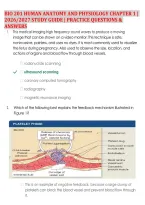
2. Which of the following best explains the feedback mechanism illustrated in
Figure 1?
This is an example of negative feedback, because a large clump of
platelets can block the blood vessel and prevent blood flow through
it.
, This is an example of positive feedback, because it results from the
interactions among collagen, endothelial cells, and platelets.
This is an example of positive feedback, because the few platelets
that initially bind attract more platelets to the damaged area.
3. What is the role of an effector in a feedback system?
Produces a response that alters the controlled condition.
Monitors changes in the controlled condition.
Sends input to the control center.
Transmits signals to the brain.
4. If a patient is experiencing abdominal pain, which imaging technique would
likely be recommended and why?
CT scan, because it provides detailed cross-sectional images.
X-ray, because it is the quickest method available.
MRI, because it uses magnetic fields for imaging.
Ultrasound scanning, because it is effective for diagnosing
abdominal conditions.
5. Describe the composition and function of the pleural cavity in relation to the
lungs.
The pleural cavity connects the lungs to the heart for better
oxygenation.
The pleural cavity is filled with air to facilitate lung expansion.
The pleural cavity is a solid structure that protects the lungs from
external damage.
, The pleural cavity consists of two fluid-filled spaces that surround
each lung, providing lubrication and reducing friction during
breathing.
6. Describe the primary purpose of ultrasound scanning in medical practice.
To perform surgical procedures.
To analyze blood samples.
To create images of organs and structures inside the body.
To measure blood pressure.
7. What is the definition of differentiation in cellular biology?
Differentiation is the mechanism of DNA replication.
Differentiation is the process of cell division.
Differentiation is the development of a cell from an unspecialized
state to a specialized state.
Differentiation is the process of cells communicating with each other.
8. Tomography, as in computed axial tomography, means:
map an image
create a 3D image
record cut sections
create an opening for recording
9. Describe how serous fluid contributes to the function of body cavities.
Serous fluid helps in the absorption of nutrients in the digestive cavity.
, Serous fluid reduces friction between the layers of membranes in
body cavities.
Serous fluid is responsible for the production of red blood cells.
Serous fluid acts as a barrier against infections in the body.
10. At the tissue level of body organization,
None of the above
Different types of tissues join together to form organs with specific
functions.
Atoms join to form molecules.
Molecules combine to form cells.
Groups of cells and the material surrounding them perform a
function.
11. What is the term that refers to the structure of the body?
Anatomy
Physiology
Combining forms
Metabolism
12. In a scenario where body temperature rises above normal, how does the
receptor function in the feedback system to help restore homeostasis?
The receptor ignores the temperature change and allows the body to
remain in a state of imbalance.
The receptor detects the increase in temperature and sends this
information to the control center to initiate a response.