
Overview Authors
Lecture 1 Introduction to the course, Urban
Sustainability, and Urban Planning
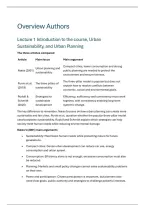
The three articles compared
Article Main focus Main argument
Compact cities, lower consumption and strong
Urban planning and
Næss (2001) public planning are needed to protect the
sustainability
environment and ensure fairness.
The three-pillar model is popular but does not
Purvis et al. The three pillars of
explain how to resolve conflicts between
(2019) sustainability
economic, social and environmental goals.
Rudolf & Strategies for Efficiency, sufficiency and consistency must work
Schmidt sustainable together, with consistency enabling long-term
(2025) development systemic change.
The key difference to remember: Næss focuses on how urban planning can create more
sustainable and fair cities. Purvis et al. question whether the popular three-pillar model
clearly explains sustainability. Rudolf and Schmidt explain which strategies can help
society meet human needs while reducing environmental damage.
Næss's (2001) main arguments
• Sustainability: Meet basic human needs while protecting nature for future
generations.
• Compact cities: Dense urban development can reduce car use, energy
consumption and urban sprawl.
• Consumption: Efficiency alone is not enough; excessive consumption must also
be reduced.
• Planning: Markets and small policy changes cannot solve sustainability problems
on their own.
• Power and participation: Citizen participation is important, but planners also
need clear goals, public authority and strategies to challenge powerful interests.
,In one sentence: Næss argues that sustainable urban planning requires compact cities,
lower resource consumption, environmental protection, social fairness and active
public planning.
Purvis, Mao & Robinson's (2009) main arguments
• Three pillars: Sustainability is commonly understood as environmental, social
and economic sustainability.
• Origins: The model developed gradually and has no single origin.
• Main criticism: The model lacks a clear theoretical foundation and does not
explain how to balance the pillars.
• Economic growth: Growth does not automatically produce social equality or
environmental protection.
• Politics: Sustainability is not a neutral concept; it involves choices about whose
interests and values matter most.
In one sentence: The authors argue that the three-pillar model is useful for describing
sustainability, but it does not explain how to resolve conflicts between economic
growth, social justice and environmental protection.
Rudolf & Schmidt's (2025) main arguments
• Efficiency: Produce the same things with fewer resources, but beware of the
rebound effect.
• Sufficiency: Reduce excessive consumption while ensuring that everyone can
meet their basic needs.
• Consistency: Transform production systems so they work with nature, for
example through renewable energy and a circular economy.
• Main argument: All three strategies are needed, but efficiency and sufficiency
alone cannot guarantee long-term sustainability.
• Long-term solution: Consistency offers the potential for a more fundamental
transformation of the economy and production systems.
In one sentence: The authors argue that sustainability requires using resources more
efficiently, consuming an adequate amount and fundamentally changing production
systems to reduce environmental damage.
, Lecture 2 Are cities sustainable?
The three articles compared
Article Main focus Main argument
Angelo & How cities became seen as We must critically examine the global
Wachsmuth solutions to environmental connections, political interests and
(2020) problems inequalities behind urban sustainability.
Cities need diversity, balanced
McPhearson et How cities can transform
connectivity and better coordination to
al. (2021) for a sustainable future
become resilient and sustainable.
Green policies and efficiency are
Whether green cities are insufficient if cities continue to prioritise
Krähmer (2020)
genuinely sustainable economic growth and excessive
consumption.
• Angelo & Wachsmuth: Question the assumption that cities can save the planet.
• McPhearson et al.: Explain how cities need to change their systems and
relationships to become sustainable.
• Krähmer: Criticises growth-oriented sustainability and argues that cities need to
reduce excessive consumption.
All three articles challenge the idea that making cities greener automatically makes
them sustainable. However, they approach the problem differently: Angelo and
Wachsmuth focus on politics and how we understand cities, McPhearson and
colleagues focus on urban systems and transformation, and Krähmer focuses on
economic growth and degrowth.
Angelo & Wachsmuth's (2020) main arguments
• Cities as solutions: Cities have increasingly been presented as important actors
in solving environmental problems.
• Historical change: This shift developed through debates about urban sprawl,
informal settlements and climate change.
• Global connections: A city can appear sustainable while causing environmental
damage elsewhere.
• Power and inequality: Sustainability policies can benefit some groups while
disadvantaging others.


