
ELECTRIC CURRENT AND
OHM’S LAW
1 ELECTRIC CURRENT
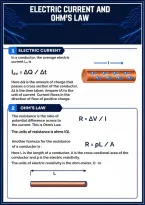
In a conductor, the average electric
current Iₐᵥ is I
Iₐᵥ = ΔQ / Δt
Here ΔQ is the amount of charge that
passes a cross section of the conductor,
Δt is the time taken. Ampere (A) is the
unit of current Current flows in the
direction of flow of positive charge.
2 OHM’S LAW
The resistance is the ratio of
potential difference across to R = ΔV / I
the current. This is Ohm’s Law.
The units of resistance is ohms (Ω).
Another formula for the resistance
of a conductor is : R = ρL / A
Here L is the length of a conductor, A is the cross-sectional area of the
conductor and ρ is the electric resistivity.
The units of electric resistivity is the ohm-meter, Ω⋅m.
L


