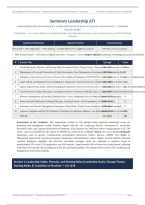
ATI Leadership and Management — Practice Assessment B / Proctored Exam / Capstone B Test-Bank Complete Solutions • 2026/2027
Summary Leadership ATI
Leadership Practice Assessment B • Leadership Proctored Exam • Capstone Assessment B — Complete
Solution Guide
160 Questions • Ten Content Domains • Detailed Rationales with Leadership Reasoning, Scope Considerations, and ATI Test-Taking
Strategies
Cognitive Distribution Question Format Total Questions
25% Recall • 55% Application • 20% Analysis 4-option MCQ (A–D, single best answer) 160 items across 10 sections
80% Scenario-based • 20% Direct recallEach item: stem + 4 options + correct answer
Aligned
+ with
rationale
ATI Leadership and Management proctored blueprint
# Section Title Q Range Count
1 Leadership Styles, Theories, and Nursing Roles (Leadership Styles, Change Theory, Nursing Roles,
Q1–Q18& Transition to Practice)
18
2 Management of Care and Prioritization (Client Prioritization, Time Management, Assignments,Q19–Q35
& Organizational Skills)
17
3 Delegation, Supervision, and Scope of Practice (Five Rights of Delegation, RN/LPN/UAP Scope,
Q36–Q52
Assignment vs. Delegation,
17 & Supervision)
4 Legal, Ethical, and Regulatory Issues (Negligence, Malpractice, Informed Consent, Confidentiality,
Q53–Q69HIPAA, & Advocacy)
17
5 Quality Improvement, Safety, and Risk Management (Sentinel Events, Never Events, RCA, National
Q70–Q85 Patient Safety Goals,
16 & Incident Reportin
6 Communication, Conflict Resolution, and Interprofessional Collaboration (SBAR, Chain of Command,
Q86–Q101Conflict Styles,16
& Workplace Incivility
7 Resource Management and Staffing (Staffing Ratios, Acuity, Budgeting Basics, & Material Resource
Q102–Q115
Management) 14
8 Patient and Staff Education (Teaching Principles, Learning Domains, Staff Competency, & Health
Q116–Q128
Literacy) 13
9 Emergency and Disaster Management (Emergency Preparedness, Triage, Disaster Response, &
Q129–Q141
Incident Command) 13
10 Capstone Integration and NCLEX Readiness (Cumulative Leadership Judgment, Case Management,
Q142–Q160
& Care Coordination)
19
TOTAL Q1–Q160 160
Instructions to the Candidate: This examination consists of 160 multiple-choice questions distributed across ten
leadership and management content domains aligned with the ATI Leadership Practice Assessment B, Leadership
Proctored Exam, and Capstone Assessment B blueprints. Each question has ONE best answer among options A–D. The
correct answer is identified by the marker [CORRECT], followed by a Correct Answer line and a detailed Rationale
integrating scope of practice considerations, prioritization frameworks (ABCs, Maslow, ADPIE, Five Rights of
Delegation), legal/ethical principles (autonomy, beneficence, nonmaleficence, justice, fidelity, veracity, HIPAA, informed
consent), delegation standards, and ATI-style test-taking strategies. Items are calibrated to cognitive levels of
approximately 25% recall, 55% application, and 20% analysis. Approximately 80% of items are scenario-based, reflecting
leadership-level nursing clinical judgment at the ATI proctored standard. All content reflects current ATI Leadership and
Management assessment standards.
Section 1: Leadership Styles, Theories, and Nursing Roles (Leadership Styles, Change Theory,
Nursing Roles, & Transition to Practice) — Q1–Q18
Summary Leadership ATI — Complete Solution Guide (2026/2027) Page 1
,ATI Leadership and Management — Practice Assessment B / Proctored Exam / Capstone B Test-Bank Complete Solutions • 2026/2027
Q1. A nurse manager involves staff nurses in decision-making for a new charting system, solicits their input,
and supports the group's final decision. Which leadership style is the nurse manager demonstrating?
A. Autocratic
B. Democratic [CORRECT]
C. Laissez-faire
D. Transformational
Correct Answer: B
Rationale: Democratic leadership involves staff in decision-making, encourages input, and supports group consensus.
The leader retains final authority but considers staff perspectives. This style promotes job satisfaction and acceptance of
changes. Autocratic makes decisions unilaterally; laissez-faire provides no direction; transformational inspires followers
toward a shared vision through motivation and role modeling. The ATI proctor often tests whether the nurse can identify
the leadership style based on observed behaviors in a scenario.
Q2. A charge nurse allows the staff to manage their own assignments, take breaks whenever they choose,
and make all decisions about patient care with no guidance. The unit has become disorganized and patient
care is suffering. Which leadership style is being used, and what is the likely outcome?
A. Democratic; high productivity and satisfaction
B. Laissez-faire; low productivity and disorganization [CORRECT]
C. Autocratic; high productivity but low satisfaction
D. Transformational; high productivity and innovation
Correct Answer: B
Rationale: Laissez-faire leadership provides minimal direction and allows staff complete autonomy, often resulting in
disorganization, role ambiguity, and decreased productivity — especially with inexperienced staff or in crisis situations.
This style is appropriate only with highly skilled, self-directed teams. Democratic leadership would involve more structure
and group decision-making. Autocratic provides high structure with low staff input. Transformational inspires through
vision and motivation. ATI testing frequently pairs laissez-faire with negative outcomes like missed care or staff
dissatisfaction.
Q3. A nurse leader articulates a compelling vision for evidence-based practice on the unit, role-models the
behaviors, and inspires staff to embrace professional growth. Staff report feeling motivated and
empowered. Which leadership style is this?
A. Transactional
B. Transformational [CORRECT]
C. Autocratic
D. Situational
Correct Answer: B
Rationale: Transformational leadership inspires and motivates followers toward a shared vision, role-models desired
behaviors, and empowers staff to achieve higher levels of performance. It is associated with improved patient outcomes,
staff satisfaction, and nurse retention. Transactional focuses on rewards/punishments; autocratic is directive and unilateral;
situational adapts style to the maturity of the follower. ATI frequently contrasts transformational with transactional
leadership styles.
Summary Leadership ATI — Complete Solution Guide (2026/2027) Page 2
,ATI Leadership and Management — Practice Assessment B / Proctored Exam / Capstone B Test-Bank Complete Solutions • 2026/2027
Q4. A nurse manager uses a 'servant leadership' approach. Which behavior best demonstrates this style?
A. Setting strict performance quotas and rewarding top performers
B. Focusing on the growth, development, and well-being of staff to enable them to provide excellent patient
care [CORRECT]
C. Making unilateral decisions to maintain unit efficiency
D. Allowing staff to manage themselves with minimal input
Correct Answer: B
Rationale: Servant leadership prioritizes the growth, well-being, and development of staff, recognizing that supporting
nurses enables them to provide excellent patient care. Servant leaders listen, empathize, and steward resources for the
team's benefit. This style is associated with high staff engagement and retention. Strict quotas reflect transactional
leadership; unilateral decisions reflect autocratic; minimal input reflects laissez-faire.
Q5. During a cardiac arrest, the charge nurse directs each team member's role, gives specific commands,
and expects immediate compliance. Which leadership style is most appropriate for this situation?
A. Democratic
B. Autocratic [CORRECT]
C. Laissez-faire
D. Transformational
Correct Answer: B
Rationale: Autocratic leadership is most appropriate during emergencies, code situations, or crises where rapid, decisive
action is needed and there is no time for group input. The leader gives clear, specific commands and expects compliance.
Democratic and laissez-faire styles are inappropriate in emergencies. Transformational leadership is a longer-term
approach. ATI testing often asks the candidate to identify the most appropriate style for a given situation, especially in
crisis scenarios.
Q6. A nurse manager is implementing a new medication reconciliation process. Staff are openly resisting
the change, citing time constraints and 'no problems with the old way.' According to Lewin's Change
Theory, which stage is the unit experiencing?
A. Unfreezing [CORRECT]
B. Moving (Changing)
C. Refreezing
D. Sustaining
Correct Answer: A
Rationale: In Lewin's Change Theory, 'unfreezing' is the first stage where the need for change is recognized and
resistance is addressed. Staff expressing concerns about the change are in the unfreezing stage. The 'moving' stage is when
the change is actually implemented. 'Refreezing' occurs when the change is integrated into practice and becomes the new
norm. Understanding resistance as a normal part of unfreezing helps the leader address concerns through education,
communication, and involvement.
Summary Leadership ATI — Complete Solution Guide (2026/2027) Page 3
, ATI Leadership and Management — Practice Assessment B / Proctored Exam / Capstone B Test-Bank Complete Solutions • 2026/2027
Q7. A nurse manager has successfully implemented a new bedside handoff process, and staff now perform it
consistently without reminders. According to Lewin's Change Theory, which stage has been achieved?
A. Unfreezing
B. Moving (Changing)
C. Refreezing [CORRECT]
D. Resistance
Correct Answer: C
Rationale: 'Refreezing' is the final stage of Lewin's Change Theory, where the change is integrated into the culture and
becomes the new normal. Staff perform the new behavior consistently without reminders. The leader's role is to reinforce
the change through positive feedback, policy updates, and ongoing support. Without refreezing, staff may revert to old
behaviors. The unfreezing stage addresses resistance; moving is the implementation phase.
Q8. A nurse leader is using Kotter's 8-step change model to implement a new evidence-based practice.
Which action represents the 'Create a Guiding Coalition' step?
A. Communicating the vision for change
B. Assembling a team of influential staff members with the power and commitment to lead the change
[CORRECT]
C. Celebrating short-term wins
D. Removing barriers to change
Correct Answer: B
Rationale: In Kotter's 8-step model, 'Create a Guiding Coalition' (Step 2) involves assembling a team of influential people
with the power, expertise, and commitment to lead the change effort. This team should include formal leaders, informal
opinion leaders, and content experts. Other steps include: creating urgency (1), developing a vision (3), communicating
the vision (4), empowering action (5), generating short-term wins (6), sustaining acceleration (7), and anchoring change in
culture (8).
Q9. A nurse manager plans to implement a new evidence-based fall prevention protocol. Which action by
the manager best addresses staff resistance to change?
A. Mandate compliance with the new protocol effective immediately
B. Involve staff in the planning and pilot testing, and address their concerns openly [CORRECT]
C. Implement the change without explanation to avoid resistance
D. Discipline staff who do not immediately adopt the new protocol
Correct Answer: B
Rationale: Involving staff in planning and piloting addresses resistance by giving them ownership of the change and an
opportunity to voice concerns. Education, communication, and visible leader support are key strategies for managing
resistance. Mandating compliance without staff input typically increases resistance. Implementing without explanation
creates confusion and mistrust. ATI emphasizes the importance of involving stakeholders, communicating the rationale,
and addressing resistance directly.
Summary Leadership ATI — Complete Solution Guide (2026/2027) Page 4