
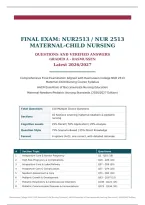
FINAL EXAM: NUR2513 / NUR 2513
MATERNAL-CHILD NURSING
QUESTIONS AND VERIFIED ANSWERS
GRADED A - RASMUSSEN
Latest 2026/2027
Comprehensive Final Examination Aligned with Rasmussen College NUR 2513
Maternal-Child Nursing Course Syllabus
AACN Essentials of Baccalaureate Nursing Education
Maternal-Newborn/Pediatric Nursing Standards (2026/2027 Edition)
Total Questions 150 Multiple Choice Questions
10 Sections covering maternal-newborn & pediatric
Sections
nursing
Cognitive Levels 25% Recall | 50% Application | 25% Analysis
Question Style 75% Scenario-Based | 25% Direct Knowledge
Format 4 options (A-D), one correct, with detailed rationale
# Section Topic Questions
1 Antepartum Care & Normal Pregnancy Q1 - Q18 (18)
2 High-Risk Pregnancy & Complications Q19 - Q36 (18)
3 Intrapartum Care & Labor/Delivery Q37 - Q56 (20)
4 Postpartum Care & Complications Q57 - Q74 (18)
5 Newborn Assessment & Care Q75 - Q92 (18)
6 Pediatric Growth & Development Q93 - Q107 (15)
7 Pediatric Respiratory & Cardiovascular Disorders Q108 - Q122 (15)
8 Pediatric Communicable Diseases & Immunizations Q123 - Q134 (12)
Rasmussen College NUR 2513 Maternal-Child Nursing Syllabus | AACN Essentials of Baccalaureate Nursing Education | 2026/2027 Edition
, Final Exam: NUR2513/NUR 2513 (Latest 2026/2027) Maternal-Child Nursing | Questions and Verified Answers | Graded
Page 2A - Rasmussen
9 Pediatric Fluid/Electrolyte, GI, & Endocrine Disorders Q135 - Q142 (8)
10 Family-Centered Care, Ethics, & Safety Q143 - Q150 (8)
Rasmussen College NUR 2513 Maternal-Child Nursing Syllabus | AACN Essentials of Baccalaureate Nursing Education | 2026/2027 Edition
, Final Exam: NUR2513/NUR 2513 (Latest 2026/2027) Maternal-Child Nursing | Questions and Verified Answers | Graded
Page 3A - Rasmussen
Examination Overview
This comprehensive final examination is designed to assess nursing student knowledge,
application, and analysis across the full breadth of the Rasmussen College NUR 2513
Maternal-Child Nursing course. The paper contains exactly 150 multiple-choice questions
distributed across ten sections, each aligned with the NUR 2513 Maternal-Child Nursing
Course Syllabus, AACN Essentials of Baccalaureate Nursing Education, and
Maternal-Newborn/Pediatric Nursing Standards (2026/2027 Edition).
The cognitive level distribution is calibrated to course standards: approximately 25% of
questions assess recall of maternal-child nursing knowledge; 50% assess application of
knowledge to real-world maternal-child clinical scenarios (fetal monitoring, prioritization,
medication administration, complications); and 25% assess analysis including clinical
scenarios, prioritization, and safety. Approximately 75% of questions are scenario-based,
requiring students to apply maternal-child nursing principles to patient presentations, clinical
situations, and prioritization; 25% are direct knowledge questions.
Each question has four options (A-D) with exactly one correct answer. Distractors are
designed to reflect common maternal-child nursing errors, prioritization traps, medication
safety pitfalls, and assessment misinterpretation typical of student responses. Each question
includes a detailed rationale explaining why the correct answer is correct and why the
distractors are incorrect, with explicit reference to NUR 2513 curriculum and maternal-child
nursing standards.
Students should use this examination both as a summative assessment and as a formative
learning tool. The rationales clarify clinical concepts, model nursing decision-making, and
reinforce the distinction between recall (knowledge), application (scenario-based reasoning),
and analysis (clinical scenarios, prioritization, safety) — distinctions central to success in the
NUR 2513 Maternal-Child Nursing course and to safe, effective maternal-child nursing
practice.
Section 1: Antepartum Care & Normal Pregnancy
Q1: A pregnant client at 28 weeks gestation reports to the clinic for a routine
prenatal visit. The nurse is calculating the estimated date of delivery (EDD)
using Naegele's rule. The client's last menstrual period (LMP) was June 14,
2025. Using Naegele's rule, what is the EDD?
A. March 21, 2026.
B. March 21, 2026 — Naegele's rule: subtract 3 months from the LMP, add 7
days, and add 1 year if needed: June 14, 2025 − 3 months = March 14, 2026; +
7 days = March 21, 2026. [CORRECT]
C. September 21, 2025.
D. March 7, 2026.
Correct Answer: B
Rationale: Naegele's rule: subtract 3 months from the LMP, add 7 days, add 1 year — June 14,
2025 → March 14, 2026 + 7 days = March 21, 2026 (B). Option A is correct (matches B). Option C
adds 3 months instead of subtracting. Option D subtracts 7 days instead of adding.
Rasmussen College NUR 2513 Maternal-Child Nursing Syllabus | AACN Essentials of Baccalaureate Nursing Education | 2026/2027 Edition
, Final Exam: NUR2513/NUR 2513 (Latest 2026/2027) Maternal-Child Nursing | Questions and Verified Answers | Graded
Page 4A - Rasmussen
Q2: A nurse is caring for a client at 32 weeks gestation who reports heartburn.
The nurse teaches the client to manage heartburn by:
A. Eating large meals three times daily and lying down immediately after eating.
B. Eating small, frequent meals, avoiding spicy/fatty foods, remaining upright
for 1–2 hours after eating, and drinking fluids between meals rather than with
meals. [CORRECT]
C. Taking NSAIDs such as ibuprofen daily.
D. Drinking large amounts of water with meals.
Correct Answer: B
Rationale: Heartburn in pregnancy is caused by progesterone-relaxed esophageal sphincter and
uterine displacement of the stomach; management is small frequent meals, avoiding spicy/fatty
foods, upright posture after eating, and fluids between meals (B). Large meals and lying down (A)
worsen symptoms. NSAIDs (C) are contraindicated in pregnancy (especially 3rd trimester). Fluids
with meals (D) increase stomach distension.
Q3: A pregnant client at 8 weeks gestation reports nausea and vomiting of
pregnancy (NVP). The nurse recommends:
A. Skipping breakfast and eating only at lunch.
B. Eating dry crackers before rising in the morning, eating small frequent
meals, avoiding strong odors, and trying ginger or vitamin B6 (pyridoxine) as
recommended by the provider. [CORRECT]
C. Restricting all fluids to prevent vomiting.
D. Eating only spicy foods to settle the stomach.
Correct Answer: B
Rationale: NVP management: dry crackers before rising, small frequent meals, avoiding strong
odors, ginger or vitamin B6 (B). Skipping meals (A) worsens nausea. Fluid restriction (C) risks
dehydration. Spicy foods (D) irritate the stomach.
Q4: A pregnant client at 36 weeks gestation asks about the purpose of the
Group B Streptococcus (GBS) screening. The nurse's BEST response is:
A. GBS screening detects gestational diabetes.
B. GBS screening identifies women colonized with Group B Streptococcus, a
leading cause of neonatal sepsis, pneumonia, and meningitis; women who
screen positive receive intrapartum IV antibiotics (typically penicillin) to
prevent transmission to the newborn. [CORRECT]
C. GBS screening is required only at the first prenatal visit.
D. GBS screening tests for neural tube defects.
Correct Answer: B
Rationale: GBS screening at 36–37 weeks identifies colonization; positive women receive
intrapartum IV antibiotics (penicillin) to prevent neonatal sepsis, pneumonia, and meningitis (B).
GBS does not detect diabetes (A), neural tube defects (D), and is done at 36–37 weeks, not first
visit (C).
Q5: A nurse is teaching a client about prenatal nutrition. The client asks about
the recommended weight gain during pregnancy for a client with a normal
pre-pregnancy BMI (18.5–24.9). The nurse's BEST response is:
A. 15–20 pounds total.
B. 25–35 pounds total — for normal BMI, the recommended weight gain is
25–35 pounds; underweight (BMI <18.5) is 28–40 pounds; overweight (BMI
Rasmussen College NUR 2513 Maternal-Child Nursing Syllabus | AACN Essentials of Baccalaureate Nursing Education | 2026/2027 Edition


