
INTRODUCTION
Contents
● What is sociology?
● The sociological imagination
● Sociological building blocks
● The origins of Western sociology
● Sociological perspectives
1. WHAT IS SOCIOLOGY?
Decision of divorce/ suicide: a matter of personal feelings?
→ can also be influenced by social groups/factors
The Study of Suicide - Durkheim
● Suicide is socially clustered: more prevalent in men, protestants, wealthy people, the unmarried
● Differences are due to people’s degree of social integration: groups that are more connected and
tied into society are less likely to commit suicide
● 4 types of suicide:
(Social and cultural)
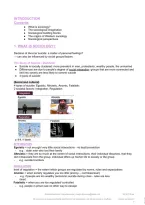
4 types of suicide: Egoistic, Altruistic, Anomic, Fatalistic
2 societal factors: Integration, Regulation
INTEGRATION
Egoistic = not enough/ very little social interactions - no trust/connection
- e.g. : older men who lost their family
Altruistic = they are so much at the centre of social interactions, their individual dissolves, that they
don’t dissociate from the group, individual offers up his/her life to society or the group
- e.g. suicide bombers
REGULATION
level of regulation = the extent which groups are regulated by norms, rules and expectations
Anomic = when society regulates you too little (anomy – normlessness!)
- e.g. if people are too wealthy (economic suicide during crisis - rules are less
clear)
Fatalistic = when you are too regulated/ controlled
- e.g. people in prison see no other way to escape
Gedownload door: margolepoudre | Wil jij €76 per
Dit document is auteursrechtelijk beschermd, het verspreiden van dit document is strafbaar. maand verdienen?
0
,Human behaviour is influenced by:
● Genetics - genes, hormones (biology)
● Personality traits (psychology)
● Social environment (sociology)
Sociology aims to show the patterns and processes by which society shapes what we do
● Focuses on social causes of human behaviour
● Aims to see the general in the particular
- e.g.: person became unemployed - is it part of a broader pattern?
● Aims to see the strange in the familiar
Sociological imagination -> C.W. Mills (p. 21)
Thing to consider: What sociologists look at and they put it at immediate context
● Our behaviours, attitudes, ... biography are influenced by the social relationships of which we
are a part and by the broader whole within which we live together as human beings
● Our social environment is itself the result of historical change
1. Biography: study choice, involvement father (unique in each
story - focuses on individual)
2. Social environment: gender, parents, friends, companies
(conscious/unconciously)
3. Historical process: educational expansion, modernisation, dual
earning model (what changes led to that)
- Exercise: Use your sociological imagination to explain the gender gap in income
→ perception of women, traditional gender norms, gender segregated labour markets
- Agency? = rules in society guide our behaviour, but we have the ability to go against them
→ e.g: signs in streets
2. SOCIOLOGICAL BUILDING BLOCKS
1. Behaviour
● External component: visible to both ego en alter, such as gestures and spoken language
● Internal component: visible only to ego, such as motivation, fear and self- image
→ Can overlap - doesn't have to be the case (e.g.: being nervous)
Gedownload door: margolepoudre | Wil jij €76 per
1
, Stuvia - Koop en Verkoop de Beste Samenvattingen
● Action = behaviour with a clear and intentional goal
○ E.g.: lining up at the checkout, leaving the house
● Social action = behaviour that considers what others have done, are doing, or might do
○ E.g.: leaving the house after an argument (partner influences behaviour), creating a
Tinder account
→ focus sociologists
Typology of social action (Weber):
1. Instrumental-rational action
2. Value-rational action
3. Affectual action
4. Traditional action
● Instrumental-rational action: action focused on achieving a goal as efficiently as possible with
the available resources
○ e.g: Marathon training plan - gym, robot cleaning
● Value-rational action: it is the act itself that matters, not the outcome; you do it because you
value it
○ e.g.:fasting because of religious reasons, ethical consumption
● Affectual action: uncontrolled response to a stimulus, which can be attributed meaning
○ e.g: vluchtmisdrijf, celebrating a goal - outsiders understand why it’s done
● Traditional action: action based on habit; the reflexive component is less present
○ e.g: giving a tip, getting baptised as part of family tradition - not questioned
→ individual behaviour forms basis for social
interaction
→ actions become predictable + how to react
● Interaction
= the interplay between the actions of one person and the responses of another person (or others), with
a shared meaning
● Made possible by the recognizability and predictability of social action
→ bidirectional relationship:
social interaction also impacts our behaviour
- e.g: educational choice influenced by
family, friends, etc / healthy lifestyle adopted
from parents
→ together (individual behaviour and social
interaction) form micro level - focuses
individual
→ macro level : focused on society
→ every single society can be defined by a
particular culture & structure
Dit document is auteursrechtelijk beschermd, het verspreiden van dit document is strafbaar. maand verdienen?
2
, ● Culture
=the values, beliefs, behaviour, practices and material objects that constitute a people’s way of life
- content of society
● Structure
= configuration of actors’ positions and the patterns of interaction and relationships among them
- how society is organized
Exercise: What do the culture and structure of a university look like?
→ culture: rules, way students interact with professors, habits
→ structure: different departments, positions - how they are related to each other - hierarchical power
e.g: the more distrust in society
→ more distrust in culture
→ less likely people to vaccine
e.g: migrational background - health
→ culture /structure affects
individual behaviour
institutionalisation= positions, roles, guidelines in society
= the way we need to behave - corresponds with cultural norms (e.g. role of men-women in relationship)
→ brings culture and structure together, overlap
socialisation: how eventually will these guidelines affect our behaviour?
→ we get acquainted with these guidelines, adopt, behave according them - good ways so we can
function in society
Gedownload door: margolepoudre | Wil jij €76 per
3


