
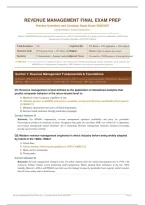
REVENUE MANAGEMENT FINAL EXAM PREP
Practice Questions and Complete Study Guide 2026/2027
Comprehensive Final Examination
Aligned with HSMAI Revenue Management Competencies, AHLA (American Hotel & Lodging Association) Standards, and Revenue
Management Curriculum Guidelines (2026/2027 Edition)
Total Questions 150 Cognitive Mix 25% Recall • 50% Application • 25% Analysis
Question Style 75% Scenario-based • 25% Direct knowledge
Format Multiple choice (4 options, one correct)
Sections 9 (Fundamentals → Strategic Leadership)
Special Focus 20 scenarios • 15 KPI analysis • 10 pricing/rate mgmt
[CORRECT] = correct answer marker • Questions span revenue management fundamentals through strategic leadership • Each rationale cites
HSMAI Revenue Management Competencies, AHLA Standards, and revenue management references.
Section 1: Revenue Management Fundamentals & Foundations
20 Questions | RM definition • Airline origins • Perishable inventory • Yield vs. revenue vs. profit management • Total Revenue Management •
RM ethics • RM across industries • Tactical vs. strategic • RM cycle • Team structure • RM culture • Future trends
Q1: Revenue management is best defined as the application of disciplined analytics that
predict consumer behavior at the micro-market level to:
A. Maximize room occupancy regardless of rate
B. Optimize product availability and price to maximize revenue growth from a perishable, fixed capacity
[CORRECT]
C. Minimize operational costs across all hotel departments
D. Increase brand awareness through marketing campaigns
Correct Answer: B
Rationale: Per HSMAI competencies, revenue management optimizes availability and price for perishable,
fixed-capacity products to maximize revenue. Occupancy-only goals (A) can dilute ADR; cost control (C) is operations,
not revenue management; brand awareness (D) is marketing. Revenue management integrates demand forecasting,
pricing, and inventory controls.
Q2: Modern revenue management originated in which industry before being widely adopted
by hotels in the 1980s–1990s?
A. Cruise lines
B. Airline industry following deregulation in 1978 [CORRECT]
C. Quick-service restaurants
D. Theme parks
Correct Answer: B
Rationale: Revenue management emerged in the US airline industry after the Airline Deregulation Act of 1978, with
American Airlines' Dinam system pioneering yield management. Hotels adopted these techniques in the late 1980s
(notably Marriott). AHLA and HSMAI curricula trace this lineage because the perishable fixed-capacity model transfers
directly from airline seats to hotel rooms.
Revenue Management Final Exam Prep | Complete Study Guide 2026/2027 Page 1
,REVENUE MANAGEMENT FINAL EXAM PREP | Practice Questions & Study Guide
Q3: Which characteristic of a hotel room most directly creates the necessity for revenue
management?
A. High storage cost
B. Perishability—unsold room nights cannot be recovered [CORRECT]
C. Low fixed costs
D. Infinite demand
Correct Answer: B
Rationale: A hotel room night is a perishable inventory: if unsold tonight, that revenue opportunity is permanently lost.
Combined with fixed capacity (same number of rooms regardless of demand) and variable demand, this creates the core
problem revenue management solves. HSMAI emphasizes perishability as the foundational revenue management driver.
Q4: Which of the following BEST describes the difference between revenue management and
yield management?
A. Yield management is broader; revenue management is narrower
B. Yield management focuses on maximizing revenue from a single inventory (rooms) at a tactical level,
while revenue management is strategic, multi-revenue-stream, and customer-centric [CORRECT]
C. They are identical terms used interchangeably
D. Yield management applies to restaurants; revenue management applies only to hotels
Correct Answer: B
Rationale: Yield management (the airline-era term) is tactical and inventory-specific—maximizing yield from a fixed
inventory. Revenue management is the strategic, holistic evolution that includes customer value, distribution, total revenue
(rooms + F&B + spa + ancillary), and long-term profit. HSMAI competencies distinguish the two terms; revenue
management is the broader discipline.
Q5: A 250-room hotel with fixed capacity is running 70% occupancy at $150 ADR. Demand for
next Friday indicates 95% occupancy achievable at $180 ADR. Which principle of revenue
management is being applied when the revenue manager raises rates?
A. Cost-based pricing
B. Demand-based dynamic pricing with capacity scarcity [CORRECT]
C. Penetration pricing
D. Loss-leader pricing
Correct Answer: B
Rationale: When demand is high relative to fixed capacity, revenue management raises rates to capture maximum
revenue from the constrained inventory—this is demand-based dynamic pricing driven by scarcity. Cost-based pricing
(A) ignores demand. Penetration (C) and loss-leader (D) are low-rate strategies inappropriate for high-demand periods.
Q6: The primary objective of Total Revenue Management is to:
A. Maximize rooms revenue only
B. Optimize revenue across all revenue streams—rooms, F&B, spa, parking, meeting space—while
considering guest profitability and lifetime value [CORRECT]
C. Minimize labor costs across departments
D. Increase OTA commission payments
Correct Answer: B
Rationale: Total Revenue Management (TRM) extends beyond rooms to optimize all guest-facing revenue streams,
accounting for guest-level profitability and lifetime value. HSMAI's competency framework identifies TRM as the
modern evolution of revenue management. Maximizing rooms only (A) is traditional revenue management; cost cutting
(C) is operations; OTA commissions (D) are costs to minimize.
Revenue Management Final Exam Prep | Complete Study Guide 2026/2027 Page 2
,REVENUE MANAGEMENT FINAL EXAM PREP | Practice Questions & Study Guide
Q7: A revenue manager is offered a paid partnership to share competitor rate shopping data
with a third-party vendor in violation of her hotel's confidentiality policy. Which ethical
principle is at stake?
A. Confidentiality and fiduciary duty to the employer [CORRECT]
B. Revenue maximization
C. Cost minimization
D. Channel optimization
Correct Answer: A
Rationale: HSMAI's Code of Ethics requires revenue managers to maintain confidentiality of proprietary data and act in
the employer's interest (fiduciary duty). Sharing competitor data without authorization violates both confidentiality and
fiduciary principles. The other options are business objectives, not ethics principles.
Q8: Which industry was NOT an early adopter of revenue management principles but has
increasingly applied them since the 2010s?
A. Cruise lines
B. Restaurants
C. Healthcare (e.g., elective surgery scheduling, hospital bed management) [CORRECT]
D. Car rentals
Correct Answer: C
Rationale: Airlines, hotels, car rentals, cruise lines, and restaurants were early revenue management adopters. Healthcare
is a more recent application area (operating room scheduling, bed management, staff scheduling). HSMAI and AHLA
curricula note that revenue management principles transfer to any industry with perishable capacity, variable demand, and
segmentable customers.
Q9: Which of the following is a tactical revenue management decision rather than a strategic
one?
A. Selecting which RMS vendor to license for the next 5 years
B. Setting tonight's BAR rate at $179 based on pickup and competitive shopping [CORRECT]
C. Developing a 3-year total revenue management plan
D. Deciding to launch a loyalty member rate program
Correct Answer: B
Rationale: Tactical revenue management involves short-term, day-to-day decisions (e.g., today's BAR rate based on
real-time demand and competitive data). Strategic decisions (A, C, D) are longer-term, structural, and align with business
strategy. HSMAI competencies distinguish tactical (operational) from strategic (long-term) revenue management.
Q10: A revenue management team typically includes all of the following roles EXCEPT:
A. Director of Revenue Management
B. Revenue Manager / Analyst
C. General Counsel / Chief Legal Officer as a core team member [CORRECT]
D. Reservation and Front Office Manager (as liaisons)
Correct Answer: C
Rationale: A revenue management team typically includes the Director of Revenue Management, revenue
managers/analysts, and liaisons from reservations, front office, sales, and marketing. The General Counsel advises on
legal/contract issues but is not a core team member. HSMAI defines team structure for cross-functional revenue
management.
Revenue Management Final Exam Prep | Complete Study Guide 2026/2027 Page 3
, REVENUE MANAGEMENT FINAL EXAM PREP | Practice Questions & Study Guide
Q11: Which scenario BEST illustrates the application of revenue management principles in a
restaurant?
A. Charging the same price for all menu items regardless of demand
B. Offering an early-bird prix fixe menu to shift demand from peak to off-peak, optimizing table turns
and revenue per available seat (RevPAS) [CORRECT]
C. Always discounting menu items by 50% to maximize covers
D. Closing the restaurant during peak hours to reduce staff costs
Correct Answer: B
Rationale: Restaurant revenue management uses differential pricing (early-bird, happy hour) and table management to
optimize RevPAS across demand periods. Constant pricing (A) ignores demand variability. 50% discounts (C) can dilute
revenue. Closing at peak (D) abandons the highest-revenue opportunity. HSMAI extends RM principles to restaurants via
RevPAS metrics.
Q12: The revenue management cycle typically follows which sequence?
A. Forecast → Set rates → Open inventory → Measure results
B. Data collection & analysis → Demand forecasting → Pricing & inventory decisions → Implementation →
Performance measurement → Continuous refinement [CORRECT]
C. Open inventory → Wait for bookings → Adjust rate if slow → Repeat
D. Sales leads meeting → Rate decision → Distribute rate → Hope for occupancy
Correct Answer: B
Rationale: The HSMAI revenue management cycle is: data collection/analysis → demand forecasting → strategic pricing
and inventory decisions → implementation across channels → performance measurement (KPIs) → continuous
refinement. This is a continuous, data-driven loop rather than reactive. The other options omit forecasting, KPIs, or
refinement.
Q13: Which of the following is an OPPORTUNITY rather than a CHALLENGE for revenue
management in the 2020s?
A. Rate parity disputes with OTAs
B. AI/ML-driven predictive analytics enabling more granular personalization and forecasting
[CORRECT]
C. Decline in direct booking share
D. Increased commission costs
Correct Answer: B
Rationale: AI and machine learning represent a major opportunity for revenue management—enabling
hyper-personalized pricing, more accurate forecasting, and dynamic optimization. Rate parity disputes (A), declining
direct bookings (C), and rising commissions (D) are challenges. HSMAI's future trends highlight AI/ML as a top
opportunity.
Q14: Revenue management and profit management differ in that profit management:
A. Maximizes room revenue only
B. Considers all costs (variable + fixed) to maximize net operating profit, not just top-line revenue
[CORRECT]
C. Is identical to revenue management
D. Applies only to F&B outlets
Correct Answer: B
Rationale: Profit management extends revenue management by incorporating costs (variable + fixed) to maximize
GOPPAR (gross operating profit per available room) or NOPAR. Revenue management focuses on top-line revenue;
profit management links revenue to bottom-line. HSMAI views profit management as the next maturity step beyond
revenue management.
Revenue Management Final Exam Prep | Complete Study Guide 2026/2027 Page 4


