
NURS 4322 | MATERNAL–NEWBORN NURSING | 2026–2027
High-Risk Pregnancy & Obstetric Emergencies Practice
Exam
2026–2027 | 110 ORIGINAL PRACTICE QUESTIONS
Emphasizes high-acuity maternal-fetal prioritization, resuscitation, hemorrhage and emergency escalation.
Independent educational study material. These are original practice questions, not official Southern Utah University, ATI,
faculty, or licensing examination materials. Similar core concepts appear in multiple files to reinforce learning.
Clinical safety note: Use institutional protocols and current professional guidance. Questions are designed for learning and
are not a substitute for medical decision-making or individualized orders.
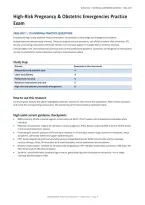
Study map
Domain Questions in this document
Antepartum and prenatal care 14
Labor and delivery 16
Postpartum nursing 12
Newborn assessment and care 12
High-risk and obstetric/neonatal emergencies 56
How to use this resource
Cover the green answer and yellow-highlighted rationale, select A–D, then review the explanation. Mark missed concepts
and revisit the corresponding clinical area. The answer key at the end provides a rapid self-check.
High-yield current guidance checkpoints
• GBS screening: ACOG universal vaginal–rectal culture at 36 0/7–37 6/7 weeks, with intrapartum prophylaxis when
indicated.
• Maternal immunization: Tdap at 27–36 weeks in every pregnancy; Pfizer Abrysvo maternal RSV at 32 0/7–36 6/7 weeks
in the recommended U.S. season.
• Preeclampsia: systolic pressure ≥160 mm Hg or diastolic ≥110 mm Hg is severe range; monitor for headache, visual
symptoms, pulmonary edema and upper-abdominal pain.
• PPH: assess objectively and treat promptly using an integrated protocol; WHO recommends uterine massage,
oxytocic therapy, fluids, IV tranexamic acid when indicated, source assessment and escalation.
• Newborn resuscitation: ventilate for persistent apnea/gasping or HR <100 after initial steps; compress if HR stays <60
after 30 seconds of effective ventilation.
• Jaundice: use bilirubin level, postnatal age in hours, gestational age and neurotoxicity risk factors—not a single
universal phototherapy number.
INDEPENDENT PRACTICE RESOURCE • NURS 4322 • Page 1
, NURS 4322 | MATERNAL–NEWBORN NURSING | 2026–2027
Practice Questions with Answers & Rationales
Questions 1–25
1. After adequate newborn ventilation the heart rate is still below 60. What is the next intervention?
A. Initiate chest compressions coordinated with ventilation
B. Begin oral feeding
C. Stop resuscitation immediately
D. Wait 10 minutes
Correct Answer: A. Initiate chest compressions coordinated with ventilation
Rationale: A sustained neonatal heart rate below 60 after effective ventilation requires compressions and advanced
care.
Incorrect options: B (Begin oral feeding); C (Stop resuscitation immediately); D (Wait 10 minutes). These do not best answer the
clinical cue; A sustained neonatal heart rate below 60 after effective ventilation requires compressions and advanced care.
2. An antepartum patient has fever, uterine tenderness, and malodorous amniotic fluid. What is the priority
concern?
A. Routine round-ligament discomfort
B. Physiologic changes only
C. Normal rupture without complications
D. Intraamniotic infection requiring immediate evaluation and treatment
Correct Answer: D. Intraamniotic infection requiring immediate evaluation and treatment
Rationale: A combination of fever, tenderness, and abnormal fluid is concerning for intraamniotic infection.
Incorrect options: A (Routine round-ligament discomfort); B (Physiologic changes only); C (Normal rupture without
complications). These do not best answer the clinical cue; A combination of fever, tenderness, and abnormal fluid is concerning
for intraamniotic infection.
3. Which postpartum lochia progression is generally expected?
A. Alba immediately followed by bright red heavy bleeding
B. No discharge from the first hour
C. Green foul drainage throughout recovery
D. Rubra initially, then serosa, then alba over time
Correct Answer: D. Rubra initially, then serosa, then alba over time
Rationale: Normal lochia changes from red to pink/brown to pale as uterine healing continues.
Incorrect options: A (Alba immediately followed by bright red heavy bleeding); B (No discharge from the first hour); C (Green foul
drainage throughout recovery). These do not best answer the clinical cue; Normal lochia changes from red to pink/brown to pale
as uterine healing continues.
4. A breastfeeding newborn is jittery and feeding poorly. Which priority assessment is appropriate?
A. Assume normal startle reflex exclusively
B. Measure glucose promptly using neonatal protocol
C. Delay all feeding assessment
D. Check only head circumference
Correct Answer: B. Measure glucose promptly using neonatal protocol
Rationale: These are possible hypoglycemia signs and warrant timely evaluation and intervention.
Incorrect options: A (Assume normal startle reflex exclusively); C (Delay all feeding assessment); D (Check only head
circumference). These do not best answer the clinical cue; These are possible hypoglycemia signs and warrant timely evaluation
and intervention.
INDEPENDENT PRACTICE RESOURCE • NURS 4322 • Page 2
, NURS 4322 | MATERNAL–NEWBORN NURSING | 2026–2027
5. A pregnant patient has seizures unrelated to a known neurologic condition and elevated blood pressure.
What must be assessed immediately?
A. Only breastfeeding plans
B. Potential eclampsia and airway/oxygenation status
C. Only fundal height
D. Only fetal sex
Correct Answer: B. Potential eclampsia and airway/oxygenation status
Rationale: Pregnancy-associated seizures with hypertension require simultaneous stabilization and evaluation for
eclampsia.
Incorrect options: A (Only breastfeeding plans); C (Only fundal height); D (Only fetal sex). These do not best answer the clinical
cue; Pregnancy-associated seizures with hypertension require simultaneous stabilization and evaluation for eclampsia.
6. What does a firm, midline uterine fundus indicate after delivery?
A. Complete absence of hemorrhage risk
B. Confirmed absence of vaginal lacerations
C. Appropriate uterine contraction that helps limit bleeding
D. A diagnosis of endometritis
Correct Answer: C. Appropriate uterine contraction that helps limit bleeding
Rationale: A contracted uterus compresses placental-site vessels, but bleeding from trauma and other causes
remains possible.
Incorrect options: A (Complete absence of hemorrhage risk); B (Confirmed absence of vaginal lacerations); D (A diagnosis of
endometritis). These do not best answer the clinical cue; A contracted uterus compresses placental-site vessels, but bleeding
from trauma and other causes remains possible.
7. Which response to a parent describing traumatic birth is most therapeutic?
A. Assume every reaction means psychosis
B. Insist they should feel grateful
C. Listen nonjudgmentally, validate concerns, and offer appropriate follow-up support
D. Prohibit discussing the experience
Correct Answer: C. Listen nonjudgmentally, validate concerns, and offer appropriate follow-up support
Rationale: Trauma-informed care supports recovery and identifies those needing additional mental-health support.
Incorrect options: A (Assume every reaction means psychosis); B (Insist they should feel grateful); D (Prohibit discussing the
experience). These do not best answer the clinical cue; Trauma-informed care supports recovery and identifies those needing
additional mental-health support.
8. A postpartum patient describes voices ordering harm to the infant. What is the immediate response?
A. Normalize the voices as mild baby blues
B. Recommend sleep only without risk assessment
C. Discharge with no follow-up
D. Ensure infant and parental safety and obtain emergency psychiatric evaluation
Correct Answer: D. Ensure infant and parental safety and obtain emergency psychiatric evaluation
Rationale: Psychotic symptoms in the postpartum period create an urgent safety situation requiring specialized
care.
Incorrect options: A (Normalize the voices as mild baby blues); B (Recommend sleep only without risk assessment); C (Discharge
with no follow-up). These do not best answer the clinical cue; Psychotic symptoms in the postpartum period create an urgent
safety situation requiring specialized care.
INDEPENDENT PRACTICE RESOURCE • NURS 4322 • Page 3


