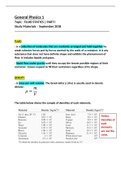
General Physics 1
Topic : FLUID STATICS | PART I
Study Materials – September 2018
___________________________________________________________________
FLUID
- is a collection of molecules that are randomly arranged and held together by
weak cohesive forces and by forces exerted by the walls of a container. It is any
substance that does not have definite shape and exhibits the phenomenon of
flow. It includes liquids and gases.
- liquid flow under gravity until they occupy the lowest possible regions of their
container. Gasses expand to fill their containers regardless of its shape.
DENSITY
- is mass per unit volume. The Greek letter ρ (rho) is usually used to denote
density:
The table below shows the sample of densities of each elements.
Notice:
Densities of
each
elements
are not the
same.
, CONCEPT OF SINKING AND FLOATING
When an object’s density is greater than that of water it will sink in water.
When its density is less it will float. For floating object, the fraction of the
volume of an object that is submerged in any liquid equals the ratio of the
density of the object to that of the liquid.
Example, the density of ice is 0.92 g/cm3. This means 92 percent of the
volume of ice is submerged in water.
SPECIFIC GRAVITY - is the ratio of the density of a material to a standard
density. It is a unitless quantity.
standard density for liquids is the density of water at 4°C: 1 g/cm3 or 1000 kg/
m3
standard density for gases is the density of oxygen at 0°C and pressure of 1 atm:
1.43 kg/m3
PRACTICE:
1. Consider two identical blocks.
a. Which block exerts greater force on the surface?
ANSWER: They exert the same amount of force on the surface. This
force is equal to the weight of the blocks.
b. Which block exerts greater pressure?
ANSWER: Block B exerts greater pressure.
PRESSURE